Showing posts with label Quirky Stuff. Show all posts

1.19.2018

Film Hacking: Instaxperiments with the Polaroid J66

I'm stubborn.

There's just no other way of putting it.  One would think that after several less than successful tries of trying to use Fuji FP-100C pack film in a handsome but otherwise obsolete Polaroid J66 camera, I'd simply toss in the towel and be content to hand this camera over to my wife to strictly be a display item for the house. 

"Not I" said the rabbit.

If nothing else, my increasingly frustrating experiments with this forlorn folder proved one thing: that film placed into its chambers was exposed in proper focus.  The main issue with the pack film was the film speed combined with an apparent reciprocity failure that left repeated exposures of the same scene to have little effect on the exposure.  After 14 repeated exposures of a sunny scene that still came out dark, it was apparent that 100 speed film was ill fitted for a camera whose design called for the use of 3000 speed film. 

But what about 800 speed? 

It was this thought that dawned upon me one bitter morning as I began to embark on a few different "Instaxperiments" as I like to call them. I'd managed to make Instax Wide film work properly in a Kodak Brownie 2C, but had to do some work to throttle down the higher speed Instax film.  As I had a decent supply of this medium, I figured I'd give the J66 one last try, and carefully placed a single sheet of Instax wide (puffy side to the front) into the film chamber under the veil of darkness. 

With bright sunny skies in seeming contrast to the frigid temps, I set out on an errand, and in the midst of it, made a quick stop Downtown to attempt this last ditch effort to salvage a decent image from the J66.  I set the focus to the "portrait" setting, found a close subject well bathed in sunlight, opened the aperture fully by using the lighten-darken dial fully to lighten, and fired away.  Scurrying home and returning to my fully darkened room, I then removed the film from the camera and gently fit it into an empty Instax film cartridge, inserting it into an Instax 210 camera I picked up a while back with a faulty lens but working film ejector, and fired away to see how the J66 fared.

Expecting little after all of the previous trials and tribulations with this camera, I approached this last ditch try with almost no fanfare or anticipation, so I was pretty much speechless to see this image develop before my eyes! 

My first try at using Instax Wide in the Polaroid J66 was actually a last ditch try to see if I could salvage an image from this camera.  I was in utter shock to see this develop before my eyes. 

1.10.2018

Film Hacking: Not Your Typical Polaroid

A number of months ago, I snapped a photo on Fuji FP-100C Instant Peel Apart Film, and was particularly pleased with the results that I obtained.  


Would you care to guess which camera model shot the photo?


12.18.2017

Innovation Station: Medium Format Macros for the Frugal

Shooters of the 35mm format seem to get all the perks cheaply.  For under $20, one can easily pickup any of a wide number of choices for a competent used shooter taking 135 stock that will pretty much do about all that one can expect, including a wide range of shutter speeds and the ability to close focus on even some of the most basic of cameras, allowing for some great shots with wonderful separation of field.

In the world of medium format however, this wide array of choices quickly vanishes.  For those of us who love working with the larger negative sizes that 120 film offers, securing a decent 120 camera for anywhere under $100 often seems like something of a challenge.  And whether one's 120 camera of choice is ultimately is a TLR, a guess focus folder, or a something more along the lines of the "Texas Leica," the ability to get close can be especially elusive on medium format altogether. 

However, with a little bit of ingenuity and some stubborn determination, one can pretty readily be up and about shooting macros in medium format after having spent less than $20 in equipment for camera and accessories, while having a tremendous amount of fun and involvement in the process! This is the hobby of photography at its most enjoyable and affordable. 

So let's start with a shot taken on Ilford HP5 with focus around infinity.  Pretty decent stuff, though this gate in foreground is completely out of focus.  It'd be great to pull the focus a bit closer...

Hey, now we're getting somewhere, though the ornament is still a bit shy of the sweet spot...

Now that's better!  Any chance focus can be pulled in even further?...

Now this is closer than one typically sees from medium format cameras.  Just how close can we pull in focus?

All the way to the nearest bar in the gate!  By now that once crisp backdrop has been wonderfully muted in the distance.

The camera used to produce these images cost me just $15 in a second hand shop, and is readily found in antique stores or online auction sites at around the same price in ready to use condition.  So what did I use for these medium format macro photos?  This! 

A simple Kodak Brownie Number 2 was used to create all of the images above, by means of a pretty simple technique.

8.07.2017

Trying to Get Instant Kicks: The Polaroid J66

Stubbornness is considered an inherited trait, and is one to which I can readily admit having. I show it at work and in my family life, but my stubbornness is pervasive enough to affect my hobby as well. Where most sane people in the hobby of film photography would not bother with trying to get an image from a piece of equipment that is functionally obsolete, I push forward with a "Can-Do" spirit that is admittedly a bit over the top at times...

To the point where I have to wonder when I should stop beating a dead horse.

The tale begins in the height of my Polaroid pack film enthusiasm.  Still psyched to have a new toy to play with in the form of the Colorpack II, while preparing to purchase yet another in the form of the Polaroid 440 from Strawberry Fields, I'm somewhat intrigued by the sight of another interesting Polaroid camera sitting before me pleading me to add it to my collection.  It's called the Polaroid J66.


Knowing nothing whatsoever about this camera, with just 15 minutes on the meter outside, and my youngest son sitting on my neck as I sweat in the small store trying to keep him from breaking any of the multitude of interesting items, I take a quick look online, and without finding much in the way of information, elect to just simply toss it into my purchase for good measure.

7.04.2017

As American as the Fourth of July: The Kodak Instamatic 704 and 804

"You know, we once made stuff here."

It's a common refrain still prevalent among older Americans, and is something that can be particularly difficult for a larger percentage of our population to relate.  I tend to consider myself as one who can occasionally forget the significance that the U.S. once held in the manufacturing world as I type away today on my Chinese made computer, uploading some digital photos taken on a camera made in the Philippines, embellished with a Japanese made lens, and adding scans of film shots done on an Indonesian made scanner. 

Yes, the United States once had a robust manufacturing sector, which certainly extended to the world of photography, with names like Kodak, Argus, Detrola, Revere, Falcon, Ansco, Polaroid, Bolsey, Universal, and others all competing head to head in a crowded marketplace for the photographer's dollar.

So what was the most American camera model of all-time?  Some might say the ubiquitous Argus C3, a classic example of a well built camera that remained nearly unchanged for a production run spanning 3 decades.  Others could opine for any of the Polaroid Land Camera models as being stellar examples of American ingenuity.  Still others might pick a wild card like the Bolsey B2 as a classic example of an immigrant landing in this country and setting forth to accomplish his dreams in a new country.  And for the curious, there is certainly the story of the Univex cameras resulting from a pair of capitalists putting their minds and resources together in the midst of the Great Depression.

My answer for the most "American" camera of all time uses much more simplistic logic. There is no holiday more American than Independence Day, often simply known as the "Fourth of July."  So is there a camera out there that is as American as July 4th?!? I'm not sure there could exist a camera as American as Independence Day as this one...

All this camera needs is some deep blue leather on the front and some white stars and it would be the ultimate "American" camera.

The Kodak Instamatic 704, along with its upmarket sibling: the 804, represent some of the finest American camera craftsmanship out there.  These sturdy 126 format cameras, produced between 1965 and 1969 are a particularly endearing pair of photo taking partners with complementary red and blue emblems that truly portray a patriotic air to them.

6.28.2017

Lemonade from a Lemon: The Mamiya Auto-Lux 35

At what point is a vintage camera review no longer a review?  Perhaps when your main objective is simply trying to get an image under when the camera you have in hand has only a fraction of its functionality.  I would say the following qualifies...

The Middletown Goodwill used to be such a treat.  It seemed as though each visit to this location always brought me a cheap and fun new toy with which to play.  I've gotten a number of lenses from this store, some nice sub $5 point and shoot cameras such as the Samsung Maxima Zoom 105, and even the Mamiya MSX-500.  

In hindsight, it's easy to think I had a perfect string of luck with my cheap scores at this location, but this isn't quite the case.  Even the all-star Home Run Derby hitter eventually lands short of the outfield wall.  Such was the case with this interesting piece.  

It looks like an SLR, and in fact it is an SLR, but not quite in the way that most people tend to think. 

Priced at about $8, and seemingly working at first glance, this seemed like a unique piece to add to the stable.  I had never heard of this model, and never expected to see one available in person again, so it seemed like an easy decision to snap it up while the opportunity existed. 

Mamiya's 1963 vintage Auto-Lux 35 is a camera that looks like an SLR, and feels much like the SLR cameras so many photographers know.  This is because it technically IS an SLR camera. But it has a few modifiers that make it a bit of a downgrade from even the more basic cameras in the SLR camp.

6.14.2017

Glee with Gadgets Pentax ME Super Dial Data Back

I'm not a photographer.  Though I may occasionally use my "Spidey Senses" and put forth some wonderful results, I'm not a 100% true, dyed in the changing bag cloth, "photographer."

I'd best describe my make up as one part photographer, one part history buff, one part collector, and one part "gear head."  The result is a quirky guy who likes using multiple classic old cameras to take photos.

The "gear head" aspect of this takes me down a geeky path where I find myself drawn to things that some other true photographers could care less about.  I might pay attention in particular to something as relevant as the intuitive nature of a viewfinder, but then also put an extra level of attention to the typefaces used in that viewfinder.

As I'm also a "data nerd" of sorts, I find that I like to know and keep track of things such as dates or exposure data at times, and have often looked at specific camera models that can accomplish the data recording in particular.  So when I discovered that a model for which I'd already developed a great fondness actually had such a capability, I simply had to give it a try.

And this is the story behind how I acquired a Pentax Dial Data Back ME.


The "Dial Data ME" back works by manually setting the three dials to the desired values to print, or to null values to disable printing.


6.13.2017

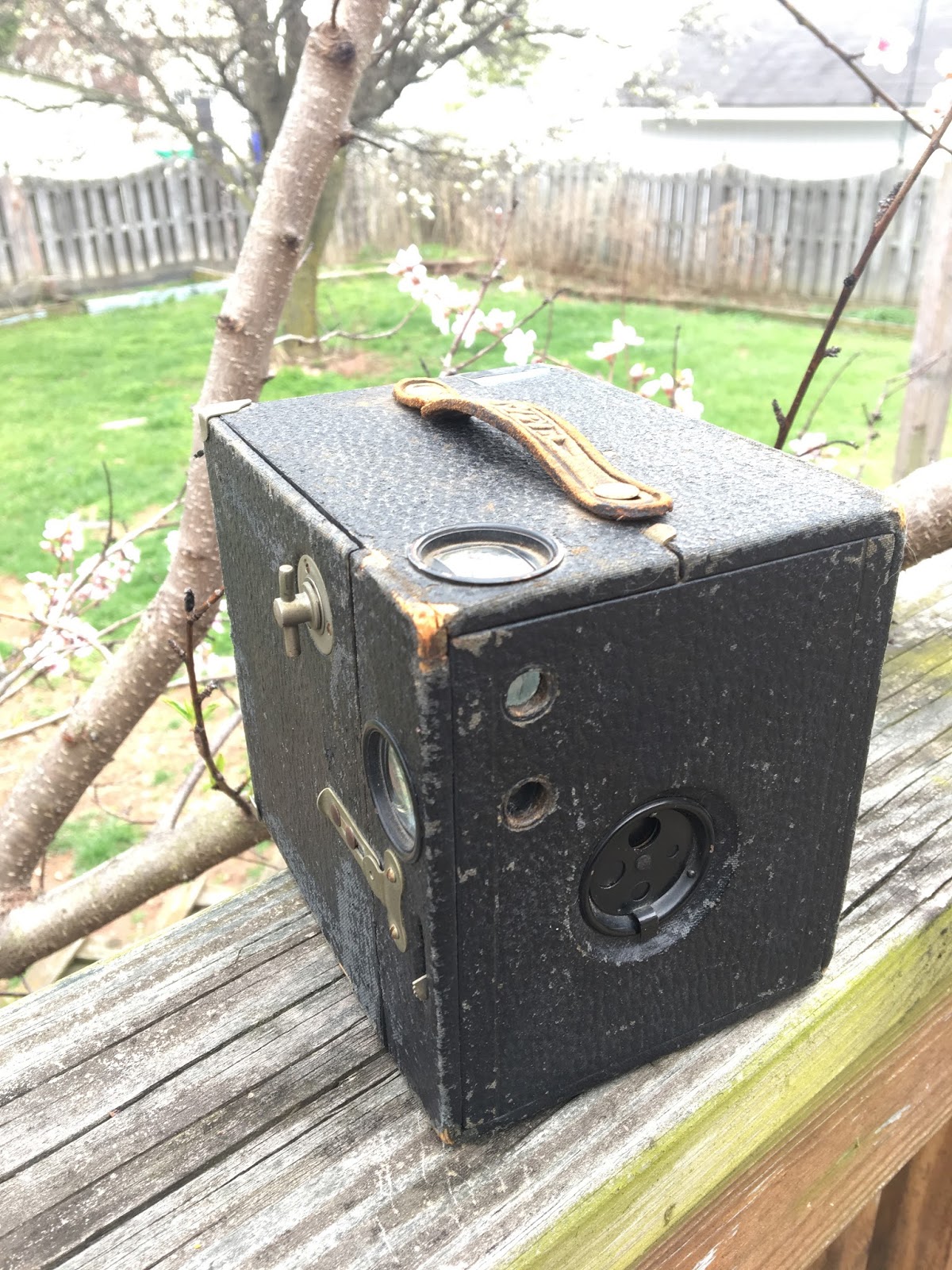
The Box Camera Baby: The Agfa-Cadet A-8

Surprises can be a very good thing, particularly when they fill an unmet need or want.

I had just won one of those "bulk" camera ebay auctions which somehow closed for surprisingly less than I'd have expected.  In fact, I considered by bid to be a mercy bid that would soon be sniped as the auction drew to a close.  Perhaps I had a little luck on my side, or perhaps traffic was light on this afternoon before a three day weekend, but I now had a motley collection of about 8 cameras that also included the Ansco GoodwinRolls, and the Pickwik.

As I surveyed my surprising win, I could see that one of the cameras headed my way would be a more modern Agfa box camera with a lot of patina on its face plate.  Doing a quick look about online, I spotted a very similar looking Agfa-Box B2 camera, and presumed this was what would be in that package on delivery day.

So the true surprise came upon opening the box and discovering the tiniest of box cameras awaiting me.  I had become the unexpected owner of an Agfa-Cadet A-8 camera, a true box camera for 127 film!


Pictures do lie. This seemingly imposing brute of a box camera is likely smaller than the box your last mobile phone was packaged in. 

This adorable little box camera dates from about 1940, and is a bit of an update over previous versions of this camera with a more ordinary leather front.  This model has a metal front with a more Art Deco style to it, with geometric lines inside of the box case and outside of the lens opening, all punctuated by the diamond "Agfa" script logo.  Atop the camera, which measures roughly 3" x 5" x 7", is a leather carrying handle.   


6.06.2017

Instamadness: The Ricoh 126C Flex

The morning of May 26, 2017 dawned in Frederick with a surprising amount of sunshine compared to the days which had proceeded it. Today was my mother's birthday, and I'd been busy preparing late the evening prior.  There would be no festive celebration, but instead remembrance.

Today would have been my mother's 81st birthday.  She passed away in the beginning of May 2014 just a few weeks shy of her 78th birthday.  The last three advents of May the 26th had been challenging to say the least, but this year, I had elected to spend it a bit differently.  At nearly the last minute, I'd elected to begin a new tradition of sorts,

My mother enjoyed photography in much the same way as I do,  But while I've always enjoyed approaching photography from new angles, armed with a varied plethora of different photographic devices, she remained fiercely loyal to a single photographic companion - her Kodak Instamatic X-35.

Nearly all of the photographic memories of my childhood were taken through the lens of this basic camera, and while I never recall seeing any photos from this camera that stun me with magnificent sharpness or phenomenal bokeh, the small plastic camera did its job of recording family memories for decades.  My mother's loyalty to this camera was so great that she simply stopped taking photos when the availability of 126 film in local stores dried up in the mid-1990's, despite me getting her what I thought was a perfectly suitable easy-loading Pentax replacement in 35mm format.

A few days prior to the advent of this day, I had been browsing about a few camera articles online when I happened upon a site that detailed some of the more "up-market" offerings in the 126 format, and within a few days, had elected to give one of the cameras featured on this page a try.  My "Why not?" moment for 126 was soon answered by the Ricoh 126C-Flex.


The 126-C Flex seems to be a marriage of parts from the TLS lineup of 35mm SLR cameras and the earlier Ricohflex 35 leaf shutter SLR cameras.  The 55mm f/2.8 lens seems to be the same as that on the Ricohflex, and provides a mild portrait/telephoto perspective for the smaller 126 format. 

6.05.2017

Fun with Film: Agfa 100 HDC

When it comes to color film, there have been Kodak loyalists, Fuji Loyalists, and those who just like shooting film regardless of who made it.  I'm certainly one who falls in the latter camp, but I've long admitted a particular fondness for Agfa color films.  I love Ultra 50, used to shoot a bit of my favorite portfolio shots on Portrait 160, and had also liked using their "general purpose" color films as well.

One of those films, not often found today, was Agfa 100 HDC.  It was a very clean and snappy film, and one that I tended to find more neutral than the warm tones of Kodak Gold or the cool hues of many Fuji stocks.  

I managed to come across a short sample roll of HDC not too long ago, and decided to give it another try.  To get as many images from the roll as I could, I spooled it onto my custom 828 backing and shot it in square format through the Bantam RF for which I had the 24x24mm square mask made.  Here is a look at some of the good and not so good from this roll.  


I was quite pleased at how this long expired film had held up over the decade and change since it was made.  Taken in late afternoon light, this image conveys a look that looks just like the scene taken.  The blue-green color of the street posts is actually the shade they are painted.


5.31.2017

The 127 Auto Ultimate? Ihagee's Auto Ultrix Westentaschen 2850

Some things take work to get right, be they relationships, recipes, or simply routines.  And while instant gratification can be a wonderful thing, there comes a certain sense of satisfaction in working carefully to improve upon something imperfect to gradually improve upon it. 

But getting to that point is not always easy.  It often takes a lot of trial and error, and some careful attention to detail to get things right, or at least close enough.  

Which brings me to my latest feature...

Despite looking rather imposing in this photo, the Auto Ultrix dimensions of roughly 5"x 3" x 1.5"

It had all of the hallmarks of a perfect shooter for me.  Compact and classic in style, yet capably equipped with a Zeiss Tessar lens, this Ihagee Auto Ultrix Westentaschen 2850 (hereafter to be referred to as the "Auto Ultrix" for the sake of brevity) seemed to be my "full frame" 127 format folder that I'd hoped the Agfa Billy Zero would be.  Found through a Craigslist ad, I paid a decent amount more than my typical threshold, but figured that this treat would be worth the investment, as the price was fair.

5.15.2017

Trying not to GAF with the Memo EE

Ever shot a photo with one hand with the other bracing a pole?  Over a blind fence? Panning a moving subject due to a slow shutter speed? Or how about simply using a scale focus camera and no meter to shoot a roll of film?  

Sometimes one best shots are taken in situations where there may be little in the way of guidance or control.  And sometimes, photography can be at its most fun when it's not a cake walk of perfectly metered exposure and/or easy focusing.

In the Summer of last year, as my frugality was ramped up to about the same degree as my Gear Acquisition Syndrome, I stumbled across a cheap listing for a compact little rangefinder camera produced under the GAF name, and couldn't resist.  For about $14.50 total, I snapped up the GAF Memo EE rangefinder in unknown working condition and not knowing just what to expect from this model.

Admittedly, I knew I was flirting with danger with this pickup.  Unlike some compact rangefinder models of the 1960's and 1970's, the GAF does not offer a manual mode, so snapping one up in an "as-is" condition leaves one at the mercy of the longevity of the rather primitive electronics within its confines.  And neither that mercy nor any luck were on my side when the GAF arrived.  I discovered a dead meter in this budget pick up.

The particularly tiny GAF Memo EE is loosely related to the Konica C35, and also has some near-identical twins with various other nameplates. 

5.12.2017

Super Sleeper: The Kodak Brownie Starflex

About the best barometer of a camera collector's affinity towards a particular example in his active collection would be the number of rolls of film that have passed through its chambers to produce images.  A camera that sees a single inaugural roll of film only to then sit and collect dust would certainly seem to be less favored than a model that has seen numerous rolls of film in the same amount of time.  

Given that I have a decent sized collection, it isn't too often that a particular example stays by my side for several months as a primary camera churning out roll after roll of film, so a camera that sees half a dozen rolls over the course of a year would admittedly be a well favored "high-use" camera for me.

Occasionally, I come to notice that a particular example in my collection has been called into use more than I would have guessed, seeming to indicate that I have a latent, almost subconscious liking of it that comes as a surprise to me.  I call these examples "Sleeper Cameras" as they possess some intangibles that seem to make them inexplicably endearing to me.   This is one of my very few examples of such a camera in my collection...

I'd more or less expected this little camera to be good for one roll and nothing more.  Nope!

3.31.2017

No Spartan Here! The Spartus Roxmar

The great thing about having a hobby shooting film in classic film cameras, and making the world aware of it is that eventually, someone will come along and help you feed your sickness! 

Not long after posting my article on the rather cumbersome Samsung Maxima 105, Mike Novak, a fellow member of the Facebook Vintage Camera Collectors Group, offered to send me a handful of cameras to borrow to which I could give a try.  Though he sent along a refinement of the Samsung Point and Shoot series, he also sent along a particularly charming camera that piqued my interest the most: The Spartus Roxmar! 


3.30.2017

Adventures in Sheet Film: The Conley Kewpie No 3

Some ideas take a long while to come to fruition, and by the time they do, they often take on a largely different context from their original context. 

Well over a year ago, as my enthusiasm for shooting cameras using film formats no longer made was hitting one of a few quirky peaks, I stumbled across an idea in a film camera forum to use 4x5 sheet film in a 122 Kodak "3A" folding camera.  At the time,  I was encountering only modest success with using spool adapters to use 120 film in these classic cameras, due in large part to some film plane alignment issues that resulted in soft images.  

The premise of "just laying the sheet of film in the chamber" to be exposed seemed like a really nice way to get the full image size of the 122 film format on film.  I rushed off to Freestyle and ordered a 25 sheet pack of their Arista sheet film.  

Turns out, this idea had its share of challenges.  Not only did my 122 cameras have some issues with focus collimation, but the film plane issues actually seemed to worsen by simply plopping the film in the film chamber with no way to keep the film taut.  Add to it that I hadn't yet embarked on developing my own black and while film, and this was turning out to be a pretty costly "Autographic Experiment."

Fast forward a year and change, and my enthusiasm for obsolete formats hits a new peak. Add in some newly found interest in antique box cameras, and my thoughts towards resurrecting a sheet film experiment are rekindled.

The most obvious idea that occurred to me was to find some sort of 122 box camera, and load it with 4x5 film, getting the most out of the sheet film and getting an image that almost encompasses all of the generous size of the 122 format.  The problem is that 122 format box cameras seemed all but non-existent, based on my searches.  I did stumble across a few listings for some Conley "Kewpie" 3A cameras at some very cheap prices, so I proceeded to snap one up.  

The only problem is that when my camera arrived, it was not a "Kewpie No 3A" but a "Kewpie No 3." That seemingly minor suffix letter makes a significant difference.  The "No 3" is designed to take 124 film rather than the 125 film whose image size is identical to 122 film. 

Not the prettiest of "classic" cameras is the Kewpie No 3, but this was a camera that was designed for affordability.

2.06.2017

Kodachrome 2017 - In COLOR!

As dusk descended upon the historic town of Frederick, the man set his trusty 1947 vintage Kodak Bantam atop his tripod facing a scene of increasing darkness along Carroll Creek and fired off his last shot of the roll of Kodachrome 828 film, experimenting with a setting of 10 secconds at f/11 and drew his photographic day to a close.  The day had been a long one, starting off with delays and disruption from livestock on the B&O Railroad line linking Frederick with Washington, DC, but had managed to improve quite a bit, turning out to be an unseasonably warm Winter's day with vivid blue skies.  Returning home, he unloaded the film from the Bantam and prepared to mail the parcel off to be developed in the hopes he had made the proper exposure calls through his sojourn of the day so as to get some rich color slides back from the 828 Kodachrome.

Reading the narrative above, one might think it depicts a time long passed in settings vastly different in appearance than they are today, but this in fact a condensed retelling of the events I experienced on January 25, 2017.

Yes, you read that title right.  Like a phoenix rising from the ashes, it is possible to shoot Kodachrome again and get results in color!


Just what is this you are looking at?  Read on! (Photo by Kelly-Shane Fuller)


12.06.2016

Univexed: In Color!

When Univex introduced the AF-3 in 1936, it was promoted as having a "Color Corrected Duo Achromatic" Lens.  This is fittingly ironic in quite a few ways.  Keep in mind the year is 1936, a time long before the time of color negative film and C-41 mini-labs.  The first incarnations of Kodachrome color slide film were near to hitting the shelves, but were only suggested for use in cameras with exposure controls and specifications that could work within the confines of their slow speed.  And truth be told, there never was color film offered in Univex's proprietary "00" format, either in 1936, or at any time afterwards.

Perhaps the verbage was a sign of things to come in the mind of the designers at Univex. Perhaps it simply indicated a lens that would portray better images on panchromatic black and white film. Perhaps it was over-inflated hype by the marketing folks.  One can only wonder.

Still, as rare as any shots are taken using Univex cameras of the "00" format, they are all but non-existent in color.  Or at least they were.

Ironically, acquiring the similarly named UniCOLOR (see what I did there?) kit this past Summer became something of an enabler for me.  For now, not only could I develop my own color film in conventional formats, but also in any UNconventional format as well, as long as I could get it into a usable tank.  I'd already determined how to do this with Black and White film cut down to the width of "00" film, so I jumped at the chance to attempt this in color.  I slit a roll of 120 Ektar 100 to provide me stock for both the AF-5 (that presumably should have as good or better "color correction" as its AF-3 predecessor) and the Iris, and took both out on sunny lunch time strolls in Washington, DC, to see just what life looks like in color through the lens of a Univex camera. 


My first shot taken with the AF-5 is a bit subdued in nature, with some slightly muted pastel hues. 

12.02.2016

Film Fun Folio #28: Kodak Autographic 1A and Long Expired Kodak Verichrome

Periodically, I'll be posting scans of some complete rolls of film on here, showing both the good and the bad, and giving some basic information as well a little write up of the shoot as well as the reasons why I selected each camera and film.  Enjoy the trip! 

Feature #28:
Camera: ca. 1929 Kodak Autographic 1A with Kodak f/7.9 lens.
Film: 1954 vintage Kodak Verichrome (orthochromatic version)
Locale: Frederick and Sharpsburg, MD

I've sort of taken my "Autographic Experiments" with the Kodak 1A and upped the ante with this roll.  I realized that I greatly enjoyed shooting the 1A as the 116 format camera that it was designed to be, and wanted to try it again.  At the same time, I had been challenged to try again with true "old school" ortho film that is more in line with the type of film used in these cameras in their heyday.  Since I'd not too long before gotten into developing my own black and white negatives, and since I had a tank and reel that could accommodate 116 format, I elected to give it ta try.  Below are the results.  

I developed this long developed film in a "cold brew" of HC-110 at a rather high concentration of about 1 part direct developing solution with 9 parts water, refrigerated for about 45 minutes before developing, and developed for about 9 minutes of nearly constant agitation.  The results rather pleasantly surprised me, as some show effects that would be largely impossible to replicate from a digital starting point. 


I started this roll with a shot taken in early Spring of a stone bridge near Boonsboro, MD.  As this was the outermost exposure on the roll, it suffered from the highest degree of fogging over the 60 years it sat dormant, but there is certainly a discernible result that gives off a wildly vintage feel.

11.29.2016

Superb Reflex Twice: The Minolta SR-T 101 - A Gallery

I just expended time, effort, and brain cells (Ok, that last part may be debatable) to reason why an SR-T 200 is for all intents and purposes, just as usable as an SR-T 101, and then I seem to contradict myself with this posting showing images taken with that very camera.  Am I that much a hypocrite?

In actuality, I'm proving my own point.  The following images were shot with an SR-T 101, and upon reviewing them, I can readily attest that every one of them would have been just as easy to have captured on the SR-T 200.  And I can speak of this having shot both models of camera.

So how did I wind up with an SR-T 101 after making the case for the underdog camera that is the 200?  It's simple really.  The lens.  I spotted this camera for a bargain price with a Minolta Rokkor 28mm wide angle lens attached, so it seemed like a perfect pickup, and it was.  It's a great camera, but so is the model 200 in nearly every way.

Since both the 101 and 200 model will meter down as low as ASA 6, this seemed the perfect chance to shoot another roll of Mr. Brown LOW ISO film on a week in mid-November.  Yet again, this film is increasingly showing itself as a great medium that allows some great strengths: namely limited depth of field photos as well as daytime time exposures!  The following shots were taken with both the 45mm and 28mm lenses and made for a great time out shooting.  Enjoy! 

First shot taken with the both the SR-T 101 and with the 28mm lens in late afternoon light.  I'd forgotten how easy it is to accidentally "appear" in your pictures with wide angle lenses.  I guess this shot is sort of like that first "tester pancake."

11.28.2016

The Peculiar Paradox of the Perplexing Pickwik

To ponder and postulate the perils of my predicament was particularly problematic.  Phooey!

Sure I'm a "camera collector," but not in the most literal sense.  I like to limit myself to working examples of everything I might acquire and I most certainly seek to run at least one roll of film through everything I may have the fortune to pick up.

A few weeks ago, I happened on a bargain of a lot containing 7 cameras that I snagged for just over $20.  While it was just one camera of this batch that really drew me in, I hoped that at least some of the other more basic cameras were in operable condition to be able to use a time or two as well.  Who knows?  Maybe I would discover a new favorite from the motley assortment.  In a marked departure from my usual luck, it turned out that all 7 cameras had fully working shutters and appeared to need just cleaning to be ready to try out. 

One of the more interesting cameras in the batch was an unusual little guy branded as a "Pickwik." It is a true pseudo-TLR complete with two lenses and a small flip up screen designed to frame fixed focus shots in the 3x4 format on 127 film.  Armed with only settings for "Time" and "Inst," it is a particularly simple if interesting little camera.  I gave it a quick look over to get an idea of its operation and put it in the queue for eventual usage.

A unique and certainly oddball among 127 cameras of the era, the Pickwik "TLR" was an interesting pickup for me.

As it turns out, the odd little camera would be the first of this group to be pressed into service.  As I worked my way through my 21 roll assortment of D-i-Y color films, I had some headaches in advancing a roll of 127 film through my Foth Derby.  I realized only later that this turned out to be that I'd used a single ended spool on the take up side of the camera and it was facing the wrong way. Still, I looked forward to the chance to get a few snaps with the Pickwik, and since I had to open the camera in the dark to re-situate the take up spool anyway, I figured I may as well complete the rest of the roll in the Pickwik instead.  I gave it a quick cleaning with cotton swabs, loaded the film and shot the last 6 shots in this unusual little "TLR" camera of sorts.

Only to get results back like this...