Showing posts with label 135 film. Show all posts

6.21.2018

Wet Weather Warrior: Pentax Zoom 90WR

Oh Pentax Zoom 90-WR, it wasn't supposed to lead to anything...


In my mind, you were supposed to be a one time thing, a flight of fancy, a spontaneous "sure why not" amid a flurry of other priorities that were more in line with my typical tastes. 

To my way of thinking, you were a consolation prize, as the second-best item of a half-hearted pity bid on a multi-piece lot that I snapped up at a low opening bid simply because I could, and since the main item of interest, the Pentax SF-1 SLR, was to be nothing more than a spare to me. 

3.08.2018

Triple Take Thursday 3: Plates, Film, and Digital

Variety is the slice of life.  While I continue to shoot traditional film stocks lately, I've been dabbling in some other mediums at the same time.  I've become increasingly involved in the use of dry plates coated by Jason Lane, that have allowed me to use a number of cameras designed for such plates, while also improvising their use into a many other roll film cameras as well. 

I'm also doing a little bit more with digital cameras, between early models with decent specifications and more recent ones with more bells and whistles.  While it's no replacement for a film camera, it does make a pretty easy tag along on my film (and now plate) photo outings.  

Here and there, as I shoot some plates, I'll be supplementing them with the same scene shot on both film and digital to allow for an interesting comparison between the blue sensitive media of the plates, the panchromatic, ortho, or color media of the film, and one or more settings on a digital camera that may mimic or differ from that of the non-digital media.  

Following are three takes of another scene in Baltimore.  Today's trip makes a stop at the Union Soldiers and Sailors Monument, and was taken the day after last week's shot along Linden Avenue.  Unlike the previous day, this Sunday emerged vivid and sunny, with remnants of the snow of the evening before still lingering.  The 109 year old monument has stood at this spot since 1959, after a relocation from nearby Druid Hill Park necessitated by highway construction.  The site near the Wyman Park Dell works well for this monument, and it has since seen its surroundings changed in ways more befitting it, as the southbound lanes of nearby Charles Street that used to curve into 29th Street encroached more upon this monument than they do today.  The change in traffic pattern has made this site more pleasant and relaxing as a result, and its a periodic stopping point for me to do for some quick photographic wanderings.  

With a few hours to burn as a loved one was at a medical appointment, I elected to make the stop past this monument to do my "triple take" as it glimmered resplendent in the noon day sun.  My plate camera was a 6.5 x 9 Zeh Zeca which has been something of a guinea pig among my plate cameras.  It came to me in a bulk auction sporting a basic lens mounted on a worn out shutter that was salvaged from a Univex TLR.  I'd tried a couple of "transplant" lenses upon this camera before electing to give the Meyer Gorlitz Trioplan 10.5cm f/4.5 from my Balda Pontina an indefinite home upon this platform. Supplementing this was the same rediscovered Yashica 35MC stocked with Eastman Double-X film that was featured on last week's entry, and the same Nikon J1 that I'd recently snapped up.  I fired off shots of the bright scene using all three cameras, with only the Zeca tripod mounted to accommodate the slow speed of the dry plates.     


Zeh Zeca 6.5 x 9 cm plate camera with Meyer Gorlitz Trioplan 10.5cm: J. Lane Dry Plate (Sixth Plate) shot at ISO 2, f/8 at 1/10 seconds, developed in HC-110 and scanned.


3.01.2018

Triple Take Thursday 2: Plates, Film, and Digital.

Variety is the slice of life.  While I continue to shoot traditional film stocks lately, I've been dabbling in some other mediums at the same time.  I've become increasingly involved in the use of dry plates coated by Jason Lane, that have allowed me to use a number of cameras designed for such plates, while also improvising their use into a many other roll film cameras as well. 

I'm also doing a little bit more with digital cameras, between early models with decent specifications and more recent ones with more bells and whistles.  While it's no replacement for a film camera, it does make a pretty easy tag along on my film (and now plate) photo outings.  

Here and there, as I shoot some plates, I'll be supplementing them with the same scene shot on both film and digital to allow for an interesting comparison between the blue sensitive media of the plates, the panchromatic, ortho, or color media of the film, and one or more settings on a digital camera that may mimic or differ from that of the non-digital media.  

Following are three takes of another scene in Baltimore, this time on a fascinating remnant of Linden Avenue, once a pretty vital arterial street that was almost entirely swallowed up to redevelopment beginning in the mid-1950's.  The 1700 block has managed to survive, complete with streetcar tracks that have been dormant since 1955.  Since the block is punctuated with an island in the middle, the east side of the street acts as auto parking, and the streetcar track remnants abruptly end, the vintage photo possibilities are somewhat limited in composition, but with careful cropping, an image of nostalgic nature is entirely possible with this scene.  

As a wet snow began to fall, I stopped past this favorite haunt one Saturday afternoon with three cameras in tow.  Instead of using a "proper" plate camera for plates, I was using the Kodak Bantam f/4.5 that I'd inherited from my father, with a pre-seated J. Lane "35mm" size plate as a recording medium.  Supplementing this was my newly rediscovered Yashica Electro 35MC stocked with Eastman Double-X film, and the Nikon J1 that I'd recently snapped up.  I fired off close focus shots of the scene using all three cameras, with the Bantam tripod mounted to accommodate the slow speed of the dry plates.     


Kodak Bantam 4.5: 36x50mm J. Lane Dry Plate shot at ISO 2, f/8 at 5 seconds, developed in HC-110 and scanned.


2.22.2018

Triple Take Thursday 1: Plates, Film, and Digital

Variety is the slice of life.  While I continue to shoot traditional film stocks lately, I've been dabbling in some other mediums at the same time.  I've become increasingly involved in the use of dry plates coated by Jason Lane, that have allowed me to use a number of cameras designed for such plates, while also improvising their use into a many other roll film cameras as well. 

I'm also doing a little bit more with digital cameras, between early models with decent specifications and more recent ones with more bells and whistles.  While it's no replacement for a film camera, it does make a pretty easy tag along on my film (and now plate) photo outings.  

Here and there, as I shoot some plates, I'll be supplementing them with the same scene shot on both film and digital to allow for an interesting comparison between the blue sensitive media of the plates, the panchromatic or color media of the film, and one or more settings on a digital camera that may mimic or differ from that of the non-digital media.  

First up in a scene taken in Patterson Park in Baltimore.  I'd known for some time that there was a small lake there, but had never taken the time to visit it until earlier this week.  Along with me for my visit were a Kodak Recomar 33 plate camera that shoots 9x12cm size plates, a Kodak Signet 35 kindly lent to me by Mike Eckman, and a Nikon J1 that I recently picked up.  As a gentle drizzle began to threaten, I managed to shoot a closely focused scene along the banks of this small pond on all three cameras to compare.  


Kodak Recomar 33: 9x12 J. Lane Dry Plate developed in HC-110 and printed on Ilford Multigrade IV RC paper.  Shot at f/8 for 4 seconds

12.20.2017

Dutch Date - Part 5: Ricoh Singlex TLS and Ricoh 35 Flex

Every so often, I'll get really frugal and ask a couple of cameras to share a roll of film.  Though there are problems here and there, they'll usually agree.  I call these "Dutch Dates" and usually try to pair cameras with something more than simply the film format in common.  Below is a look at just one such pairing...


As they settled in to enjoy an English delicacy, the 35 Flex asked the Singlex if the battle wounds were real or self-inflicted. 

Camera Models: Ricoh Singlex TLS (1967) and Ricoh 35 Flex (1963)

Similarities: Both are 1960's Ricoh SLR cameras under their own brand name.

Differences: The Singlex is a conventional focal plane shutter SLR with interchangeable lenses, while the 35 Flex is a leaf shutter SLR with a fixed lens. 

Film Shared: Ilford FP4+, Fresh Dated 

The 1960's might be considered to be the prime period for Ricoh's camera models.  Though the Japanese camera maker certainly had a pretty lengthy run of producing some very capable, and often quite unique film cameras, the Sixties seem to be when Ricoh made a name for itself in a pretty crowded industry.  Though the maker continued creating some excellent cameras in the decades to follow, it seemed to be increasingly marginalized, at least in the US, as Canon, Nikon, Pentax, Minolta, and Olympus took the top spots in the remaining field.


12.05.2017

Dutch Date - Part 3: Minolta Freedom Dual C and Minolta Freedom Zoom Explorer

Every so often, I'll get really frugal and ask a couple of cameras to share a roll of film.  Though there are problems here and there, they'll usually agree.  I call these "Dutch Dates" and usually try to pair cameras with something more than simply the film format in common.  Below is a look at just one such pairing...


They scarfed down their British fare with reckless abandon, and remarked, how of their contemporaries coming up in the 90's, they were some of the few who could really see the "big picture."

Camera Models: Minolta Freedom Dual C (1991) and Minolta Freedom Zoom Explorer (1999)

Similarities: Both are Minolta made point and shoot models with multiple focal lengths that have the fairly rare ability to shoot at the 28mm focal length on the wide end of their focal length range.

Differences: The Freedom Dual C, an earlier model, is actually a dual lens camera rather than a zoom like the Freedom Zoom Explorer.  It offers special buttons only to turn off flash or to use a self timer.  The Explorer however has a burst mode, night portrait mode, red-eye reduction flash, and macro mode among its options. 

Film Shared: Ilford Delta 400, fresh dated, developed in TFX-2. 

As the 1990's progressed, point and shoot cameras continued to try to reach new and impractical levels of focal length, as the typical 35-70mm range began to expand ever upwards with each successive year.  As the decade closed, and a consumer digital era crept imminently close, the longest of these super zooms stretched to a 200mm focal length! 

Far fewer camera models in this age of length inadequacy crept inward, typically leaving 35mm (or more often 38mm) as the widest focal length offered, and in effect leaving snapshooters in close quarters with few comparative choices.  Minolta was one of the few makers to crack the semi-wide ceiling on some of their models, with a couple of models reaching inward to be operable at a wide 28mm focal length.  


10.06.2017

Darkroom Diaries: Mastering Microfilm with HC-110

Looking to shoot film on a budget?  How about this "All You Can Eat Buffet" deal of the film world! For the cost of about 2 rolls of film, you are supplied with enough film to make about 20 or more rolls of film! This film has a nice slow speed and fine grain to allow you to open the lens up on most cameras in full sun, and it comes free of perforations, making an ideal candidate to stock 828 cameras with film! 

So what's the downside?  Well, there's lots of contrast that needs to be tamed in order to get an image with a more pictorial feel.  And the lack of sprockets that makes this a great 828 film also makes it very difficult to use in 35mm cameras, with some models needing some degree of modification, with some other cameras entirely unable to use the stock.  

This bargain film stock is microfilm, a long established medium of Archivists for the preservation of print media. Though never manufactured for pictorial use, this fine grained stock can be adapted for use in 828 and many 35mm cameras with a few caveats.

The most inhibiting of these caveats is the lack of perforations (sprockets) in most microfilm stocks.  This is film that was designed to be fed through a viewer with direct wheel contact, rather than fed through a camera with sprocket gearing and teeth.  This works fine in an 828 camera, but will slip when fed through manual advance 35mm cameras.  Many of the more modern 35mm film cameras with auto advance use an IR sensor that counts the film sprockets in 35mm stock as it advances.  With non-perforated microfilm, these cameras have no sprockets to count, and will simply give up and return the film to the 35mm cassette after attempting to load it.

For manual advance cameras that use a toothed wheel to pull film onto the take up spool, an improvised solution is to apply a layer or two of painters tape to the this wheel to increase adhesion and avoid the slippage that would otherwise result.  Within two minutes of trying this with a Ricoh KR30SP that I have, I had a camera that readily accepted the Microfilm stock.

Two 35mm cameras that will accept microfilm without any modification are the Canon 10S and the original Voigtlander Vito.  Both of these use a contact wheel that lacks teeth to advance film onto the take up spool.

So this all established, what are the rest of the challenges to using this medium?  The first would be supply.  Microfilm isn't typically found in the same places that those of us shooting conventional film pick up our supply.  Neither B&H nor Freestyle sells it, but it can typically be found on eBay.  If lucky, one can find single (100 foot long) roll sales for under $20.  It may take some patience and scouring, but it is out there.

Somewhat less challenging is the process of preparing a length of microfilm for use in a camera.  With 35mm, this involves taking a reusable cartridge, and either loading it with a length of film in the dark, or using a daylight bulk film loader.  Either method should work, but I used the former method, limiting the length of film to about an 18 shot roll.

I also loaded some 828 rolls by simply doing the same process above, but instead interleaving it with 828 backing paper (that the film was taped to on its beginning side) as I wound it onto an 828 spool. It wasn't long before I had three rolls of film ready to use in a variety of cameras.

Shooting this film involves some additional challenges.  I found that rating the Kodak Imagelink 1461 film at about ISO 20 seemed to give the best results.  

I knew I would encounter the potential for a lot of contrast when developing, and elected to scale back my typical stand development time (using Kodak's HC-110 developer at a 1:99 dilution) from 30 minutes to only 16 minutes.  This resulted in some pretty thin negatives, but these scanned with no issues whatsoever.

Below are some samples from my first three rolls of microfilm - the "All You can Eat Buffet" of the photographic world. 

On a very sunny day, I ran a short roll of Microfilm through a Bantam f/8 828 camera.  This wound up working perfectly with the slow shutter of the camera, and delivered some particularly good images given the very limited capabilities of this basic camera. Contrast is a bit high still, but not in an overwhelming way.

6.28.2017

Lemonade from a Lemon: The Mamiya Auto-Lux 35

At what point is a vintage camera review no longer a review?  Perhaps when your main objective is simply trying to get an image under when the camera you have in hand has only a fraction of its functionality.  I would say the following qualifies...

The Middletown Goodwill used to be such a treat.  It seemed as though each visit to this location always brought me a cheap and fun new toy with which to play.  I've gotten a number of lenses from this store, some nice sub $5 point and shoot cameras such as the Samsung Maxima Zoom 105, and even the Mamiya MSX-500.  

In hindsight, it's easy to think I had a perfect string of luck with my cheap scores at this location, but this isn't quite the case.  Even the all-star Home Run Derby hitter eventually lands short of the outfield wall.  Such was the case with this interesting piece.  

It looks like an SLR, and in fact it is an SLR, but not quite in the way that most people tend to think. 

Priced at about $8, and seemingly working at first glance, this seemed like a unique piece to add to the stable.  I had never heard of this model, and never expected to see one available in person again, so it seemed like an easy decision to snap it up while the opportunity existed. 

Mamiya's 1963 vintage Auto-Lux 35 is a camera that looks like an SLR, and feels much like the SLR cameras so many photographers know.  This is because it technically IS an SLR camera. But it has a few modifiers that make it a bit of a downgrade from even the more basic cameras in the SLR camp.

6.22.2017

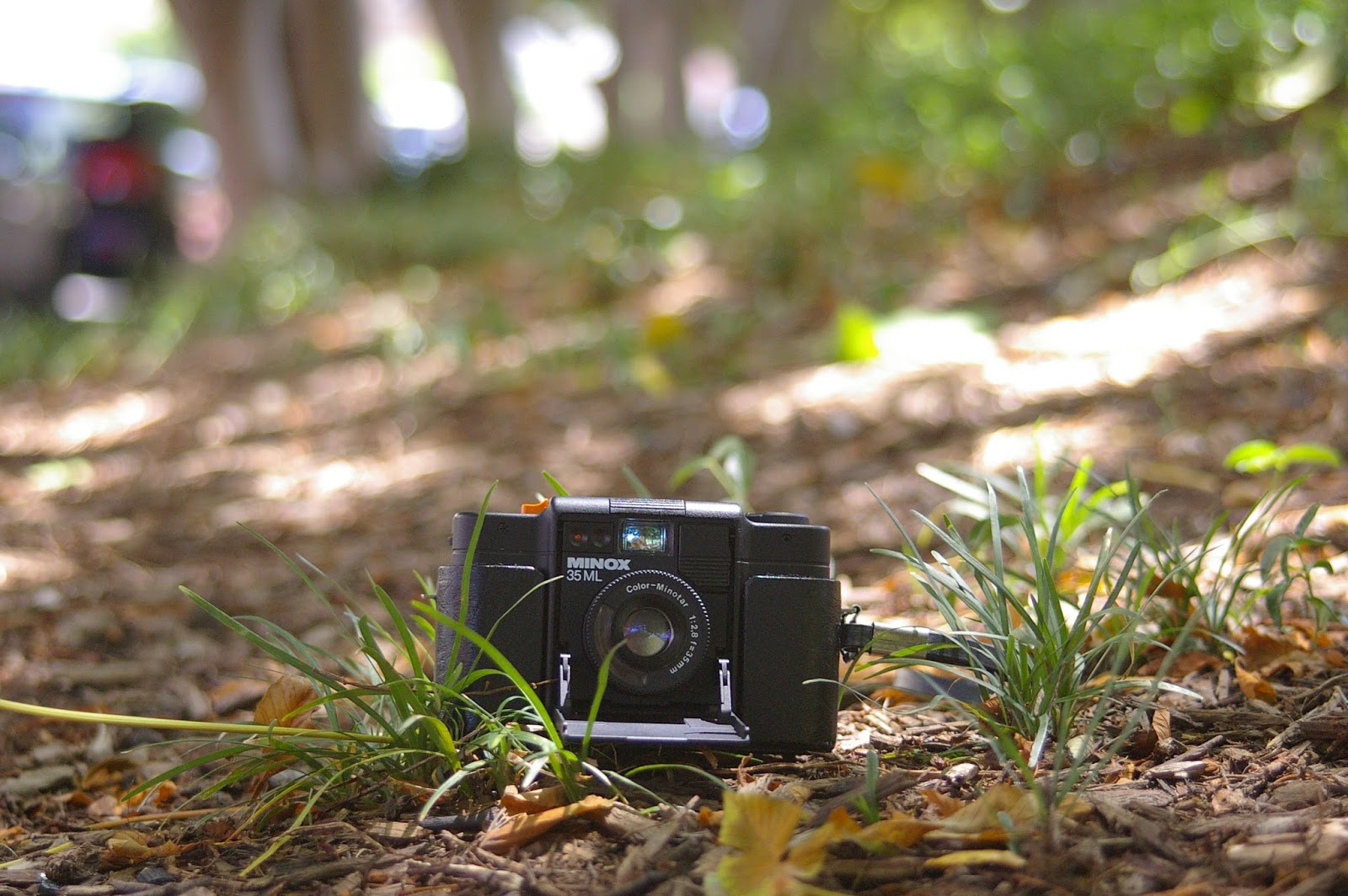
Agent Double-0-Thirty Five: The Minox 35ML

Just yesterday, I posted an article covering one camera that I'd hoped might be a 35mm version of my beloved Bantam, and here, a mere 24 hours later, I'm posting an article on another similar camera, at least when it comes to size, form factor, and country of origin.

Typically I deliberately try to keep my articles staggered.  An SLR camera review isn't followed with another SLR camera review, Rangefinders don't follow other rangefinders, and so forth.  However, in this case, two cameras of a different build type, but both offering some features to make them something of a 35mm Kodak Bantam, have managed to pace behind each other.  

In the case of this review, this similarity comes in the form of the Minox 35ML, a tiny and amazing piece of machinery in 35mm format that, for lack of a better descriptor, is best termed as a modern day compact folding camera. 

While not entirely spy-worthy, the Minox 35ML is an amazingly small device.

The Minox 35ML comes from a photographic icon famous in the photographic community for its smaller "Spy Cameras" utilizing tiny devices to record 8x11mm images on small size film.  The Minox name brings to mind the thrilling world of James Bond movies from the 1960's and 1970's, as a means to discretely take images of documents. These cameras still have a following to this day keeping the medium alive and well.

Less known however are Minox's 35mm offerings, which stay very true to the maker's tendency to create amazingly compact devices with a surprising amount of functionality.  I had never noted the presence of Minox in the sphere of 35mm film photography when I suddenly stumbled upon one for sale at a local Goodwill for a modest $25.  I picked it up and could immediately see what a unique gem of a camera this was.

6.21.2017

Kwentisentially Kompact - Agfa's Karomat 36

For as long as I have successfully been able to use it, I have loved my Kodak Bantam Special 4.5. Its incredibly compact design and intuitive manual controls make it one of the easiest fully manual cameras I have yet to use. Add in that it is a family heirloom and this basic little camera that few employ today in their photo taking regimen sits uniquely as a favorite of mine.  
And while I do like the quirky and unique attributes of the 828 film format, even I can admit that I'm not always eager to cut down 120 film to respool to fit into my small cadre of 828 film cameras. Yet, with no Kodak-made 35mm equivalent to this trim Bantam model, I elected to look about to see if there was an affordable Bantam-like imposter made by anyone. So when this camera showed up on my radar for about $20, I knew I had found a contender for my 35mm Bantam. 

The look of the Agfa Karomat 36 is in some ways simple and elaborate at the same time. 
The Agfa Karomat's structural resemblance to the Bantam is certainly not just coincidence, as both cameras have their origins rooted in compact design practices of the era. With the Bantam, this came in the form of the 828 film, among the smallest of roll film sizes at the time of its introduction in 1938.  With the Karomat, the lineage reaches back to the use of Agfa "Rapid" cartridges, a spool free cassette using 35mm stock that was the basis for some of Agfa's earlier attempts at 35mm.  Coincidentally, Ansco, with which Agfa would collaborate, also used a similar cassette for their Memo box camera.  


6.20.2017

Fun with Film: Kodak Supra 100

The world of Color Negative Film has gotten to be a bit dull to me - not dull as in "unsaturated," but more so dull in that there are not a lot of fresh options when I care to see if I can try out a new palette. 

Fortunately, there are, at the moment, a number of expired film stocks still found today, under 15 years old, that can still produce good results.  While these films may not be readily available, or even consistent from roll to roll, they can at least make for a fun new shooting exercise to throw into a trusted camera to see what you get.

One such film is Kodak Supra 100, an emulsion that appears to have shown up on the market around 2000, just as the world of digital photography was about to take off.  The introduction of a slower 100 speed film during an era when compact point and shoot cameras (that tended to need faster speed films) had gained so much traction in the market is an interesting and refreshing thing to note.  I'd presume that this film was marketed towards serious amateurs using SLR cameras or similar equipment.  

Information on Supra's selling points today can be a tad scant given that many web pages contemporary with the period the film was sold, have since vanished into cyberspace.  It seems that this film's main strengths were a vivid color and fine grain in comparison to the Kodak Gold and Royal Gold products at the time.  Supra was discontinued in all speeds around 2003, and remaining stocks of the film appear sporadically on eBay and other sales outlets, often in quantities of 5 rolls or less.

I happened to snap up a small lot of expired film from an ebay auction that included one roll of Supra, and was curious to see what this film could do, though the most recent examples of the film I could find on the web were a bit too "Lomo" for my tastes.  I elected to set out close to home with this film loaded in my Exakta VX, swapping from the Domiplan 2.8 to the Primotar 3.5 lens, and then finishing the roll in the Minolta A5 in order to see what sort of color the latter camera might provide.   

At the onset of the roll, the Supra provides a look that certainly doesn't look like a roll of film that was likely 15 years old, offering up bright colors that embody the vivid morning on which I rambled about.  Grain increase is evident in the sky, but is by no means distracting. 


6.16.2017

Five Dollar Deal : Canon FTb

Most film camera collectors may dream of hitting a yard sale or thrift store and finding a Leica priced for a nominal $5 or so.  I'm not even a Leica-phile, but would gladly welcome such luck in my sojourns through the various places in my area where I might spot film cameras for sale.

Still, I certainly can't complain.  I've been fortunate to encounter a few very reasonably priced acquisitions at some of my favorite local haunts.  These include the Tower 60, the Ricoh Five·One·Nine, the Olympus OM-2, and the Yashica T2.  Still, while all of these were great pick ups, I think one camera stands out as the most stellar deal that I've ever stumbled across...

Handsomely clad in all-black, the Canon FTb is a well built and handsome model for its time. 

On the way home one evening, I capriciously elected to stop in a Goodwill near me at which I had never previously seen anything film related, save a fixed focus point and shoot... once. My cynicism was obviously high, expecting it to be wasted time and effort, but as the entire effort would take no more than five minutes, it wouldn't be a huge loss.

To my sheer surprise, a pair of SLR cameras (one manual and one auto focus) were haphazardly tossed onto the shelf in the electronics section, both priced at $4.99, having just been placed there judging by the price stickers having been printed and dated on the same day.  I wasted little time in quickly snapping them up and getting in line to pay.

6.15.2017

Point and Shoot Pity Party Part 7 - Nikon Lite Touch Zoom 80

This is Part 7 of a recurring series on basic point and shoot consumer cameras, the details of which can be found here.

It was in the midst of my point and shoot hysteria that I paid a visit to a favorite Goodwill one afternoon, determined to get my hands on nearly anything cheap to try.  The selection today was both good and not so good.  A little over half a dozen point and shoot cameras, most offering autofocus, awaited me, but nothing really jumped out as a unique addition. Not wanting to leave empty-handed, I picked what seemed to be the neatest, and most compact of the lot, and thought I'd give it a try. . 


Name: Nikon Lite Touch Zoom 80
Format: 35mm
Type: Autofocus Compact Camera
Year: 1998
Features: Infinity Focus Mode, Auto Slow Speed Flash Mode, Force Flash on and Off, Red Eye Reduction, Self Timer, Early Rewind Button, Panorama Mode.
Lens: 38-80mm asperhical Macro Zoom, f/5.0-9.6, 5 elements in 5 groups.  
Battery: 1 x CR-123 cell.
Manual: http://cdn-10.nikon-cdn.com/pdf/manuals/archive/LiteTouch%20Zoom%2080%20-%20LiteTouchZoom%2080%20QD.pdf

6.12.2017

Spell it Out: The Ricoh Five·One·Nine

Camera model designations are a curious mix.  There are numbers, combinations of letters, names, and amalgams of any and all of these.  There is also the occasional camera model that actually spells out a single digit number, such as the Olympus Six.  However, I've never seen any other camera model that spells out a multi-digit number than the handsomeness that is the Ricoh Five·One·Nine.

Adorned with a lovely script face for it's logo, this camera has one of the more unusual model names among cameras, and is said just how it is written.  This is not a "Ricoh Five-Nineteen."

6.08.2017

Overshadowed Overachiever: The Minolta Maxxum 5

A few months ago, I waxed poetic about an oft-overlooked Minolta camera model, remarking of its many charms, and insisting that it was a great sleeper find that was overlooked due to all of the attention of its slightly more capable siblings that hog the spotlight.

Well, prepare yourself for more of that.


Like a Hollywood reboot brought 30 years forward from its original setting, I'm once again here to espouse the virtues of an oft-overlooked Minolta camera model that I feel to be a phenomenal bargain in the marketplace today.  


To those of us either discovering or re-discovering film, the myriad of Minolta Maxxum models and their generational successions can be a daunting learning curve.  However, the one most novel standout from the procession of about 15 years of Minolta "Maxxum" film SLR models is the Minolta Maxxum (Dynax) 7, an amazing machine that uses an intuitive LCD display on the back to display settings.  It is a film camera that can easily be mistaken for a DSLR, and regularly fetches upwards of $100 on the used market.  It has, to this date, retained a certain degree of cult status that is only reinforced by the scarcity and price in the used market.


But for a mere fraction of the price of a Minolta Maxxum 7, a comprehensively featured alternative in this same line up can be readily found in working condition: a light weight camera excellently suited for advanced film photography on a budget. This my friends, is the Minolta Maxxum 5.


Unlike the dated look of many Maxxum line cameras of the 1980's and 1990's , the 2000 vintage Maxxum 5 presents a fairly contemporary look in comparison.

6.02.2017

ME Superb! The Pentax ME Super

Fully aware that I have posted a lot of camera reviews as of late, I feel compelled to offer a "Cliff's Notes" version for those viewers who simply wish to skip down to the photos without guilt...

  • Quirky guy buys cheap "parts only" camera in order to secure a manual focus lens.
  • Quirky guy finds out that camera actually works with no seeming issues.
  • Quirky guy elects to try out the camera on a whim, though worried of its performance.
  • Quirky guy finds a stellar new favorite camera in this "throwaway!"
It's true, and I blame the Pentax K-1000.  And this is why.

As the proud new owner of the Pentax ZX-7 camera that can readily accept both AF and manual Pentax lenses, I got a "bee in my bonnet" to pick up a K-series 50mm lens in order to have an affordable fast prime to fit onto this modern film camera.  With patience not being my strongest virtue at this particular point in time, I scoured ebay "Buy-it-Now" listings for a cheap pickup on such a lens and found the cheapest to be around $35 once shipping was added.  I certainly wanted to see if I could find such a lens for a bit less, so I employed a particular strategy to search for a "parts" camera body that included the lens to see if I could find a worn out camera with an optically decent lens attached.

Knowing that the basic K-1000 cameras were typically running about $50 or more with lenses attached, I tried to jog my brain cells to recall what other models were made by Pentax, and vaguely recalled the LX and ME.  The LX, a known premium model, certainly was showing up at prices reflecting that premium.  However, I was able to find a some worthwhile results on my search using "Pentax ME Lens," the cheapest of which offered an ME Super body and lens for $29 total.  The seller readily acknowledged that the camera likely didn't work, but this was still cheaper than buying the lens alone, and that was really all I wanted.

I knew nothing about this camera model, but by using logic (something that one should really discard in this hobby), I figured that if a bland vanilla K-1000 typically cost at least $50 with a lens, and if an ME Super could be found pretty easily for $30, then it stood to reason that an ME Super was an older, less desirable, less versatile camera than the austere "K-Grand."  I gave little initial thought to the camera at all though - it was almost certainly dead, and even if it worked, I would hardly be elated to have a camera that was the lesser of the K-1000.


This camera can really be summed up in the one in-focus word in this photo. 


5.29.2017

Minolta's Metropolitan: The A5 Rangefinder

"Wow, but you're handsome."  That was my very first thought. 

As someone who owns rangefinder cameras made from the 1940's through the 1970's, I tend to be a bit dismayed to see how the outward appearance of this genre of cameras gradually grew to be a bit less attractive as the years went onward. The svelte design of a flagship camera like the 1948 Konica I had become less endearing by the time the Auto S2 was released less than two decades later. Both are excellent cameras in their own way, but the earlier camera possesses a sleek design that had been jettisoned as the camera took on a faster lens and improved functionality in the form of exposure metering. 

Looking at some of my other rangefinders of the 1960's, I'm not particularly smitten by the overall look of the Ricoh 520M CDS, Taron Marquis, or Yashica M-II.  But then I happen to acquire a little gem of a camera from the 1960's that really impresses me with its outward appearance...

Simple and elegant, the Minolta A5 puts forth an attractive and clean look. 

I call it my "Metropolitan" as the gorgeously raised "M" logo, looking more like an upside down "W," strongly reminds me of the solitary "M" logo associated with New York's Transit system during the later part of the same decade.  It's clean, simple, and even a bit elegant. It seems right at home in the decade in which it originated.  It's specifications are more or less identical to most decent Japanese rangefinders of the era, sporting an f/2.8 lens and a capable shutter that shot as fast as 1/500 of a second.  Another spare item generously granted to me for trial by Mike Eckman, the A5 impresses me with its clean look.  

5.24.2017

Fun with Film: Imation Chrome 100

One of the more interesting and encouraging bits of news that emerged a couple of years ago as I was getting back into film photography was the initiation of an effort to save machinery and restart production of transparency film by Ferrania in Italy.  Though the project has been fraught with a number of unforeseen challenges, it is moving forward at a better pace now, and is showing signs of emerging at some point hopefully within the year. 

As a result of this, the "Ferrania" name carries a significantly higher profile than it did during the 1990's onward, when it was largely a "private label" film maker that produced many "store brand" films until about 2007 or so, when its production lines shut down.  In addition, Ferrania produced branded film as well, but this typically was marketed under the "Scotch" and later "Imation" lineups. I took a lot of shots in the early 1990's on a private label "Seattlechrome" brand that I suspect may well have been made by Ferrania. 

While I've managed to find a decent amount of Ferrania color negative films over the past year under various labels over the past year, the slide film product that Ferrania now seeks to replicate for its new product had been pretty elusive in searches on ebay.  I HAD been able to find a single roll of Imation Chrome 100 early last Summer that I excitedly snapped up in hopes it would give me a vague idea of how the forthcoming film will look.  

I split the roll between my Ricoh 520M CDS and the Olympus OM-2, with shots on the former taken on a Maine trip, and shots on the latter taken locally.  I anticipated there may be an extreme amount of color shifting, and some loss of speed, so I rated it around ISO 80 and hoped for the best.  The results from this 12 year old film, while not pristine, were appreciably better than I'd feared they might be.  The film had a slight amount of grain, and some color shifting towards the blue end of the spectrum, but didn't look nearly as shifted as the 2008 vintage Ektrachrome I took along to Oregon in 2015.  Here are samples of 12 year old Imation Chrome with some degree of post processing...

Loaded first into the Ricoh 520M, I had a lovely day before me to see what the Imation Chrome would do.  The color rendering is exceptionally on the cold side, but contrast and detail remain adequate. 


5.22.2017

Nikon's Perfect Vision? The N2020

Bloated, ungainly, and bulbous are all words that could be accurately used to describe Nikon's autofocus SLR cameras of the 1990's.  Despite their reputation for rugged and dependable cameras, Nikon's film SLR line up in the later days of film carried a look that was admittedly unbecoming to a number of camera fans, myself included.

But it wasn't always this way.  Nikon's very first successful autofocus SLR actually looked much more like its manual focus predecessors than the bulky AF cameras that would follow it.  In fact, the camera actually had a sister model (the N2000) that looked more or less identical to it, but lacking the autofocus feature.  The 1986 AF model, known as the F-501 in other markets, was known as the N-2020 in North America, which leads to me jest that this camera was Nikon's perfect vision of its future.

I'd rarely use the term "elegant" to describe most Nikon Autofocus SLR cameras, but I certainly can appreciate such a trait in the N2020. 

My interest in the N2020 came after reading Mike Eckman's well-penned Nikon trifecta article.  I was particularly pleased to discover that he had a spare "beater" body that he'd shell out for some surplus trade bait of my own.  I'd already had some experience with the N5005 and N60 that I'd genuinely liked, but the N2020 seemed very much like my kind of Nikon, being an autofocus camera that remained remarkably true to its manual focus roots.

5.19.2017

From Russia with Lovely Bokeh: The Zorki 4

The camera sat on my shelf looking sort of lost among a handful of Japanese, American, and German counterparts, bedecked with its incongruous Cyrillic lettering on its face plate, and looking every bit the fish out of water.  It certainly didn't beckon to me, resulting in a feeling that was anything but love at first sight. 

I picked it up and briefly peered through the combination viewfinder and rangefinder, and my eyes literally began to hurt to try to focus on a nearby object, as the entire field of view looked both bright and fuzzy to me.  I placed it back on the shelf, a tad overwhelmed by the operational nuances of this interesting but somewhat puzzling machine, but also confused as to why its benefactor thought I would appreciate it.

So, fellas?  Heard any good state secrets lately?

The camera in question was the Russian made Zorki 4, a generous loaner from Mike Eckman, who also runs a great site featuring vintage cameras.  Though I certainly appreciated the kindness of the gesture, I had yet to grasp just what was so enthralling about this Cold War relic that emerged in 1957 from behind the Iron Curtain.