Showing posts with label Film. Show all posts

3.08.2018

Triple Take Thursday 3: Plates, Film, and Digital

Variety is the slice of life.  While I continue to shoot traditional film stocks lately, I've been dabbling in some other mediums at the same time.  I've become increasingly involved in the use of dry plates coated by Jason Lane, that have allowed me to use a number of cameras designed for such plates, while also improvising their use into a many other roll film cameras as well. 

I'm also doing a little bit more with digital cameras, between early models with decent specifications and more recent ones with more bells and whistles.  While it's no replacement for a film camera, it does make a pretty easy tag along on my film (and now plate) photo outings.  

Here and there, as I shoot some plates, I'll be supplementing them with the same scene shot on both film and digital to allow for an interesting comparison between the blue sensitive media of the plates, the panchromatic, ortho, or color media of the film, and one or more settings on a digital camera that may mimic or differ from that of the non-digital media.  

Following are three takes of another scene in Baltimore.  Today's trip makes a stop at the Union Soldiers and Sailors Monument, and was taken the day after last week's shot along Linden Avenue.  Unlike the previous day, this Sunday emerged vivid and sunny, with remnants of the snow of the evening before still lingering.  The 109 year old monument has stood at this spot since 1959, after a relocation from nearby Druid Hill Park necessitated by highway construction.  The site near the Wyman Park Dell works well for this monument, and it has since seen its surroundings changed in ways more befitting it, as the southbound lanes of nearby Charles Street that used to curve into 29th Street encroached more upon this monument than they do today.  The change in traffic pattern has made this site more pleasant and relaxing as a result, and its a periodic stopping point for me to do for some quick photographic wanderings.  

With a few hours to burn as a loved one was at a medical appointment, I elected to make the stop past this monument to do my "triple take" as it glimmered resplendent in the noon day sun.  My plate camera was a 6.5 x 9 Zeh Zeca which has been something of a guinea pig among my plate cameras.  It came to me in a bulk auction sporting a basic lens mounted on a worn out shutter that was salvaged from a Univex TLR.  I'd tried a couple of "transplant" lenses upon this camera before electing to give the Meyer Gorlitz Trioplan 10.5cm f/4.5 from my Balda Pontina an indefinite home upon this platform. Supplementing this was the same rediscovered Yashica 35MC stocked with Eastman Double-X film that was featured on last week's entry, and the same Nikon J1 that I'd recently snapped up.  I fired off shots of the bright scene using all three cameras, with only the Zeca tripod mounted to accommodate the slow speed of the dry plates.     


Zeh Zeca 6.5 x 9 cm plate camera with Meyer Gorlitz Trioplan 10.5cm: J. Lane Dry Plate (Sixth Plate) shot at ISO 2, f/8 at 1/10 seconds, developed in HC-110 and scanned.


3.01.2018

Triple Take Thursday 2: Plates, Film, and Digital.

Variety is the slice of life.  While I continue to shoot traditional film stocks lately, I've been dabbling in some other mediums at the same time.  I've become increasingly involved in the use of dry plates coated by Jason Lane, that have allowed me to use a number of cameras designed for such plates, while also improvising their use into a many other roll film cameras as well. 

I'm also doing a little bit more with digital cameras, between early models with decent specifications and more recent ones with more bells and whistles.  While it's no replacement for a film camera, it does make a pretty easy tag along on my film (and now plate) photo outings.  

Here and there, as I shoot some plates, I'll be supplementing them with the same scene shot on both film and digital to allow for an interesting comparison between the blue sensitive media of the plates, the panchromatic, ortho, or color media of the film, and one or more settings on a digital camera that may mimic or differ from that of the non-digital media.  

Following are three takes of another scene in Baltimore, this time on a fascinating remnant of Linden Avenue, once a pretty vital arterial street that was almost entirely swallowed up to redevelopment beginning in the mid-1950's.  The 1700 block has managed to survive, complete with streetcar tracks that have been dormant since 1955.  Since the block is punctuated with an island in the middle, the east side of the street acts as auto parking, and the streetcar track remnants abruptly end, the vintage photo possibilities are somewhat limited in composition, but with careful cropping, an image of nostalgic nature is entirely possible with this scene.  

As a wet snow began to fall, I stopped past this favorite haunt one Saturday afternoon with three cameras in tow.  Instead of using a "proper" plate camera for plates, I was using the Kodak Bantam f/4.5 that I'd inherited from my father, with a pre-seated J. Lane "35mm" size plate as a recording medium.  Supplementing this was my newly rediscovered Yashica Electro 35MC stocked with Eastman Double-X film, and the Nikon J1 that I'd recently snapped up.  I fired off close focus shots of the scene using all three cameras, with the Bantam tripod mounted to accommodate the slow speed of the dry plates.     


Kodak Bantam 4.5: 36x50mm J. Lane Dry Plate shot at ISO 2, f/8 at 5 seconds, developed in HC-110 and scanned.


2.22.2018

Triple Take Thursday 1: Plates, Film, and Digital

Variety is the slice of life.  While I continue to shoot traditional film stocks lately, I've been dabbling in some other mediums at the same time.  I've become increasingly involved in the use of dry plates coated by Jason Lane, that have allowed me to use a number of cameras designed for such plates, while also improvising their use into a many other roll film cameras as well. 

I'm also doing a little bit more with digital cameras, between early models with decent specifications and more recent ones with more bells and whistles.  While it's no replacement for a film camera, it does make a pretty easy tag along on my film (and now plate) photo outings.  

Here and there, as I shoot some plates, I'll be supplementing them with the same scene shot on both film and digital to allow for an interesting comparison between the blue sensitive media of the plates, the panchromatic or color media of the film, and one or more settings on a digital camera that may mimic or differ from that of the non-digital media.  

First up in a scene taken in Patterson Park in Baltimore.  I'd known for some time that there was a small lake there, but had never taken the time to visit it until earlier this week.  Along with me for my visit were a Kodak Recomar 33 plate camera that shoots 9x12cm size plates, a Kodak Signet 35 kindly lent to me by Mike Eckman, and a Nikon J1 that I recently picked up.  As a gentle drizzle began to threaten, I managed to shoot a closely focused scene along the banks of this small pond on all three cameras to compare.  


Kodak Recomar 33: 9x12 J. Lane Dry Plate developed in HC-110 and printed on Ilford Multigrade IV RC paper.  Shot at f/8 for 4 seconds

4.22.2016

Film Fun Folio #25: Seagull 4A103 and Expired Agfa Ultra 50

Periodically, I'll be posting scans of some complete rolls of film on here, showing both the good and the bad, and giving some basic information as well a little write up of the shoot as well as the reasons why I selected each camera and film.  Enjoy the trip! 

Feature #25:
Camera: ca. 1992 Seagull 4A-103 TLR Camera.
Film: Agfa Ultra 50 (expired 2002)
Locale: Central Maryland and Washington DC.

Color negative films really are not my thing.  Compared to color transparencies, I find their rendition to generally be quite anemic, their white balance often looking a touch sickly, and their contrast level just unrealistic compared to the dynamic world at large.

Getting back into film, I had read people posting comments online referring to Kodak Ektar 100 as "the Fuji Velvia of Color Negative Films." Well, my friends, I have tried many rolls of Ektar and while it is certainly nicer than the Kodak Gold of olden days, it certainly seems a far cry from Velvia.  

But there WAS a print film worthy of that splashy moniker, and it was not made by Kodak, nor was it even made by Fuji.  This film was a product of none other than Agfa, named "Ultra 50" and it was an incredible product.  It, along with its less saturated sibling "Portrait 160," constituted the only color negative films that I ever loved.

Sadly, Ultra 50 is no longer made, but its dwindling expired stocks can still be acquired at a rather sizable premium.  I recently elected to snag a roll of 120 stock that had expired in 2002, and elected to see if it was still any good.  I loaded it into my long-owned Seagull (which almost certainly saw a roll or two of this film decades ago) and rated most of the shots at about ISO 25 to account for expected loss in sensitivity.  Still I worried about how the color in this vivid film might portray after all this time.


Well, let's just say the old film still has that special something.  See for yourself!

1 - Washington, DC - f/4 - 1/300 - I elected to do a little bit of deliberately shallow depth of field on some of the shots since I had a TLR to assist in focusing, and the results were generally pleasing.  What is really pleasing is the color rendition on the Ultra 50! 

4.05.2016

Medium Format Cameras on a Budget: Five Under $50

There comes an inevitable time for most people who shoot 35mm to consider stepping up a larger format.  The 135 format is certainly tops when it comes to convenience, film and camera selection, and image quality in relation to its size and yet despite all of these great attributes in this comfortable format, there is often something alluring to the moving into medium format to get a larger image size, or simply to broaden one's experience in photography as a hobby.  

For the medium format novice, the options are often a bit confusing, and this combines with price tags that can provide some "sticker shock" to someone used to being able to find a trusty old SLR on the cheap.  Given this, it is readily understandable that many who may actively shoot 35mm and are looking to do some exploratory dabbling in medium format, may never elect to try it out based upon the prices they see for gear.

But there ARE options out there; options that will enable the photographer a great deal of photographic control and provide some outstanding image quality without breaking the bank.  At the challenge of my buddy James at The Casual Photophile, I've assembled a nice starter list of medium format cameras that one can find for under $50 that run the full gamut of what medium format has to offer. These vary between formats as well as camera style to encompass the breadth of the "medium" so to speak. 


3.18.2016

Fun with Film: [kromiǝm] 500

Those like myself who really enjoy shooting analog color slides have little in the way of options as 2016 starts off.  At present, three emulsions are being made by Fuji, while one other by Agfa is reportedly being discontinued.  Meanwhile, delays in the Ferrania project to restart the Ferraniachrome 100 emulsion mean that this product is not ready for consumption.  Expired stocks are growing increasingly limited, and competition on auction sites can mean paying a scary premium for Ektachrome.  Fortunately, there are a few other options, one of which is called [kromiǝm] 500!


3.04.2016

Diminutive, Dapper, and Delightful - The Kodak Retina Type 141

Some of the best stories start out wherein one or multiple parties had been partaking of some mind-numbing intoxicants. And some of these same stories carry with them a degree of regret afterwards. 

I've had a few such occurrences of this, none of which need repeating here, aside from my very last one.  In this case, the intoxicant was a second glass of egg nog (Ok, so I'm a light weight!) during the week after Christmas, and the result of this imbibing was a new addition to my collection.  When the buzz had worn off, I wondered if I had made a mistake that I would regret, but it was one of those things of which only time would tell.

For a few weeks, I had been contemplating picking up a Kodak Signet 35 rangefinder camera, as I had read some good things about it.  However, given my recent experiences of the only borderline pocket-ability of the Kodak Retinette, I was a little leery about adding another camera that was wasn't fully portable to my collection.  As I looked through listings, I ultimately put in "Kodak 35" as my search term, and a page or two down, I was smitten by what looked at first glance to be a great deal: A "Kodak Regina (sic) Camera" that looked tiny and sparkling.  It was $30 to buy, and I suddenly wanted it.  Within 15 minutes, I was now a Retina owner.

I'd certainly heard of the Kodak Retina line of cameras from looking at various film camera collecting forums, and yet I had never considered one seriously.  Part of this was due to the fact that most of the Retinas I had seen showcased were later examples of rigid body cameras that didn't look to be the compact wonder that this little guy was, while nearly all Retinas of any vintage that I had seen listed for sale started at $50 and up, or so I thought. Yet, here was a clean example of a folding Retina complete with an Ektar lens for $30.  I couldn't resist.  I figured I had better snap this up before someone else did.

I can't say there was a full borne feeling of "morning after regrets" to follow these actions, but I was a bit nervous in wondering if I was getting anything resembling a working camera, as this just seemed a little too good to be true. As I awaited for its arrival, I did a bit of research to try to determine just what I had bought.

A review of a number of "Retina resources" would reveal that my new Retina was a type 141 dating from between 1937 and 1939, made in the early days of this camera's production. Despite the Kodak name, which previously elicited connotations of basic American made box and folding cameras, the Retina was of German make, produced beginning in 1934 when Kodak purchased the Nagel Camerawerks in 1931.  It was certainly a different breed of Kodak. 

The Retina's history would last for decades, though nearly each successive model would get larger and larger, first to incorporate a rangefinder, and later to abandon the folding design, while also adding in a light meter. Fortunately, since mine is of an early vintage, it remains stellarly svelte.

My worries of a bad decision began to evaporate, most notably when the camera actually arrived.  There before me was a glistening mechanical jewel, completely functional and ready for film.  My only lingering worry was that there was some haze in the 75 year old lens that I worried might impact contrast.  As such, I elected to load the Retina with a strong contrast film, Rollei Retro 80S to try to impart some additional snap to the images. 


2.19.2016

An Autographic Experiment - Part 3 - Using 116 Film in a 116 Camera

My love affair with my Autographic 1A had seemed to have plateaued.  Once envisioned as a cheap (only $7.19) camera that would enable me to shoot occasional "supersized" landscape photos on 120 film, my actual results, initially promising, were getting progressively worse, and after another set of washed out results in Film Fun Folio #19, I had begun to question whether I needed to simply relegate this elegant old camera to a shelf display.  Besides, if I wanted large transparencies, the smaller 1A paled in comparison to the 3A to provide such goodies. 

But being the master of last chances that I am, I gave the venerable old Autographic one last grace period to prove to me that it could find value as an active member of my collection. This was helped no doubt by a lucky lowball bid that landed me a roll of long expired Verichrome Pan film in the 1A's native 116 film format.  And with this, I figured, it was time to do one more "Autographic Experiment"

Though I had heard of good results from using long expired Verichrome Pan, the truth was that results could still be hit and miss, largely in relation to how well the film had been stored.  This roll expired in the mid-1970's: not a "Spring Chicken" but not as ancient as some rolls that people were shooting with success.  I loaded up the Autographic and began to flesh out ideas for shooting subjects.  I was not about to simply fire off these 8 shots on just anything.  Rather, I would try to bias my subjects to those of a historical nature, and potentially see if this old film would give me some successful tries of "Nostalgraphy."

I had been discovering the wealth of Civil War era history near where I live, so it seemed this camera and film would eventually get an assignment to capture some battlefield sites.  For now though, with a loaded camera and an itchy shutter finger, I set my sights on a lady.  I had a lunch date, and her name was "Aggie." 

The "Black Aggie" statue is the subject of a decades old legend involving a curse.  An unauthorized copy of a similar figure called "grief," this statue once adorned a cemetery plot in Druid Ridge Cemetery outside of my hometown of Baltimore, MD.  The origin of this supposed curse vary, and its effects include stories of women made infertile, a man losing his arm, and night time visitors reporting Aggie's deep set eyes glowing in the darkness.  The monument was removed from its site in 1967.

I had recently been reminded of this legend, and had just discovered that Aggie had been relocated to a courtyard just a 20 minute walk from my work.  So off I went to memorialize this legend on film, using a camera that wasn't much younger than the memorial itself. Unfortunately, the lighting in the courtyard on a lightly overcast day was pretty drab for the ISO 50 at which I was rating the film, so the nominal shutter speeds available of 1/25 and 1/50 were a stretch.  In addition, I'd neglected to bring a tripod this day, so I had to do some particular improvisation on the fly, letting my Olympus Pen digital double as a prop as I tried to frame Aggie in the dim "Brilliant Finder."  I fired off a pair of shots and expected to use the rest on some of the Civil War sites in Central Maryland in the coming weeks.


2.12.2016

Film Fun Folio #20 - Yashica 12 and Velvia 100F

Periodically, I'll be posting scans of some complete rolls of film on here, showing both the good and the bad, and giving some basic information as well a little write up of the shoot as well as the reasons why I selected each camera and film.  Enjoy the trip! 

Feature #20:
Camera: ca. 1967 Yashica 12 TLR
Film: Fuji Velvia 100F
Locale: Central Maryland.

When I picked it up late in the Summer of 2014, I saw it as my TLR of the future.  Only problem was that my interest in TLR cameras was soon overshadowed by the magnificent portability and varied formats of 120 folding cameras.  The 12 continued to see decent usage, particular when experimenting with new films when I wanted to be sure of proper focus on the final image, but it never really grew to be the tagalong camera I expected it to be when I first bought it.  Having shot a few rolls through my Seagull TLR recently, it seemed only natural that the 12 should see some use as well, and it did indeed on the advent of Fall in Central Maryland.  Though I had hoped to do more shallow depth of field shots with the camera given its ease of focus accuracy compared to most folding cameras, it really didn't get that chance on this roll, though it was nice to get 12 shots from a roll of film compared to the 8 on the larger format cameras.


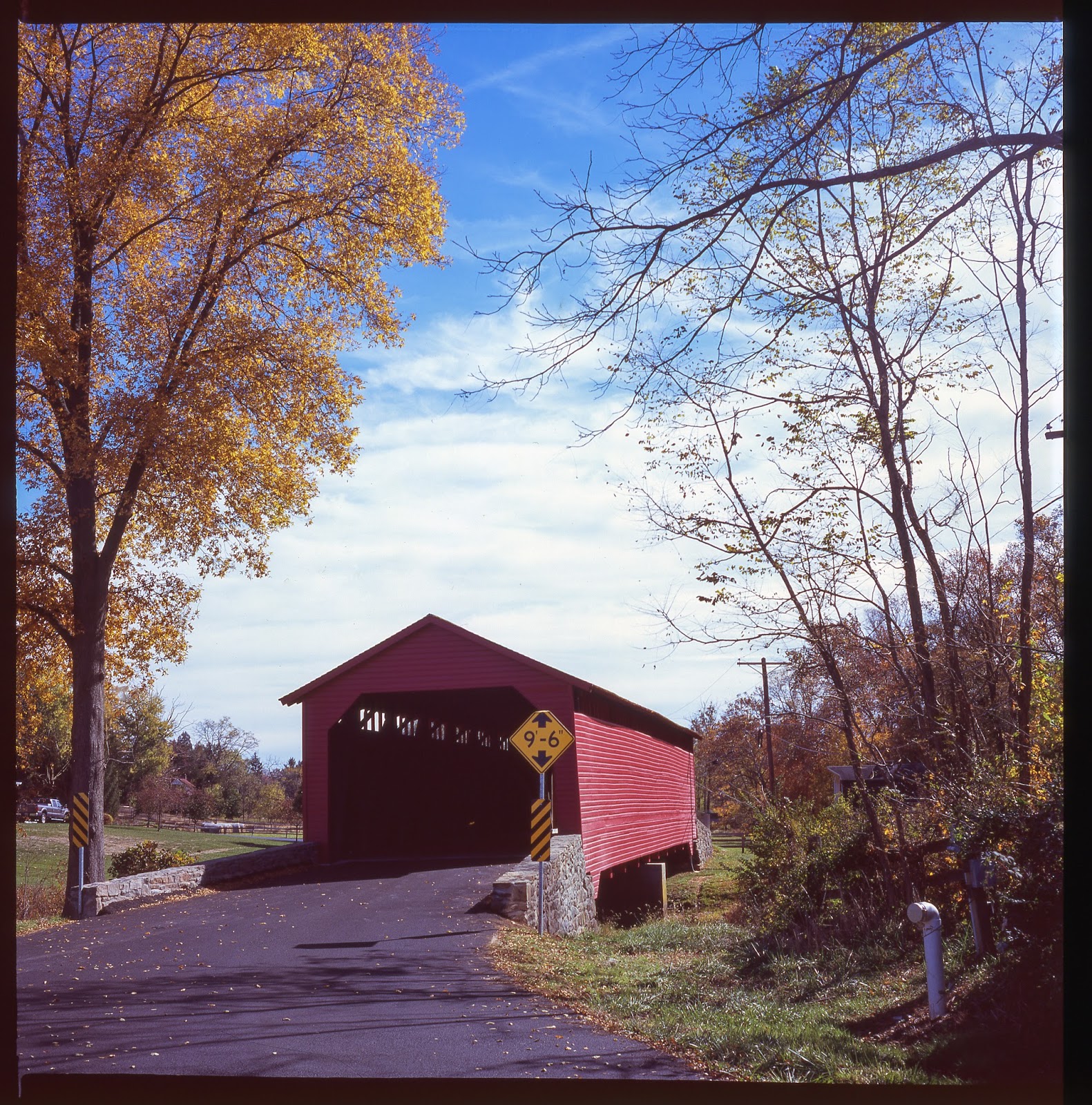
1 - Lewistown, MD - f/11, 1/125 - Continuing the covered bridge ramble in late October, I snapped this shot of the Utica Mills bridge from the opposite side as the other cameras.  The result is one that does brim with image sharpness.


2.09.2016

Innovation Station: Creating 828 film from 120 Film

Not too long ago, I featured a post spotlighting my use of an 828 Bantam camera, for which film hasn't been commercially available for 30 years, with the exception of respooled rolls of Tri-X using 35mm stock that is distributed by Film for Classics for sale at some film retailers.

But let's say you have a Kodak Bantam or other similar 828 format camera and want to use a stock other than Tri-X, or you want to use the format as it was originally intended, in 28x40mm fashion without sprocket holes being evident. Or perhaps you would just like to save money! 

The good news is that any film that is available in 120 format can be used in your 828 camera.  It involves a little bit of effort, but it can be done reasonably cheaply and without a lot for much in the way of specialized tool setups.  Even better, if you follow all the steps shown below, you will actually get the equivalent of TWO rolls of 828 film every time you do this, as the resulting roll of film will readily take 16 exposures, rather than the native 8 of the original format!

Here's what you will need to get started:
  • An unused rigid bodied 120 camera, likely either a TLR or Brownie in style.
  • Your choice of a roll of 120 film, plus spare 120 spool to be a take up spool.
  • Two 828 spools, one to act as the supply spool, the other to take up the film.
  • One 828 camera in which to enjoy shooting your extra long 828 film.
  • One unused flat rigid plastic card, such as a Hotel Room Pass Card, Store Loyalty Card, etc.
  • A couple of junk slides plus some permanent glue.
  • One Utility knife blade that is SHARP!
  • Some Electrical Tape.
  • Scissors
  • A completely dark room or perhaps a changing bag.


2.05.2016

The Periphery of Pocketable: The Kodak Retinette

I doubt there is any "perfect" camera out there, though in my recent experience with a Kodak Bantam, I had an interesting chance to get a glimpse of something that surprisingly embodied a sense of perfection in its ability to create some great images in a pretty wide range of scenes, all in a package that is incredibly portable, slipping easily into the pocket of my jacket; a pocket designed for an MP3 player, mobile phone, or other similar portable device.

But even with all of these things going for it, the Bantam had one challenging drawback: it's film format.  Don't get me wrong - I actually really love 828 format, as well as the fact that I can cut down any 120 film of my choice to create a roll of double-length 828 film, but I have a growing number of film stocks only available in 35mm format that I want to try, and for putting these emulsions to the test, I want to use a 35mm camera rather than trying to plaster the film stock to 828 backing paper in the dark and hope it is lined up correctly.

I have a wonderful and quite capable 35mm camera in the form of the Exakta VX, but as great as it is, it is a bulky monster, and as such, it will never be a camera that I can simply carry along at pretty much any time.  Knowing this, I decided that I would look for a "135 Bantam" of sorts, one that used 35mm film, but was similar in features and size to the beloved Bantam.  Sadly, Kodak did not make a 35mm version of the 1940's design of the Bantam, leaving me an interesting challenge of finding something that could possibly equate to the Bantam for the 135 format.

My list of must-haves, based upon the most likable traits of the Bantam were as follows:
  • Compact Form Factor
  • Full Manual Control
  • At least 4 shutter speeds plus a bulb setting
  • A good (preferably coated) 4-element lens with and f/4.5 or better maximum aperture
  • A slightly wide focal length.
  • An affordable price tag.
The availability of a rangefinder or metering would also be nice, but not essential.  I spent some time perusing sites, and found some possible candidates on Mike Eckman's Camera site that piqued my interest.  I had all but settled on an Agfa Karat and found one on ebay at a low bidding price and put a modest bid in, given the risks of a non-functioning shutter or a seized focusing ring.  The bidding went over my very modest bid, so I let it go.

Without doing much in the way of research, I spotted another camera on a reasonable buy-it-now price, and decided it was worth the modest cost to give it a shot.  From the photos on the listing it seemed to fit most of my list of must-haves. It was at least worth a roll of film, and it certainly seemed more travel-friendly than the Exakta.  And this is how I became the owner of a Kodak Retinette, okay two Kodak Retinette cameras.


Two Kodak Retinettes, a ca. 1959 Type 030 on the left, and a ca. 1962 Type 042 on the right, with some other goodies tossed in for size comparison.


1.22.2016

Six In One Hand: The Gossen Sixtomat

I shoot a decent amount of film on cameras that lack a meter, and I spend many days walking around with a bulky $300 exposure meter.  That meter is also known as an Olympus PEN E-PM2.  Okay, so technically it isn't a meter, but the statement brings up a bigger point.

There are numerous times when I am carrying around a fairly bulky digital camera that I don't intend to shoot photos on, particularly if I am shooting subjects for which I'd rather use film as my medium. Sometimes I can get around this by using the "Sunny 16 Rule" but when shooting transparency film, a miscalculation of the degree of overcast may wind up resulting in an over or underexposure beyond what the film can handle.  Similarly, I have a light meter app that works well, but can be prone to glare on the screen.  As well, I have seen my phone itself reset the calibration of this app on one occasion, so I can't quite trust it without worry.

Thus, the Olympus PEN has been a fairly regular staple in my small camera bag, even if I don't intend on taking photos with it.  I generally trust the readings I get from it to provide me enough accuracy to shoot transparency film using its settings.  Aside from the bulk of it however, it has additional hiccups as well.  I can not set the ISO rating below 200.  Thus, if I am shooting Provia 100, Velvia 50, Retro 80S, or RPX 25, I have to do a number of quick calculations on the fly to determine exposure based upon the readings for ISO 200.  Also, the PEN obviously runs on batteries, and there are times when I have to take my readings quickly when the battery is mostly depleted.  And if it does crap out, I am out of luck until I can charge it - and I still have to carry around its bulk.

How nice would it be if there was an affordable and compact way to take accurate exposure readings for even the slowest speed films that did not depend on batteries.  The cynic in me would expect this to be an absolute impossibility.  That cynic has since been proven wrong. Meet the Gossen Sixtomat!

Clad in ivory and trimmed in gold, the mid-century appearance of the Sixtomat is hardly what I would call contemporary, but therein, I hardly consider it to be a fashion accessory, and more of a tool.  But that's not to say that this little device isn't fascinating in its design. Quite the contrary. The Sixtomat shows a clear degree of simplicity, easy form factor, and sensible layout and readings.  Have a look!


1.15.2016

Film Fun Folio #18 - Balda Pontina and Provia 100F

Periodically, I'll be posting scans of some complete rolls of film on here, showing both the good and the bad, and giving some basic information as well a little write up of the shoot as well as the reasons why I selected each camera and film.  Enjoy the trip! 

Feature #18:
Camera: ca. 1951 Unbadged Franka Solida with Schneider 75mm f/2.9 lens.
Film: Fuji Velvia 100F
Locale: Central Maryland.

There have been times when I thought that this camera and my Zeiss Ikonta 521 were the only 6x9 folders that I would ever need, but some light leaks in recent rolls cast some concerns about my beloved Balda Pontina's ability to be completely trusted to deliver a competent image free of defects.  The summer was spent with the Balda sitting with a roll of Provia loaded, but unused.  Finally, with Fall upon me, and some time to explore, the loaded Balda got the call for 8 more images to see what I could muster from it.  I did a nice range of images, including some landscapes in bright light and some time exposures taken in the wee hours of the morning.  


1 - Thurmont, MD - f/5.6, 1/50 - Nice pictoral representation of colors, but a light leak is again evident in this shot.


1.08.2016

Fun with Film: Film X by Washi in E6 Chemistry

From the Lomography Site:

If you believe that life is best captured in color, then give Washi Film X a try. This panchromatic negative mask-less color film delivers high saturation, crystal clarity and an overall warm tone. Originally designed for road traffic surveillance, this emulsion yields a distinct texture to give your photographs beaming with character. What’s more, you can also process it as a slide film for even more vibrant hues!

Imagine a 400 speed color film that you could elect to process either as a color negative for printing, or in E6 chemistry as a vibrant transparency with amazing color.  This is pretty much what is claimed of Washi-X, a new film offered by Lomography.

The name derives from a hand made Japanese paper, and indeed the purveyors of Washi-X are actually trying to summon the spirit of hand making paper in another of their products, Film Washi, an ISO 25 medium made in small batches for the analog market.  This French made product is certainly unique in its nature and made with a great degree of pride.

But what of their Washi-X product?  Is this some miracle product made from scratch that might forever change the dynamic of analogue photography?  Is it even possible to make color film from scratch with any degree of consistency?  Is it possible to make a version with a Kodachrome palette? Can I get "less filling" and "tastes great?"


Packaging of Film X is admittedly pretty slick, with a sleeve bundled by a label rather than the typical plastic film can. 


12.31.2015

Digital Diminishment: A Year (and Decades) In Review

B.B. King once sang "The Thrill is Gone."  Though this song was penned long before commercial digital photography was a reality, the tag line from this song resonates a bit with me as 2015 draws to a close. It wasn't always this way.

Like so many, I made the switch from film to digital around the turn of the millennium.  At the time, it was such an easy choice to make.  A seeming one-time budget outlay meant the end of a constantly recurring stream of film developing expenses while providing instant gratification and the ability to review or retake one's photos on the fly.  By the end of 2002, my Canon Elan IIe was relegated to sitting idly while my Casio QV3000EX enabled me to take photos of my favorite subjects as well as to take photos of countless other subjects that I'd overlooked before due to the expenses of film developing.  It seemed there was no coming back.


2002, rendered by the Casio QV-3000


12.23.2015

Following in My Father's Footsteps: The 828 Kodak Bantam Special.

It was among the first cameras to enter my hands that would rekindle an interest in shooting with film again.  And yet I am only now writing about it.  

Why you might ask? Let's just say the best laid plans do not always come to fruition.

It was quite possibly the most novel and quirky idea for this blog that I'd ever summoned up. It was going to be epic and a little bit amazing.  And it stalled.

In a nutshell, while going through items my mother had passed onto us, I encountered a remarkably small little camera of my father's that caught my eye.  After a little bit of investigation, I discovered it was none other than a Kodak Bantam camera that uses 828 film, a format discontinued in the mid-1980's that is slightly larger than 35mm.  Soon after, I found a batch of Kodachrome slides from the 1940's and 1950's that were clearly taken with this same camera, as evidenced by the larger transparency size.  Eventually a magnificent idea began to gel.


What if I took this camera and literally "followed in my father's footsteps" to retake the images from these perspectives today?  It seemed like the perfect "then and now" photo montage but with an interesting twist.  I'd not seen where anyone had done then an now images taken over 50 years apart with the exact same camera.  It was a flash of brilliance! 


12.18.2015

Film Fun Folio #16 - Super Ikonta 531 and Rollei Retro 80S

Periodically, I'll be posting scans of some complete rolls of film on here, showing both the good and the bad, and giving some basic information as well a little write up of the shoot as well as the reasons why I selected each camera and film.  Enjoy the trip! 

Feature #16:
Camera: ca. 1946 Zeiss Super Ikonta 531 with 105mm/f3.5 Tessar Lens.
Film: Rollei Retro 80S
Locale: Central Maryland.

It's a camera that took a little while to impress me, before finally showing its capabilities when I took it as a late addition to a March trip to Portland.  Despite this, the Super Ikonta had been sitting idly for months, as I lacked the time to shoot film in a way that rotated through my collection.  Finally, after being smitten by Rollei Retro 80S, I deemed that I'd run my next roll of this film through the 531 and hope I could manage to adhere to it's particularities in carefully cocking the shutter so as to avoid accidentally exposing the frame prior to releasing the shutter.   


1 - Baltimore, MD - f/11, 1/100 - A shot taken on a mild September day shows great sharpness, and some very pleasing tones.  The Super Ikonta is gradually looking a bit more super as I feed more rolls through it. 


12.11.2015

Film Fun Folio #15 - Franka Solida and Astia 100F

Periodically, I'll be posting scans of some complete rolls of film on here, showing both the good and the bad, and giving some basic information as well a little write up of the shoot as well as the reasons why I selected each camera and film.  Enjoy the trip! 

Feature #15:
Camera: ca. 1951 Unbadged Franka Solida with Schneider 75mm f/2.9 lens.
Film: Fuji Astia 100F (Expired 2013)
Locale: Central Maryland.

It's the camera that, when I'm shooting it, I can't wait to get the roll over with, and when that is done, I can't wait to see the results.  Just after getting back the results from the last roll of Velvia 100F shot on this camera, I elected to give it another go, this time with one of only two rolls of Astia that I had been holding on to, and had no idea what to do with.  I decided to keep it simple in some respects, and keep the stubborn shutter on 1/200 and to adjust the aperture as needed.  Below are the results from this experiment.


1 Lower Marlboro, MD - f/11, 1/200 - My first shot results in a somewhat washed out exposure that I had to contain in post processing by stopping down the exposure a bit.  Overall, not bad, and certainly sharp at this aperture.


11.27.2015

Film Fun Folio #14 - Autographic 3A and Velvia 100F Double Feature

Periodically, I'll be posting scans of some complete rolls of film on here, showing both the good and the bad, and giving some basic information as well a little write up of the shoot as well as the reasons why I selected each camera and film.  Enjoy the trip! 

Feature #14:
Camera: ca. 1928 Kodak Autographic 3A Camera with f/7.7 Bausch & Lomb Rapid Rectillinear Lens.
Film: Fuji Velvia 100F
Locale: Frederick County, MD.

The thought of what could be done with huge 120 exposures as panoramic scenes taken in a 122 camera was sooo appealing, and I'd gotten a few promising results from some of my first rolls in the Autographic 3A, only to be disappointed in a follow up roll.  I tried to take a few lessons learned from these experiments and feed the massive camera two more rolls of film to see if I could find something encouraging and useful among the exposures.


All photos were taken at 1/100, with real apertures set between f/22 and f/32.  These "settings" however are not accurate for the light levels in the scenes, but are an adjustment due to the tendency of previous attempts to shoot at normal settings on this camera that came out looking overexposed.  I tend to suspect a slow shutter or an odd aperture iris that causes these overexposures, so I tried to properly compensate.  


1 - Feagaville, MD - Off the bat, the exposure compensation has worked wonders for the exposure.  The result is one with vibrant colors and very natural looking contrast and toning.  The only problem is that the scene, focused at infinity, fails to really render fully focused.  Not sure if this is an issue with the film plane or the focus of the camera. 


11.23.2015

Kickstarter Project: The Galaxy Photographer Planner and Handbook

It was not even a year ago when I found myself in the predicament of having to improvise a way to jot down my exposure information while taking analogue photos.  My solution was the creation of cut-out "exposure notes" that I freely shared from a blog post in late January.

The need to do this stemmed from a lack of any tailored way among a readily available product to handily do this, neither in the print world or even by means of a mobile app. Generally, my improvised solution has worked fairly well, but has a few hiccups to accompany it.  I may not always have a printed "slip" available to tape to the camera back when loading a new roll of film, or I may not have a piece of tape at the ready to stick it to the back of the camera.  Similarly, some of my older cameras have rather delicate coverings, and the tape tends to pull a bit from this covering when it is later removed.  Also, the format I devised did not allow me to venture beyond simply using 120 format or a similar roll film format with limited exposures.

But alas, there may well be hope, with a product listed on the popular crowdfunding site Kickstarter, that will remedy some of the issues I have encountered while using my sticky "notes" that I print myself.  It is called the Galaxy Photographer Planner and Handbook. Comprised of 256 printed pages, it serves as a photo diary and almanac of sorts, and is inspired by a number of photographic diaries dating back to over 100 years.