Showing posts with label Yashica 12. Show all posts

2.12.2016

Film Fun Folio #20 - Yashica 12 and Velvia 100F

Periodically, I'll be posting scans of some complete rolls of film on here, showing both the good and the bad, and giving some basic information as well a little write up of the shoot as well as the reasons why I selected each camera and film.  Enjoy the trip! 

Feature #20:
Camera: ca. 1967 Yashica 12 TLR
Film: Fuji Velvia 100F
Locale: Central Maryland.

When I picked it up late in the Summer of 2014, I saw it as my TLR of the future.  Only problem was that my interest in TLR cameras was soon overshadowed by the magnificent portability and varied formats of 120 folding cameras.  The 12 continued to see decent usage, particular when experimenting with new films when I wanted to be sure of proper focus on the final image, but it never really grew to be the tagalong camera I expected it to be when I first bought it.  Having shot a few rolls through my Seagull TLR recently, it seemed only natural that the 12 should see some use as well, and it did indeed on the advent of Fall in Central Maryland.  Though I had hoped to do more shallow depth of field shots with the camera given its ease of focus accuracy compared to most folding cameras, it really didn't get that chance on this roll, though it was nice to get 12 shots from a roll of film compared to the 8 on the larger format cameras.
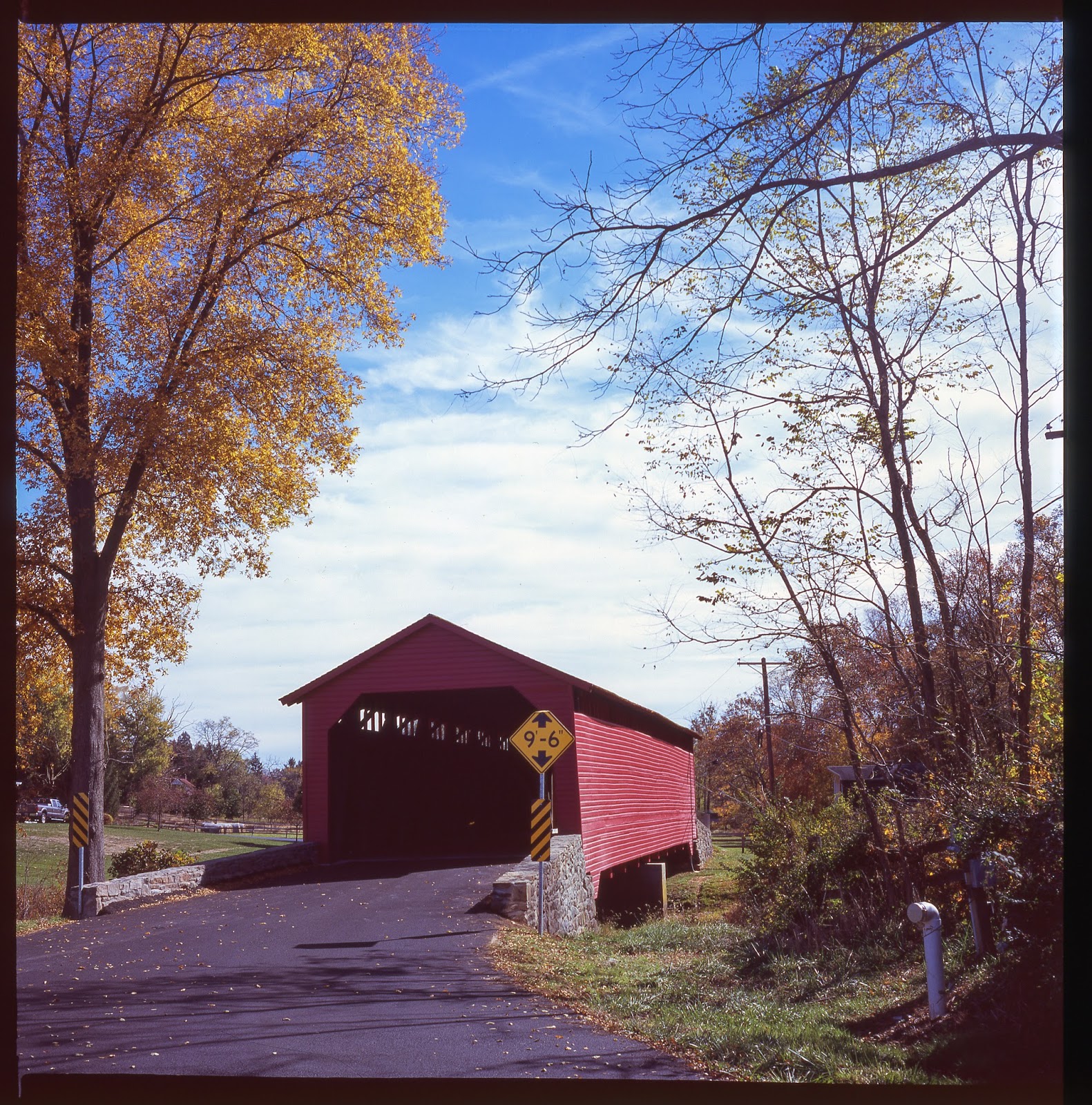

1 - Lewistown, MD - f/11, 1/125 - Continuing the covered bridge ramble in late October, I snapped this shot of the Utica Mills bridge from the opposite side as the other cameras.  The result is one that does brim with image sharpness.


5.01.2015

Film Rewind - A second take on some Film Cameras

If a look through the chronology of my posts is to be believed, I'm a "camera whore."  I get a camera, shoot a roll or two through it, and then stow it away as my fascination turns to the next novel project or acquisition in my repertoire.  

I am very proud to say that is not the case.

The story and interest in the machines does not end with the publishing of the article.  In fact, the article often sets about to be the springboard for even more new and novel fun with the camera once I have gotten a taste of its strengths and limitations.  As such, I thought it would be a nice idea to publish this follow up as a sort of "where are they now" feature. Enjoy! 


It's the very camera that got me interested in film photography once again, and after a little bit of trial and error, I got it working once again.  Since discovering the portability and fun of the folding cameras, I've used the Seagull less, but it is still a wonderful camera to use, though often maligned by "serious" photographers. Ironically, it is the medium format camera I've had the longest, and yet it is the newest in my collection, as every other 120 camera I own was somewhere in the world on the day I was born.  Below is a Provia 100F image taken with the Seagull.  I had to secure the camera on the rear of my car, causing the light bleed in the lower corner. 


3.06.2015

Fun with Film: Agfa Crossbird 200 / Digibase CR200

Kodachrome, Ektachrome, Anscochrome, Agfachrome, Scotchchrome, Astia.

Each of these is a line of color transparency films that is no longer manufactured.  Kodak is out of the business, and Ilford is strictly manufacturing only Black and White Films. Ferrania is actively working to get into the production of transparency films, but production of the initial Kickstarter batch has yet to begin. As such, only Fuji remains to produce Velvia in 50 and 100 speed versions, as well as Provia 100F.

But there is one other option in medium format at the moment - Rollei Agfa.

Typically a seller of a varied line of black and white films of various lineages, the European supplier actually offers one pseudo-slide film among its range of offerings.  I say "pseudo" because they apparently offer the same film packaged and marketed in two different ways. On one hand is the Rollei Digibase CR 200, a traditionally marketed color transparency film based upon the old Agfachrome 200 formulation.  On the other hand is a film called "Crossbird 200," a color reversal film marketed towards being "cross processed," that is, processed in the chemistry for color negative film instead, so as to yield unpredictable colors.  From all appearances, both are the same exact film.

On my return to shooting on film, I was naturally pretty dismayed to see that the selection of color transparency (slide) films had dwindled as much as they had.  Amid my digital shooting days, I recall seeing the news that Kodachrome had passed on, but had no idea that the Ektachrome line had passed as well.  As I began to explore the offerings at B&H Photo, only the trio of remaining Fuji films remained as options, along with both iterations of the Rollei Agfa 200.  The straight "Digibase CR200" version was only available in a five pack, and I certainly wasn't ready to commit that kind of money to an unknown yet. However, the "Crossbird" version was available in single rolls, and I gladly pulled the trigger to try to a test roll, so as to be able to compare it to the remaining Fuji films.

Reading up on whatever I could find regarding others uses of these films left me a little worried, and admittedly rather unenthusiastic about using the roll of film.  For one, the film is on a polyester base instead of acetate, which reportedly leaves it susceptible to "light piping" if any of the film sees the light of day, thus inciting recommendations to load it under subdued light or darkness if possible.  Other reviews however stated that the finished results when processed using E6 chemistry, left an unpleasant and overwhelming yellow cast in the image.  As such, it took several months before I finally took the plunge and loaded the film into my Yashica 12 on Christmas Day, 2014, so as to begin to snap off a roll of test photos. 


2.13.2015

Fun with Film: Rollei Infrared 400

It has taken me a little while to really get back into shooting black and white film.  Between my fascination with old color Kodachrome slides and the wealth of color that was amid the landscapes during the Summer and Fall when I began to get back into shooting film, the premise of stripping that vibrance from my resulting images was not something I was initially ready to do.

That bias has since abated, with the rural landscapes largely having turned to a rather uniform palette that is the color of dull straw since November, the once rich green grasses now in a muted shade of sickly moss, and the colorful foliage on the trees now replaced by withering vines and branches.

However, even as I dove back into film, and was picking up a roll or two of whatever color films were still obtainable, a black and white film caught my eye that seemed particularly interesting to try. It took some time and effort to find a lab willing to process it, but finally, I have results in hand.  The film in question: Rollei Infrared 400.


9.26.2014

Return to Film: The Perfect *12*

They say "Looks aren't everything" but one has to admit that they're a start.

Photographers can often tend to admire beauty, given that a photographer works strictly in a visual medium.  This thought is hardly universal in that many have the more logical thought of placing form over function, and some of the most productive of professional photographers work with rigs that are weather beaten and anything but aesthetic.

While I hardly consider myself a "photographer," I've generally tended to favor photographic devices that were easy to use while giving good results, allowing a sufficient level of control that was easy to access and utilize.  I'd rarely considered the elegance of the overall device to be a factor in my decisions about equipment. 

Fresh from my frustrations from my first round of disappointments from the reactivation of my old Seagull camera, and prior to my ability to remedy that problem, I started looking at alternatives that included picking up a "new" TLR.  I was hardly ready to outlay the money for a Rollei or Mayima, and had read good things about older models made by Ricoh, Minolta, and Yashica.  

Ricoh cameras were not too readily found, while Minolta Autocord cameras had a pretty established following that led to them fetching prices in the $200-300 range on auction, a bit more than I really wanted to pay for a hobbyist camera.  Yashica cameras were pretty plentiful, but came in a very wide range of models over the decades, and took some time to figure out.  There was the "A," the "D," the "Yashicamat," the "44," the "635," and a number of variations of the "124."  Looking at auction results for "Yashica TLR," it was nearly impossible to tell what the distinguishing aspects of these particular cameras were.

And then I spotted it, the prettiest of all the Yashica TLR's, sporting the most simple of model numbers: 12!