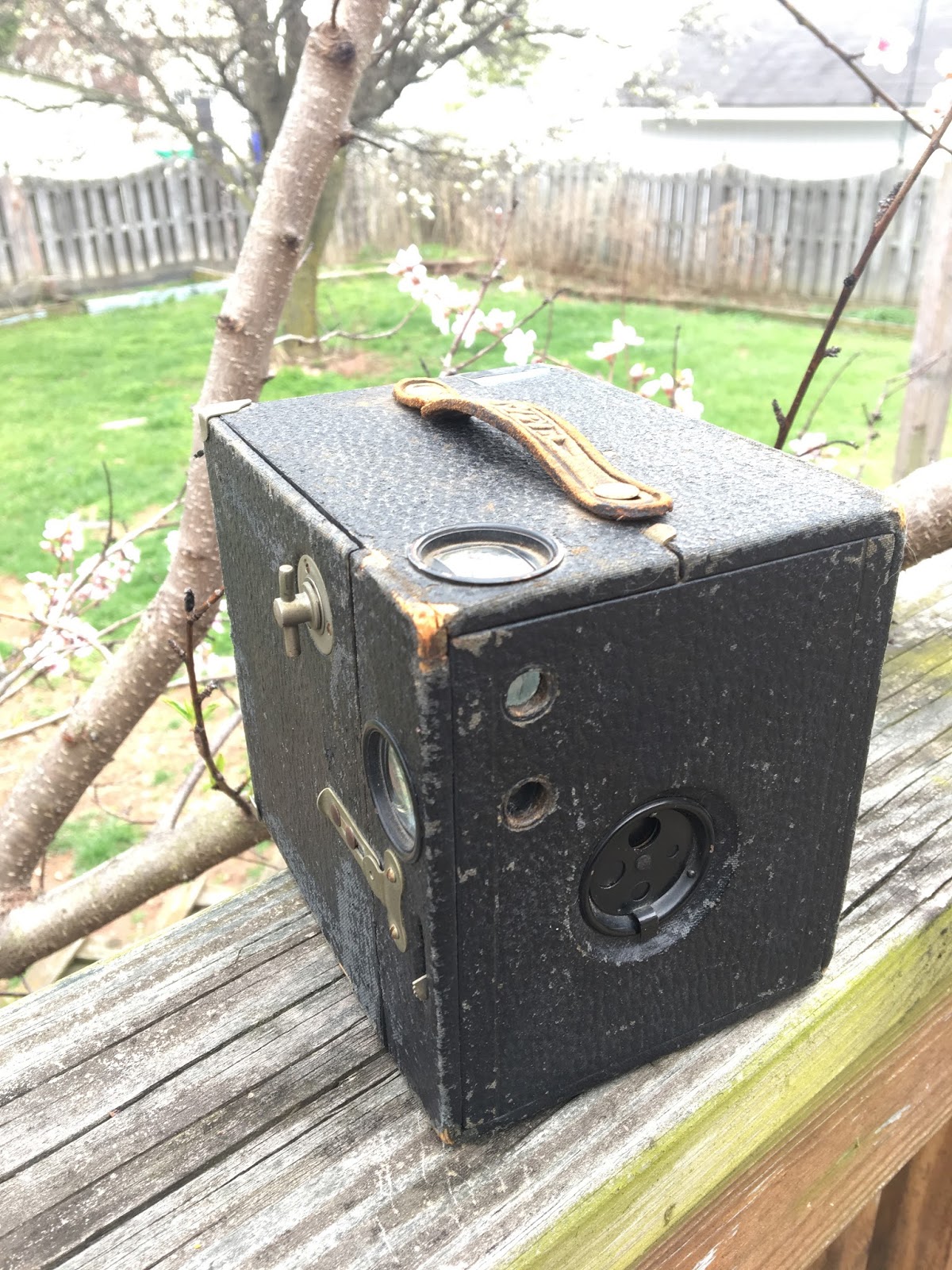
Showing posts with label Box Camera. Show all posts

1.10.2018

Film Hacking: Not Your Typical Polaroid

A number of months ago, I snapped a photo on Fuji FP-100C Instant Peel Apart Film, and was particularly pleased with the results that I obtained.  


Would you care to guess which camera model shot the photo?


12.18.2017

Innovation Station: Medium Format Macros for the Frugal

Shooters of the 35mm format seem to get all the perks cheaply.  For under $20, one can easily pickup any of a wide number of choices for a competent used shooter taking 135 stock that will pretty much do about all that one can expect, including a wide range of shutter speeds and the ability to close focus on even some of the most basic of cameras, allowing for some great shots with wonderful separation of field.

In the world of medium format however, this wide array of choices quickly vanishes.  For those of us who love working with the larger negative sizes that 120 film offers, securing a decent 120 camera for anywhere under $100 often seems like something of a challenge.  And whether one's 120 camera of choice is ultimately is a TLR, a guess focus folder, or a something more along the lines of the "Texas Leica," the ability to get close can be especially elusive on medium format altogether. 

However, with a little bit of ingenuity and some stubborn determination, one can pretty readily be up and about shooting macros in medium format after having spent less than $20 in equipment for camera and accessories, while having a tremendous amount of fun and involvement in the process! This is the hobby of photography at its most enjoyable and affordable. 

So let's start with a shot taken on Ilford HP5 with focus around infinity.  Pretty decent stuff, though this gate in foreground is completely out of focus.  It'd be great to pull the focus a bit closer...

Hey, now we're getting somewhere, though the ornament is still a bit shy of the sweet spot...

Now that's better!  Any chance focus can be pulled in even further?...

Now this is closer than one typically sees from medium format cameras.  Just how close can we pull in focus?

All the way to the nearest bar in the gate!  By now that once crisp backdrop has been wonderfully muted in the distance.

The camera used to produce these images cost me just $15 in a second hand shop, and is readily found in antique stores or online auction sites at around the same price in ready to use condition.  So what did I use for these medium format macro photos?  This! 

A simple Kodak Brownie Number 2 was used to create all of the images above, by means of a pretty simple technique.

6.13.2017

The Box Camera Baby: The Agfa-Cadet A-8

Surprises can be a very good thing, particularly when they fill an unmet need or want.

I had just won one of those "bulk" camera ebay auctions which somehow closed for surprisingly less than I'd have expected.  In fact, I considered by bid to be a mercy bid that would soon be sniped as the auction drew to a close.  Perhaps I had a little luck on my side, or perhaps traffic was light on this afternoon before a three day weekend, but I now had a motley collection of about 8 cameras that also included the Ansco GoodwinRolls, and the Pickwik.

As I surveyed my surprising win, I could see that one of the cameras headed my way would be a more modern Agfa box camera with a lot of patina on its face plate.  Doing a quick look about online, I spotted a very similar looking Agfa-Box B2 camera, and presumed this was what would be in that package on delivery day.

So the true surprise came upon opening the box and discovering the tiniest of box cameras awaiting me.  I had become the unexpected owner of an Agfa-Cadet A-8 camera, a true box camera for 127 film!


Pictures do lie. This seemingly imposing brute of a box camera is likely smaller than the box your last mobile phone was packaged in. 

This adorable little box camera dates from about 1940, and is a bit of an update over previous versions of this camera with a more ordinary leather front.  This model has a metal front with a more Art Deco style to it, with geometric lines inside of the box case and outside of the lens opening, all punctuated by the diamond "Agfa" script logo.  Atop the camera, which measures roughly 3" x 5" x 7", is a leather carrying handle.   


4.04.2017

Outside the Box Thinking? The Gevaert Gevabox

Photography is an interesting hobby that is often quite illogical, particularly as it pertains to gear.  For example, why do people willingly shell out 5 times as much for a 50mm f/1.2 lens as they will for the half-stop slower 50mm f/1.4?  As well, why will people expend a hefty premium for a lens or camera in a certain "serial number sweet spot" specific to each model?  
I am certainly guilty of similar behavior, but in much the opposite way.  Though I have a decent assortment of some very capable cameras with fine lenses, I'll often shelve these more advanced models to shoot on something significantly more basic in nature.  One could easily ask why I have my Zeiss Super Ikonta 531/2 sitting at home while I'm out shooting with cameras like this:


These handsome siblings are both variants of the Gevaert Gevabox, a rather snappy line of cameras that were made after World War II by various camera makers in association with film maker Gevaert. On the left in the photo above is the 1955 variant, sporting a fixed focus lens, but an f/11 lens that can be stopped down to f/16, as well as having a shutter than can accomodate two speeds in addition to a time exposure setting.  On the right is the earlier 1951 version, whose features include a zone focusing lens, an f/8 lens with three diaphragm settings to close down to f/16, but only a single shutter speed in addition to the bulb setting. At least one other variant exists of this model, dating to 1950, made by Hermann Wolf, and strongly resembling the "Adox 66" camera of the same time period.    

I first happened upon a listing that included a 1951 version several months ago and was immediately struck by its styling that combined flashier chrome trim with the traditional box camera format to make a box camera very distinctive in appearance.  I would check listings every so often for one of these beauties, but it took months before I stumbled across one priced within reason to snap up!

As luck would have it, I had not even taken delivery of this camera when I happened upon a copy of the 1955 version in a Baltimore store and priced perfectly.  I suddenly had picked up a Gevabox grouping! 

3.30.2017

Adventures in Sheet Film: The Conley Kewpie No 3

Some ideas take a long while to come to fruition, and by the time they do, they often take on a largely different context from their original context. 

Well over a year ago, as my enthusiasm for shooting cameras using film formats no longer made was hitting one of a few quirky peaks, I stumbled across an idea in a film camera forum to use 4x5 sheet film in a 122 Kodak "3A" folding camera.  At the time,  I was encountering only modest success with using spool adapters to use 120 film in these classic cameras, due in large part to some film plane alignment issues that resulted in soft images.  

The premise of "just laying the sheet of film in the chamber" to be exposed seemed like a really nice way to get the full image size of the 122 film format on film.  I rushed off to Freestyle and ordered a 25 sheet pack of their Arista sheet film.  

Turns out, this idea had its share of challenges.  Not only did my 122 cameras have some issues with focus collimation, but the film plane issues actually seemed to worsen by simply plopping the film in the film chamber with no way to keep the film taut.  Add to it that I hadn't yet embarked on developing my own black and while film, and this was turning out to be a pretty costly "Autographic Experiment."

Fast forward a year and change, and my enthusiasm for obsolete formats hits a new peak. Add in some newly found interest in antique box cameras, and my thoughts towards resurrecting a sheet film experiment are rekindled.

The most obvious idea that occurred to me was to find some sort of 122 box camera, and load it with 4x5 film, getting the most out of the sheet film and getting an image that almost encompasses all of the generous size of the 122 format.  The problem is that 122 format box cameras seemed all but non-existent, based on my searches.  I did stumble across a few listings for some Conley "Kewpie" 3A cameras at some very cheap prices, so I proceeded to snap one up.  

The only problem is that when my camera arrived, it was not a "Kewpie No 3A" but a "Kewpie No 3." That seemingly minor suffix letter makes a significant difference.  The "No 3" is designed to take 124 film rather than the 125 film whose image size is identical to 122 film. 

Not the prettiest of "classic" cameras is the Kewpie No 3, but this was a camera that was designed for affordability.

1.06.2017

One Goodwin Turn Deserves Another - The Ansco No. 2A Goodwin

Certain groundbreaking names are often etched in the memory of the photographic community.  Even those who have never shot film have typically heard of George Eastman and Auguste Lumiere.  It is tough not to think of Ansel Adams or Henri Cartier Bresson when thinking of early photographers. As well, hobby collectors of film cameras are often well aware of the legacies created by Ernst Leitz and Carl Zeiss.

But what about the Reverend Hannibal Goodwin?  In a way, most of the people mentioned already owe a bit to the Reverend Goodwin for his contribution to photography.

Goodwin filed the first patents to produce film in a flexible roll form.  In this way, he could be considered the "Grandfather" of motion pictures, and of the 35mm film format, though he never lived to see his innovation reach its widespread potential.

Prior to the recently retired Reverend's patent filing in 1887, most photography was done on rigid materials such as glass plates.  Goodwin's intent was to create a sturdy film material from a nitrocellulose film base for the purpose of biblical teachings.  His patent was not granted until over 11 years later, by which point George Eastman was already producing roll film using a process of his own.  Goodwin would begin setting up an operation in 1898, only to die in an accident at the end of 1900. 

Later, this patent would be sold, along with the Goodwin's film production business to Scovill & Anthony (later shortened to "Ansco") who used their leverage as patent holders to sue Eastman for patent infringement, resulting in an award of $5 million dollars to Ansco in 1914, and saving it from bankruptcy.

The Ansco film and camera production business would continue to exist in various forms over the next several decades, merging first with Agfa in 1928, and eventually simply was folded into parent company GAF in the late 1960's.  In its earlier years, the company did pay a modest tribute to Reverend Goodwin by naming some models in its box camera lineup with his name, such as the Ansco No. 2A Goodwin.

The austere and basic Ansco No. 2A Goodwin