4.10.2017

Fun With Film: Foma Retropan 320 Soft

There is certainly enough evidence about to make the conclusion that film is not dead.  After a precipitous decline in the 2000's, the niche market that has resulted is seemingly stable by most accounts, and has by some measures seen some signs of growth.

While we may not see a new consumer film camera model released by a major film manufacturer for some time, if ever, there have been some recent introductions in the world of film stocks.  One of these is Foma Retropan 320 Soft, a film promoted to have fine grain and wide tonal ranges in order to evoke a retro look.  

Intrigued enough at the time I placed my last B&H order, I thought Retropan might be a nice film to have at my disposal when I wanted a softer and creamier look.  Though I never quite stumbled upon a day or scene that made me think "It's time to break out the Retropan!," I did eventually just elect that I simply wanted to give this film a try, so it was loaded into my Konica I for a little bit of fun testing in some late winter conditions.  

I exposed the film around box speed and developed using my typical process of stand developing in HC-110, something for which I can readily admit has only been modestly successful with Foma films.  My results begin to follow below...

Rather than creamy, I was surprised at how sharp this film was.  In addition, while I had read some issues regarding grain, I wasn't fully prepared for just how grainy these shots turned out.  


4.04.2017

Outside the Box Thinking? The Gevaert Gevabox

Photography is an interesting hobby that is often quite illogical, particularly as it pertains to gear.  For example, why do people willingly shell out 5 times as much for a 50mm f/1.2 lens as they will for the half-stop slower 50mm f/1.4?  As well, why will people expend a hefty premium for a lens or camera in a certain "serial number sweet spot" specific to each model?  
I am certainly guilty of similar behavior, but in much the opposite way.  Though I have a decent assortment of some very capable cameras with fine lenses, I'll often shelve these more advanced models to shoot on something significantly more basic in nature.  One could easily ask why I have my Zeiss Super Ikonta 531/2 sitting at home while I'm out shooting with cameras like this:


These handsome siblings are both variants of the Gevaert Gevabox, a rather snappy line of cameras that were made after World War II by various camera makers in association with film maker Gevaert. On the left in the photo above is the 1955 variant, sporting a fixed focus lens, but an f/11 lens that can be stopped down to f/16, as well as having a shutter than can accomodate two speeds in addition to a time exposure setting.  On the right is the earlier 1951 version, whose features include a zone focusing lens, an f/8 lens with three diaphragm settings to close down to f/16, but only a single shutter speed in addition to the bulb setting. At least one other variant exists of this model, dating to 1950, made by Hermann Wolf, and strongly resembling the "Adox 66" camera of the same time period.    

I first happened upon a listing that included a 1951 version several months ago and was immediately struck by its styling that combined flashier chrome trim with the traditional box camera format to make a box camera very distinctive in appearance.  I would check listings every so often for one of these beauties, but it took months before I stumbled across one priced within reason to snap up!

As luck would have it, I had not even taken delivery of this camera when I happened upon a copy of the 1955 version in a Baltimore store and priced perfectly.  I suddenly had picked up a Gevabox grouping! 

3.31.2017

No Spartan Here! The Spartus Roxmar

The great thing about having a hobby shooting film in classic film cameras, and making the world aware of it is that eventually, someone will come along and help you feed your sickness! 

Not long after posting my article on the rather cumbersome Samsung Maxima 105, Mike Novak, a fellow member of the Facebook Vintage Camera Collectors Group, offered to send me a handful of cameras to borrow to which I could give a try.  Though he sent along a refinement of the Samsung Point and Shoot series, he also sent along a particularly charming camera that piqued my interest the most: The Spartus Roxmar! 


3.30.2017

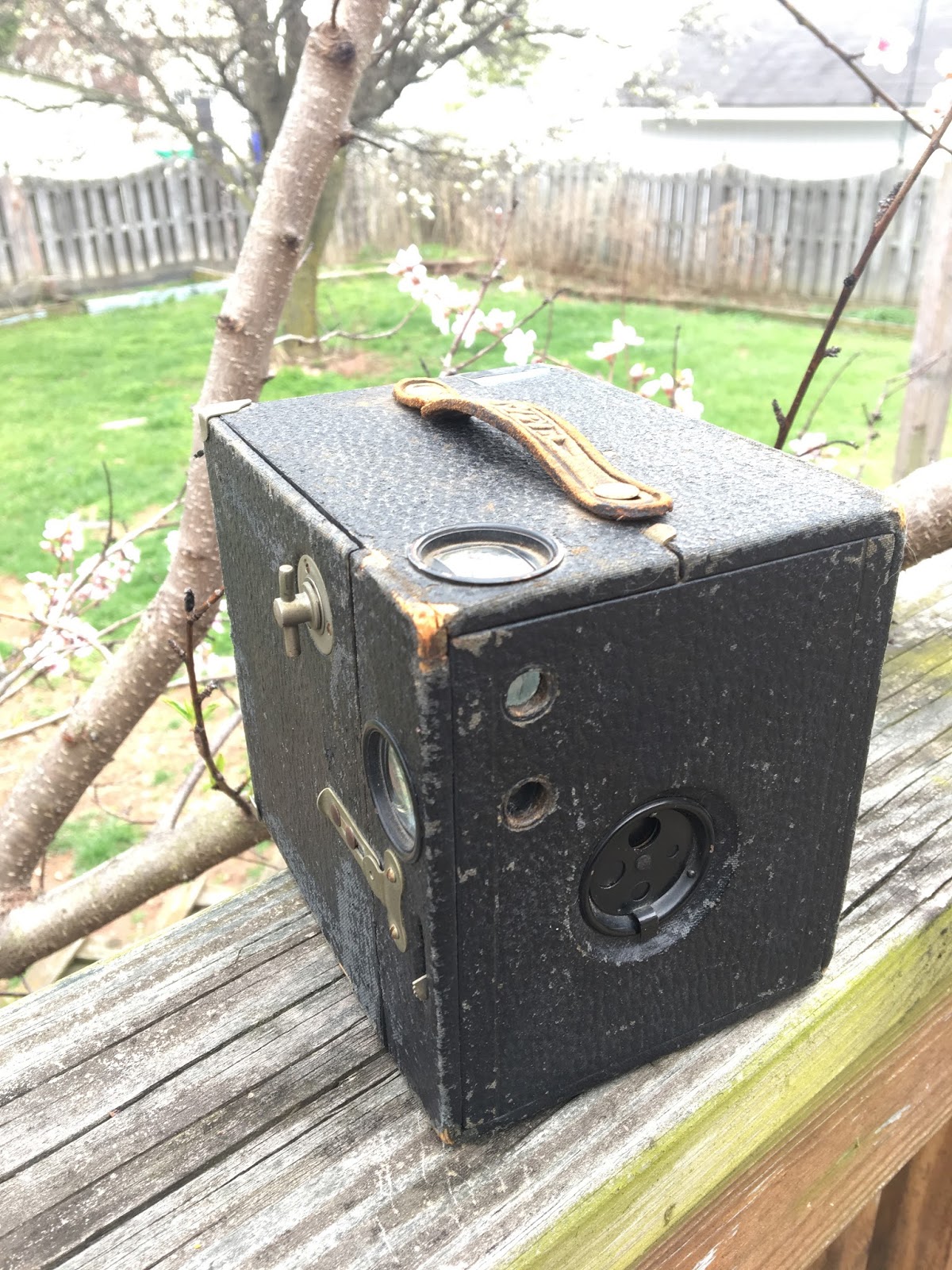
Adventures in Sheet Film: The Conley Kewpie No 3

Some ideas take a long while to come to fruition, and by the time they do, they often take on a largely different context from their original context. 

Well over a year ago, as my enthusiasm for shooting cameras using film formats no longer made was hitting one of a few quirky peaks, I stumbled across an idea in a film camera forum to use 4x5 sheet film in a 122 Kodak "3A" folding camera.  At the time,  I was encountering only modest success with using spool adapters to use 120 film in these classic cameras, due in large part to some film plane alignment issues that resulted in soft images.  

The premise of "just laying the sheet of film in the chamber" to be exposed seemed like a really nice way to get the full image size of the 122 film format on film.  I rushed off to Freestyle and ordered a 25 sheet pack of their Arista sheet film.  

Turns out, this idea had its share of challenges.  Not only did my 122 cameras have some issues with focus collimation, but the film plane issues actually seemed to worsen by simply plopping the film in the film chamber with no way to keep the film taut.  Add to it that I hadn't yet embarked on developing my own black and while film, and this was turning out to be a pretty costly "Autographic Experiment."

Fast forward a year and change, and my enthusiasm for obsolete formats hits a new peak. Add in some newly found interest in antique box cameras, and my thoughts towards resurrecting a sheet film experiment are rekindled.

The most obvious idea that occurred to me was to find some sort of 122 box camera, and load it with 4x5 film, getting the most out of the sheet film and getting an image that almost encompasses all of the generous size of the 122 format.  The problem is that 122 format box cameras seemed all but non-existent, based on my searches.  I did stumble across a few listings for some Conley "Kewpie" 3A cameras at some very cheap prices, so I proceeded to snap one up.  

The only problem is that when my camera arrived, it was not a "Kewpie No 3A" but a "Kewpie No 3." That seemingly minor suffix letter makes a significant difference.  The "No 3" is designed to take 124 film rather than the 125 film whose image size is identical to 122 film. 

Not the prettiest of "classic" cameras is the Kewpie No 3, but this was a camera that was designed for affordability.

3.23.2017

Point and Shoot Pity Party Part 4: The Olympus ∞ Stylus Zoom

This is Part 4 of a recurring series on basic point and shoot consumer cameras, the details of which can be found here.

To most bargain hunters, the term "As Is" can often be a deterrent, but to the savvy film camera bargain hunter, is is not often a deal killer, due in large part to the excess challenges for the average seller to find a battery and film, and to process it to test its functionality.  As such, I really didn't blink when I saw these words on the price tag affixed to the Olympus ∞ Stylus Zoom as I browsed through the downtown hospital thrift shop.  While its specs didn't wow me over, the price of this camera and the inclusion of the original box and manuals made it a pretty easy buy after a morning of jury duty.  It seemed a good candidate for this pity party! 

Front View (closed)

Front View (open)

Top View

Through the small viewfinder.  Note the centering focus marks and the close framing line near right top. 

Name: Olympus ∞ Stylus Zoom
Format: 35mm
Type: Autofocus Point and Shoot 
Year: 1993
Features: Weatherproof, Self Timer and Remote, Red Eye Reduction, Slow-sync Flash Mode.
Lens: 35-70mm, f/4.5-6.9 (6 elements in 5 groups).
Battery: 1 CR-123 cell.
Manual: http://www.derrybryson.com/manuals/Olympus/35%20MM%20CAMERAS/Stylus%20Zoom%20instruction%20manual.pdf

3.22.2017

Oh Me Too? (What more can I add?) The Olympus OM2

Some camera reviews are easier than others for me.  Give me an overlooked quirky model and I can readily reveal the fun aspects of shooting one of these unique models supplemented with what little bits of interesting information that I can discover about the model and its maker.  It's a fun process that makes for a fun to write review that I always feel proud to share.

But give me a well-known and well-loved model with oodles already written about it, and I will be crippled by a severe case of writer's block.  After all, what more can I add to a conversation that has already been so extensively covered from more or less every conceivable angle.  And that is just where I am in trying to pen a fitting review of the Olympus OM-2N.

A special thanks to my Minolta 5D for producing such a wonderful vanity shot of the OM-2

The Olympus OM-2 is perhaps the most well known camera for which I have in my stable and I've yet to write a post.  On its debut in the 1970's (arguably the prime period of manual focus SLRs), the OM-2 was very well received for its compact size and easy to use feature set. Forty years later, the OM-2 is still a darling of a camera for many of today's film shooters, and has any number of positive write-ups online.  Two of my film shooting buddies, Mike and James both have favorable reviews posted of the OM-2 that can relay more about the camera's history and attributes than I can ever hope to convey here.

3.21.2017

All Weather Friend - The Nikon Action Touch

Confession time: I can't swim.  Throughout my younger years, I held a certain trepidation towards the water after falling into a river while fishing with my brother early on.  He pulled me from the cold waters of the Gunpowder River, but I never quite pulled myself from my aversion to bodies of water, despite trying to learn to swim in the years that followed.

And while I may not savor the feeling of swimming across a pool in a way that many people do, I do enjoy visits to lakes and beaches, and even can find a certain enjoyment in rain soaked days at times. Oh, and yes, as you may know, I like taking pictures.

In an earlier photographic life, I was admittedly guilty of trying to use a less than all-weather camera in all sorts of situations.  I held my Minolta X-700 under an umbrella as I took photos in a rain storm, or tucked it in a coat pocket as I wandered through falling snow to capture winter scenes.  Perhaps this abuse is what led the EV compensation dial to throw off the meter in this classic camera.  Who knows?  I'm not giddy about the outcome of the camera, but am at least glad to have captured some long lost scenes in less than fair weather.


If only I had elected to use a more weatherproof camera during these days for such scenes, I might still have the X-700 as a member of my arsenal to use in more optimal settings.  If only I'd had a camera like the Nikon Action Touch!