2.29.2016

Kodachrome Classic Monday #79

Every Monday, I'll be spotlighting a different classic Kodachrome slide that I've picked up, and trying where I can to detail the who, what, when, where, why, and how (much) of the image:

This Week:

What: Mountain Town

2.26.2016

Film Fun Folio #21 - Agfa Billy Record and Rollei Retro 80S

Periodically, I'll be posting scans of some complete rolls of film on here, showing both the good and the bad, and giving some basic information as well a little write up of the shoot as well as the reasons why I selected each camera and film.  Enjoy the trip! 

Feature #21:
Camera: ca. 1951 Agfa Billy Record I with Agnar 75mm/f 6.3 lens.
Film: Agfa Rollei Retro 80S 
Locale: Frederick County, Maryland.

Since the day I first used it, the basic Agfa Billy has been all but asking to be taken seriously in spite of its very limited shutter speeds, and its slow and basic lens.  It's a well working and easy camera to use, but in retrospect, it has often been overlooked as a serious image maker for other cameras in my repertoire.  As a result, it has seen decent usage, but its most recent "assignments" have been more for novelty photography, such as with long expired film or as a test bed for cross processing of slide film.  

In these experiments, I had been pleasantly surprised by the quality of the images put forth by the less than revered Agnar lens.  Thus, I elected to approach this roll of my much liked Retro 80S film with a more serious tone.  All shots were exposed at an EI of about 50 and all are taken within an aperture stop of one stop from wide open.  And this marks one of the few times when I actually load one of these old cameras with film that has a common brand with it, as Rollei film carries the same Agfa diamonds as this camera.  

Though sent off with 7 rolls of color 120 slide film of colorful fall scenes for developing, I was extremely eager to see the results from this roll taken on black and white.  My findings are below.


1 - Catoctin Furnace, MD - f/8, 1/50 - I struggled for a good perspective from which to shoot this old iron furnace.  Foliage just didn't seem to fall in the most photogenic places.  The result above is OK, but doesn't quite hit the mark. 


2.22.2016

Classic Kodachrome Monday #78

Every Monday, I'll be spotlighting a different classic Kodachrome slide that I've picked up, and trying where I can to detail the who, what, when, where, why, and how (much) of the image:

This Week:

What: Forms of Transit.

2.19.2016

An Autographic Experiment - Part 3 - Using 116 Film in a 116 Camera

My love affair with my Autographic 1A had seemed to have plateaued.  Once envisioned as a cheap (only $7.19) camera that would enable me to shoot occasional "supersized" landscape photos on 120 film, my actual results, initially promising, were getting progressively worse, and after another set of washed out results in Film Fun Folio #19, I had begun to question whether I needed to simply relegate this elegant old camera to a shelf display.  Besides, if I wanted large transparencies, the smaller 1A paled in comparison to the 3A to provide such goodies. 

But being the master of last chances that I am, I gave the venerable old Autographic one last grace period to prove to me that it could find value as an active member of my collection. This was helped no doubt by a lucky lowball bid that landed me a roll of long expired Verichrome Pan film in the 1A's native 116 film format.  And with this, I figured, it was time to do one more "Autographic Experiment"

Though I had heard of good results from using long expired Verichrome Pan, the truth was that results could still be hit and miss, largely in relation to how well the film had been stored.  This roll expired in the mid-1970's: not a "Spring Chicken" but not as ancient as some rolls that people were shooting with success.  I loaded up the Autographic and began to flesh out ideas for shooting subjects.  I was not about to simply fire off these 8 shots on just anything.  Rather, I would try to bias my subjects to those of a historical nature, and potentially see if this old film would give me some successful tries of "Nostalgraphy."

I had been discovering the wealth of Civil War era history near where I live, so it seemed this camera and film would eventually get an assignment to capture some battlefield sites.  For now though, with a loaded camera and an itchy shutter finger, I set my sights on a lady.  I had a lunch date, and her name was "Aggie." 

The "Black Aggie" statue is the subject of a decades old legend involving a curse.  An unauthorized copy of a similar figure called "grief," this statue once adorned a cemetery plot in Druid Ridge Cemetery outside of my hometown of Baltimore, MD.  The origin of this supposed curse vary, and its effects include stories of women made infertile, a man losing his arm, and night time visitors reporting Aggie's deep set eyes glowing in the darkness.  The monument was removed from its site in 1967.

I had recently been reminded of this legend, and had just discovered that Aggie had been relocated to a courtyard just a 20 minute walk from my work.  So off I went to memorialize this legend on film, using a camera that wasn't much younger than the memorial itself. Unfortunately, the lighting in the courtyard on a lightly overcast day was pretty drab for the ISO 50 at which I was rating the film, so the nominal shutter speeds available of 1/25 and 1/50 were a stretch.  In addition, I'd neglected to bring a tripod this day, so I had to do some particular improvisation on the fly, letting my Olympus Pen digital double as a prop as I tried to frame Aggie in the dim "Brilliant Finder."  I fired off a pair of shots and expected to use the rest on some of the Civil War sites in Central Maryland in the coming weeks.


2.15.2016

Classic Kodachrome Monday #77

Every Monday, I'll be spotlighting a different classic Kodachrome slide that I've picked up, and trying where I can to detail the who, what, when, where, why, and how (much) of the image:

This Week:

What: Hustle and Bustle

2.12.2016

Film Fun Folio #20 - Yashica 12 and Velvia 100F

Periodically, I'll be posting scans of some complete rolls of film on here, showing both the good and the bad, and giving some basic information as well a little write up of the shoot as well as the reasons why I selected each camera and film.  Enjoy the trip! 

Feature #20:
Camera: ca. 1967 Yashica 12 TLR
Film: Fuji Velvia 100F
Locale: Central Maryland.

When I picked it up late in the Summer of 2014, I saw it as my TLR of the future.  Only problem was that my interest in TLR cameras was soon overshadowed by the magnificent portability and varied formats of 120 folding cameras.  The 12 continued to see decent usage, particular when experimenting with new films when I wanted to be sure of proper focus on the final image, but it never really grew to be the tagalong camera I expected it to be when I first bought it.  Having shot a few rolls through my Seagull TLR recently, it seemed only natural that the 12 should see some use as well, and it did indeed on the advent of Fall in Central Maryland.  Though I had hoped to do more shallow depth of field shots with the camera given its ease of focus accuracy compared to most folding cameras, it really didn't get that chance on this roll, though it was nice to get 12 shots from a roll of film compared to the 8 on the larger format cameras.


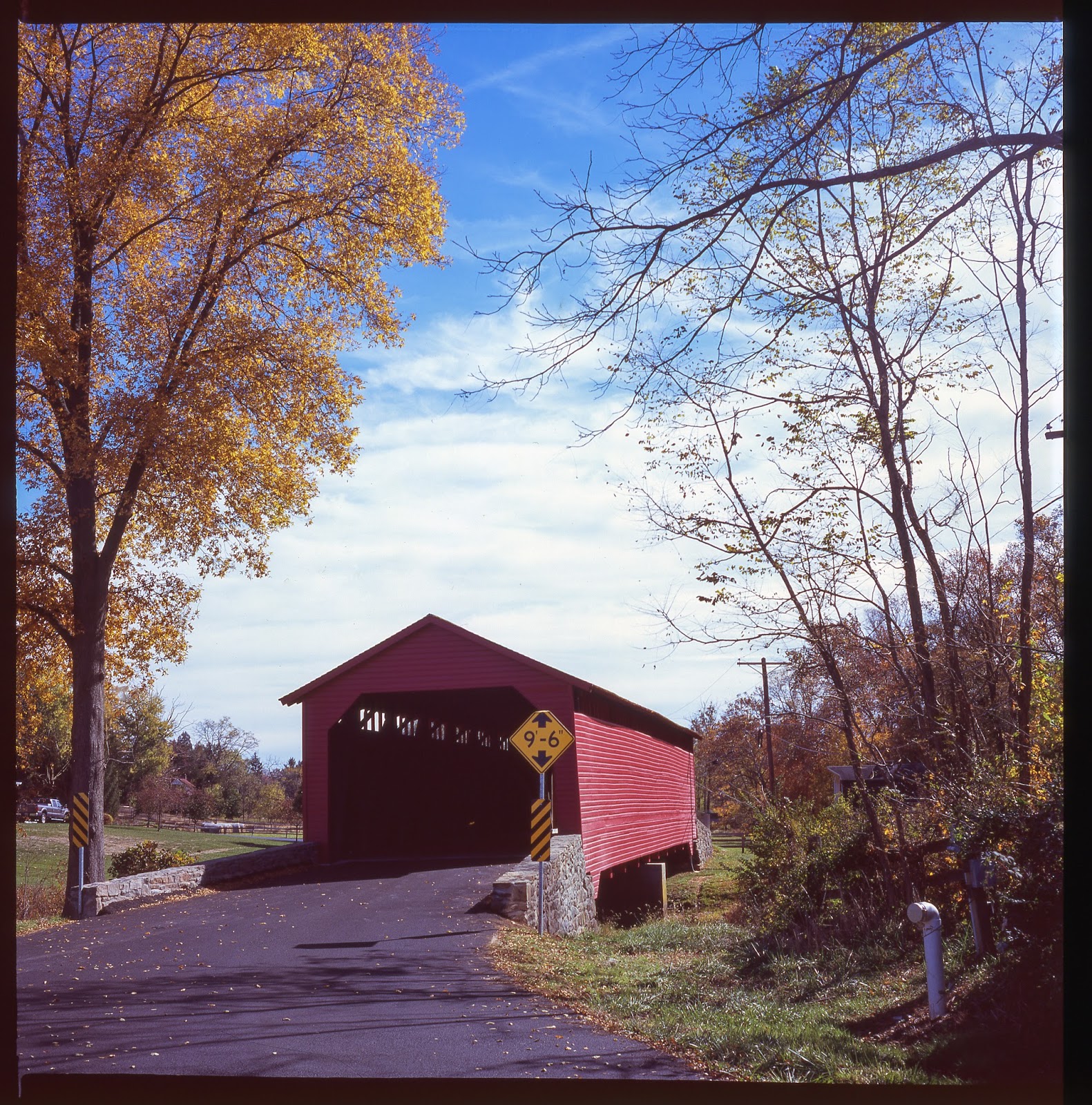
1 - Lewistown, MD - f/11, 1/125 - Continuing the covered bridge ramble in late October, I snapped this shot of the Utica Mills bridge from the opposite side as the other cameras.  The result is one that does brim with image sharpness.


2.09.2016

Innovation Station: Creating 828 film from 120 Film

Not too long ago, I featured a post spotlighting my use of an 828 Bantam camera, for which film hasn't been commercially available for 30 years, with the exception of respooled rolls of Tri-X using 35mm stock that is distributed by Film for Classics for sale at some film retailers.

But let's say you have a Kodak Bantam or other similar 828 format camera and want to use a stock other than Tri-X, or you want to use the format as it was originally intended, in 28x40mm fashion without sprocket holes being evident. Or perhaps you would just like to save money! 

The good news is that any film that is available in 120 format can be used in your 828 camera.  It involves a little bit of effort, but it can be done reasonably cheaply and without a lot for much in the way of specialized tool setups.  Even better, if you follow all the steps shown below, you will actually get the equivalent of TWO rolls of 828 film every time you do this, as the resulting roll of film will readily take 16 exposures, rather than the native 8 of the original format!

Here's what you will need to get started:
  • An unused rigid bodied 120 camera, likely either a TLR or Brownie in style.
  • Your choice of a roll of 120 film, plus spare 120 spool to be a take up spool.
  • Two 828 spools, one to act as the supply spool, the other to take up the film.
  • One 828 camera in which to enjoy shooting your extra long 828 film.
  • One unused flat rigid plastic card, such as a Hotel Room Pass Card, Store Loyalty Card, etc.
  • A couple of junk slides plus some permanent glue.
  • One Utility knife blade that is SHARP!
  • Some Electrical Tape.
  • Scissors
  • A completely dark room or perhaps a changing bag.