Showing posts with label Equipment. Show all posts

7.20.2018

Digitalesque: The Kodak Advantix Preview

It's 2018 - Picture your typical consumer taking snapshot photos today on both their every day outings and special moments. In the vast majority of cases, their tool of choice is a smartphone, and the typical post-photo tendency is often to look at the screen of the phone to see how the image came out, should it need to be taken again.

Now let's dial the clock back a bit shall we?  Nine years to be exact to 2009.  The Smartphone is certainly present, but its still largely in its infancy, while the more common flip phones are often used for taking rudimentary digital snap shots in a pinch.  However, a more established tool of choice is the digital consumer camera, often offering up a healthy zoom and an inflated megapixel count.  These are typically the tag along of many a consumer who wants to be able to take photos that may be worthy of printing.  And, just as today, the typical post-photo tendency is often to look at the screen on the back of the camera to see how the image came out, should it need to be taken again.

Now let's dial the clock back just ONE more time. Going back another nine years brings us to the year 2000. The consumer smartphone is little more than a dream in its designer's mind, while the digital consumer camera prevalent in 2009 is largely in its own infancy, with 2 or 3 megapixel sensors offering up paltry image quality hardly suitable for keepsake printing or enlarging.  In this era, just 18 years removed from our present landscape, film is still king, offered readily across a range of retail outlets. Minilabs are found in nearly every shopping center and general big box store, and the majority of the photos taken by your every day consumers are done on a variety of compact film cameras.

However, unlike 2009 and 2018, the typical post-photo tendency is NOT to look at the screen on the back of the camera to see how the image came out since no such screen existed, leaving the consumer to wait until the film was developed to see how an image came out.

But for one very odd exception...


From the front, the Advantix Preview looks largely in line with many similar compact cameras of the era, offering a modest zoom on a rather slow lens primarily for taking snapshots. 

Released in the year 2000, the Kodak Advantix Preview can be described as many things: a digital camera that wasn't, a bizarre bridge of two worlds, or a poorly executed hybrid concept for which demand never really existed.  For a handful of us film-happy dreamers, it can be considered as a foundation for a future which could have conceivably existed, but which never came to be.

6.21.2018

Wet Weather Warrior: Pentax Zoom 90WR

Oh Pentax Zoom 90-WR, it wasn't supposed to lead to anything...


In my mind, you were supposed to be a one time thing, a flight of fancy, a spontaneous "sure why not" amid a flurry of other priorities that were more in line with my typical tastes. 

To my way of thinking, you were a consolation prize, as the second-best item of a half-hearted pity bid on a multi-piece lot that I snapped up at a low opening bid simply because I could, and since the main item of interest, the Pentax SF-1 SLR, was to be nothing more than a spare to me. 

12.28.2017

Dutch Date - Part 6: The Minolta Autopak 700 and the GAF Anscomatic 726

Every so often, I'll get really frugal and ask a couple of cameras to share a roll of film.  Though there are problems here and there, they'll usually agree.  I call these "Dutch Dates" and usually try to pair cameras with something more than simply the film format in common.  Below is a look at just one such pairing...


So would the two early Gen X'ers find that their classic American staple tasted like a finely aged Bourbon or stale beer?  Read on to find out!

Camera Models: Minolta Autopak 700 (ca 1966) and GAF Anscomatic 726 (ca 1969)

Similarities: Both are Japanese made 126 format auto-exposure rangefinders of early 1970's vintage with the capability of full manual control.  

Differences: The GAF has a higher top speed (1/500) than the Minolta (1/250) and, from limited previous experience, is much more accomodating to use of 35mm film spooled into a 126 cartridge. 

Film Shared: Expired Kodak Gold 200-126 expired in January 1992. 

It was just last May when I first elected to pick up and use a camera in the favorite format of my mom: none other than 126 cartridge.  Though it seemed my initial tries with this film and format encountered more challenges than conquests, I ultimately discovered a new love and respect for this largely forgotten film format, and some of the machines designed to utilize it.  With cameras in 126 format available for next to nothing, I snapped up a small sampling of various "Instamatic" type cameras to get a better feel of all that the 126 format once was. 


12.20.2017

Dutch Date - Part 5: Ricoh Singlex TLS and Ricoh 35 Flex

Every so often, I'll get really frugal and ask a couple of cameras to share a roll of film.  Though there are problems here and there, they'll usually agree.  I call these "Dutch Dates" and usually try to pair cameras with something more than simply the film format in common.  Below is a look at just one such pairing...


As they settled in to enjoy an English delicacy, the 35 Flex asked the Singlex if the battle wounds were real or self-inflicted. 

Camera Models: Ricoh Singlex TLS (1967) and Ricoh 35 Flex (1963)

Similarities: Both are 1960's Ricoh SLR cameras under their own brand name.

Differences: The Singlex is a conventional focal plane shutter SLR with interchangeable lenses, while the 35 Flex is a leaf shutter SLR with a fixed lens. 

Film Shared: Ilford FP4+, Fresh Dated 

The 1960's might be considered to be the prime period for Ricoh's camera models.  Though the Japanese camera maker certainly had a pretty lengthy run of producing some very capable, and often quite unique film cameras, the Sixties seem to be when Ricoh made a name for itself in a pretty crowded industry.  Though the maker continued creating some excellent cameras in the decades to follow, it seemed to be increasingly marginalized, at least in the US, as Canon, Nikon, Pentax, Minolta, and Olympus took the top spots in the remaining field.


12.12.2017

Dutch Date - Part 4: The Minolta 460Tx and the Minolta-16 MG

Every so often, I'll get really frugal and ask a couple of cameras to share a roll of film.  Though there are problems here and there, they'll usually agree.  I call these "Dutch Dates" and usually try to pair cameras with something more than simply the film format in common.  Below is a look at just one such pairing...


As they devoured their Chinese fare, the lively discussion between the two often turned into heated exchanges, as both tried to best each other. 

Camera Models: Minolta Autopak 460Tx (1979) and Minolta-16 MG (1966)

Similarities: Both are Minolta made products that shoot a 16mm wide film stock, albeit using different cartridges.

Differences: The 460Tx uses perforated 110 film, has adjustable focus and aperture, but a seemingly constant shutter speed.  The 16 MG offers fixed focus, with an integrated sliding filter for closer focus.  Aperture and shutter on the 16 MG are both adjustable, albeit on a scale resembling a program exposure.

Film Shared: Lomography Orca 110BW, fresh dated. 

As the popularity of film photography increased, and the capabilities of photographic film improved, the decades from the 1930's onward increasingly sought ways to improve on the portability of cameras while still providing versatility and good image quality.  The miniaturization of cameras hit a certain stride in the later part of the 20th century, with many cameras easily fitting into pockets to have at the ready at any time.  


12.05.2017

Dutch Date - Part 3: Minolta Freedom Dual C and Minolta Freedom Zoom Explorer

Every so often, I'll get really frugal and ask a couple of cameras to share a roll of film.  Though there are problems here and there, they'll usually agree.  I call these "Dutch Dates" and usually try to pair cameras with something more than simply the film format in common.  Below is a look at just one such pairing...


They scarfed down their British fare with reckless abandon, and remarked, how of their contemporaries coming up in the 90's, they were some of the few who could really see the "big picture."

Camera Models: Minolta Freedom Dual C (1991) and Minolta Freedom Zoom Explorer (1999)

Similarities: Both are Minolta made point and shoot models with multiple focal lengths that have the fairly rare ability to shoot at the 28mm focal length on the wide end of their focal length range.

Differences: The Freedom Dual C, an earlier model, is actually a dual lens camera rather than a zoom like the Freedom Zoom Explorer.  It offers special buttons only to turn off flash or to use a self timer.  The Explorer however has a burst mode, night portrait mode, red-eye reduction flash, and macro mode among its options. 

Film Shared: Ilford Delta 400, fresh dated, developed in TFX-2. 

As the 1990's progressed, point and shoot cameras continued to try to reach new and impractical levels of focal length, as the typical 35-70mm range began to expand ever upwards with each successive year.  As the decade closed, and a consumer digital era crept imminently close, the longest of these super zooms stretched to a 200mm focal length! 

Far fewer camera models in this age of length inadequacy crept inward, typically leaving 35mm (or more often 38mm) as the widest focal length offered, and in effect leaving snapshooters in close quarters with few comparative choices.  Minolta was one of the few makers to crack the semi-wide ceiling on some of their models, with a couple of models reaching inward to be operable at a wide 28mm focal length.  


11.17.2017

Dutch Date - Part 2: The Detrola Model HW and the Falcon Model F

Every so often, I'll get really frugal and ask a couple of cameras to share a roll of film.  Though there are problems here and there, they'll usually agree.  I call these "Dutch Dates" and usually try to pair cameras with something more than simply the film format in common.  Below is a look at just one such pairing...

The two Seniors noshed on some Japanese fare, while recalling the days when their format wasn't at all obscure!

Camera Models: Detrola Model HW (1939) and Falcon Model F (1937)

Similarities: It's as if someone built the shell of this camera for both makers to utilize in putting their own finishing touches and features on their version, as they are that similar.  Both are Art Deco era American Viewfinder collapsible 127 cameras whose design is rich in Art Deco lettering and design work, and as it so happens, both have tended to have a particular dislike of "homemade" 127 film, from previous experience.  Both also have Wollensak 2 inch Velostigmat lenses that have unit focusing instead of front element focusing. 

Differences: The models come from different manufacturers, and have slight differences in top shutter speed, as well as expected differences in trim. 

Film Shared: Rerapan 100 in 127 format, fresh dated. 

If you have read more than a few of my posts, you'll soon note that I'm a bit of a sucker for what are often known as "obsolete" formats.  After successfully cutting down 120 film to feed old 828 format cameras, my attention later turned to 127 format models, and I began to expand my film cutting adventures to this format as well.  However, I discovered some 127 cameras weren't the most enthusiastic about using this custom slit film, often slipping in the film advance, or simply having many issues with film plane flatness.  


10.24.2017

Dutch Date - Part 1: The Nikon N75 and the Maxxum HTSi

Every so often, I'll get really frugal and ask a couple of cameras to share a roll of film.  Though there are problems here and there, they'll usually agree.  I call these "Dutch Dates" and usually try to pair cameras with something more than simply the film format in common.  Below is a look at just one such pairing...


The two Japanese millennials sat and reminisced on their youth as they partook in a shared roll of a newer American classic: Kodak's TMAX 100.

Camera Models: Minolta Maxxum HTSi (1997) and Nikon N75 (2002)

Similarities: Both are "mid-entry level" SLR cameras dating from the last 10 years of film's dominance that are largely overlooked today by film enthusiasts, who instead opt for higher end models of the era.  Both were acquired as an extra of a multi-camera lot, and happened to function perfectly.

Differences: The models come from different makers, and have different button locations for some similar functions.  The Minolta allows for manual setting of ISO speeds and has a faster top shutter speed of 1/4000 second.  The Nikon has five illuminated focus points that can be easily selected using a pad on the back of the camera.

Film Shared: Kodak TMax 100, fresh dated. 


In a world of camera collecting and shooting, you're bound to acquire a few extras you'd never intended to snap up.  Typically, these come in the form of an extra camera body bundled in with a multi camera lot that contains something else of interest.  All too often, these extra pieces are either something broken, something that you already have, or something that is just not terribly interesting.

Of the last of those classifications, there is often room for a slight change of heart, one that happens when you pick up that camera, load it with batteries (if it requires them), and fire off a few test shots, only to realize "You know what?!?  I don't hate this!"


9.26.2017

Zeh, not Meh - The Zeca Zeh Goldi Camera

For the classic camera collector, picking a handful of favorites can not only be a huge challenge, but it can also be something that largely defies strict logical thought.  

Consider one of my recent acquisitions that has quickly catapulted itself into "Top 10" camera status among my varied collection.  This is a camera that lacks any focusing aids whatsoever, has a top shutter speed of a "whopping" 1/125 of a second, and uses a film format that is especially difficult to find.  

So why would I be so enamored with a camera with such a limited feature set and usability? Because what I have is a camera compact enough to fit in a shirt pocket featuring a sharp, fast f/2.9 lens capable of focusing down to a mere 18", and giving an image size nearly 40% larger than the frame of 35mm film, all in an extremely well made housing indicative of a quality standard that has been abandoned for decades.  This little favorite of mine is the Zeh Goldi.

The diminutive and delightful little Zeh Goldi.

Though marked as "Zeca," the brand of this little known camera is actually known as "Zeh." This German camera maker released the Goldi in 1930, primarily as a half frame shooter of 127 film, though some less common full frame examples are also known to exist.  Zeh also made versions of this camera body for Rodenstock, which sold it as the Ysella.  Thus, while many various lenses can be found on Goldi cameras, it seems that Rodenstock Trinars are among the more common variants.  My particular version has a "Zecanar" branded lens, which may be of Rodenstock make, though it has a particular "hidden" talent that the Trinar variant lacks.  More on that later. 

6.28.2017

Lemonade from a Lemon: The Mamiya Auto-Lux 35

At what point is a vintage camera review no longer a review?  Perhaps when your main objective is simply trying to get an image under when the camera you have in hand has only a fraction of its functionality.  I would say the following qualifies...

The Middletown Goodwill used to be such a treat.  It seemed as though each visit to this location always brought me a cheap and fun new toy with which to play.  I've gotten a number of lenses from this store, some nice sub $5 point and shoot cameras such as the Samsung Maxima Zoom 105, and even the Mamiya MSX-500.  

In hindsight, it's easy to think I had a perfect string of luck with my cheap scores at this location, but this isn't quite the case.  Even the all-star Home Run Derby hitter eventually lands short of the outfield wall.  Such was the case with this interesting piece.  

It looks like an SLR, and in fact it is an SLR, but not quite in the way that most people tend to think. 

Priced at about $8, and seemingly working at first glance, this seemed like a unique piece to add to the stable.  I had never heard of this model, and never expected to see one available in person again, so it seemed like an easy decision to snap it up while the opportunity existed. 

Mamiya's 1963 vintage Auto-Lux 35 is a camera that looks like an SLR, and feels much like the SLR cameras so many photographers know.  This is because it technically IS an SLR camera. But it has a few modifiers that make it a bit of a downgrade from even the more basic cameras in the SLR camp.

6.23.2017

A Breath of Fresh Air: The Airesflex Model U(T) TLR camera.

Though I have been familiar with their usage for the better part of 25 years, and have owned several, I can't say that TLR cameras have ever really been a mainstay of mine. Instead, these cameras have usually tended to supplement other types of cameras in my collection.  True, I've had occasions where TLR cameras were the ideal choice (at least on my budget) for specific projects such as portraiture and wedding photography, but I could never see where a TLR would be my primary photo taker given their bulk, shutter speed limitations, and the reversing of the image in the viewfinder.

All this negativity stated, did I mention that I love TLR cameras?  When it comes to a camera that delivers superb output and precisionate focusing onto a medium format negative at a modest price, nothing quite beats a TLR camera.

For the past couple of years, I'd been largely content to keep just two TLR cameras in my collection: namely the Seagull 4A-103 and the Yashica 12.  Both have rewarded me with some of my favorite images over the past three years, and are called upon periodically when I want to ensure that I can trust a camera to deliver excellent results.  I did have a little indiscretion last Spring when I picked up the Silverflex Model S, but was quickly dismayed by the results from that camera.

So with my TLR quota largely filled, one might wonder why I elected to purchase this one evening...

The Airesflex offers a basic, yet still somewhat elegant look to it, as an example of a well-built 1950's Japanese TLR camera. 

With a price tag of just $25 compared to a value that is at least three times that, I would think a more apt question would be "Why would I NOT add this camera to my collection.  It took mere seconds to arrive at the decision that the Airesflex would be coming home with me.

6.22.2017

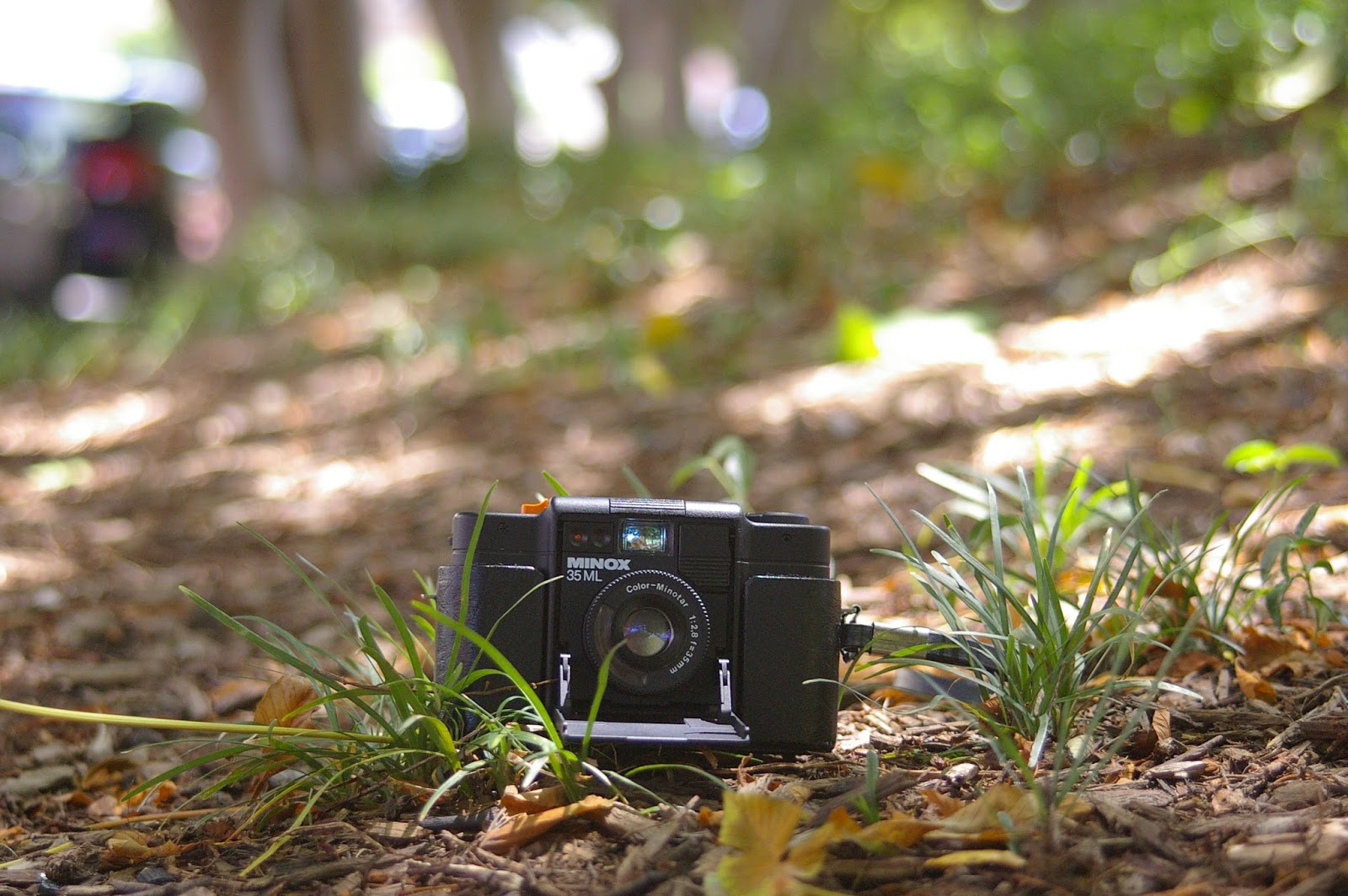
Agent Double-0-Thirty Five: The Minox 35ML

Just yesterday, I posted an article covering one camera that I'd hoped might be a 35mm version of my beloved Bantam, and here, a mere 24 hours later, I'm posting an article on another similar camera, at least when it comes to size, form factor, and country of origin.

Typically I deliberately try to keep my articles staggered.  An SLR camera review isn't followed with another SLR camera review, Rangefinders don't follow other rangefinders, and so forth.  However, in this case, two cameras of a different build type, but both offering some features to make them something of a 35mm Kodak Bantam, have managed to pace behind each other.  

In the case of this review, this similarity comes in the form of the Minox 35ML, a tiny and amazing piece of machinery in 35mm format that, for lack of a better descriptor, is best termed as a modern day compact folding camera. 

While not entirely spy-worthy, the Minox 35ML is an amazingly small device.

The Minox 35ML comes from a photographic icon famous in the photographic community for its smaller "Spy Cameras" utilizing tiny devices to record 8x11mm images on small size film.  The Minox name brings to mind the thrilling world of James Bond movies from the 1960's and 1970's, as a means to discretely take images of documents. These cameras still have a following to this day keeping the medium alive and well.

Less known however are Minox's 35mm offerings, which stay very true to the maker's tendency to create amazingly compact devices with a surprising amount of functionality.  I had never noted the presence of Minox in the sphere of 35mm film photography when I suddenly stumbled upon one for sale at a local Goodwill for a modest $25.  I picked it up and could immediately see what a unique gem of a camera this was.

6.21.2017

Kwentisentially Kompact - Agfa's Karomat 36

For as long as I have successfully been able to use it, I have loved my Kodak Bantam Special 4.5. Its incredibly compact design and intuitive manual controls make it one of the easiest fully manual cameras I have yet to use. Add in that it is a family heirloom and this basic little camera that few employ today in their photo taking regimen sits uniquely as a favorite of mine.  
And while I do like the quirky and unique attributes of the 828 film format, even I can admit that I'm not always eager to cut down 120 film to respool to fit into my small cadre of 828 film cameras. Yet, with no Kodak-made 35mm equivalent to this trim Bantam model, I elected to look about to see if there was an affordable Bantam-like imposter made by anyone. So when this camera showed up on my radar for about $20, I knew I had found a contender for my 35mm Bantam. 

The look of the Agfa Karomat 36 is in some ways simple and elaborate at the same time. 
The Agfa Karomat's structural resemblance to the Bantam is certainly not just coincidence, as both cameras have their origins rooted in compact design practices of the era. With the Bantam, this came in the form of the 828 film, among the smallest of roll film sizes at the time of its introduction in 1938.  With the Karomat, the lineage reaches back to the use of Agfa "Rapid" cartridges, a spool free cassette using 35mm stock that was the basis for some of Agfa's earlier attempts at 35mm.  Coincidentally, Ansco, with which Agfa would collaborate, also used a similar cassette for their Memo box camera.  


6.16.2017

Five Dollar Deal : Canon FTb

Most film camera collectors may dream of hitting a yard sale or thrift store and finding a Leica priced for a nominal $5 or so.  I'm not even a Leica-phile, but would gladly welcome such luck in my sojourns through the various places in my area where I might spot film cameras for sale.

Still, I certainly can't complain.  I've been fortunate to encounter a few very reasonably priced acquisitions at some of my favorite local haunts.  These include the Tower 60, the Ricoh Five·One·Nine, the Olympus OM-2, and the Yashica T2.  Still, while all of these were great pick ups, I think one camera stands out as the most stellar deal that I've ever stumbled across...

Handsomely clad in all-black, the Canon FTb is a well built and handsome model for its time. 

On the way home one evening, I capriciously elected to stop in a Goodwill near me at which I had never previously seen anything film related, save a fixed focus point and shoot... once. My cynicism was obviously high, expecting it to be wasted time and effort, but as the entire effort would take no more than five minutes, it wouldn't be a huge loss.

To my sheer surprise, a pair of SLR cameras (one manual and one auto focus) were haphazardly tossed onto the shelf in the electronics section, both priced at $4.99, having just been placed there judging by the price stickers having been printed and dated on the same day.  I wasted little time in quickly snapping them up and getting in line to pay.

6.15.2017

Point and Shoot Pity Party Part 7 - Nikon Lite Touch Zoom 80

This is Part 7 of a recurring series on basic point and shoot consumer cameras, the details of which can be found here.

It was in the midst of my point and shoot hysteria that I paid a visit to a favorite Goodwill one afternoon, determined to get my hands on nearly anything cheap to try.  The selection today was both good and not so good.  A little over half a dozen point and shoot cameras, most offering autofocus, awaited me, but nothing really jumped out as a unique addition. Not wanting to leave empty-handed, I picked what seemed to be the neatest, and most compact of the lot, and thought I'd give it a try. . 


Name: Nikon Lite Touch Zoom 80
Format: 35mm
Type: Autofocus Compact Camera
Year: 1998
Features: Infinity Focus Mode, Auto Slow Speed Flash Mode, Force Flash on and Off, Red Eye Reduction, Self Timer, Early Rewind Button, Panorama Mode.
Lens: 38-80mm asperhical Macro Zoom, f/5.0-9.6, 5 elements in 5 groups.  
Battery: 1 x CR-123 cell.
Manual: http://cdn-10.nikon-cdn.com/pdf/manuals/archive/LiteTouch%20Zoom%2080%20-%20LiteTouchZoom%2080%20QD.pdf

6.14.2017

Glee with Gadgets Pentax ME Super Dial Data Back

I'm not a photographer.  Though I may occasionally use my "Spidey Senses" and put forth some wonderful results, I'm not a 100% true, dyed in the changing bag cloth, "photographer."

I'd best describe my make up as one part photographer, one part history buff, one part collector, and one part "gear head."  The result is a quirky guy who likes using multiple classic old cameras to take photos.

The "gear head" aspect of this takes me down a geeky path where I find myself drawn to things that some other true photographers could care less about.  I might pay attention in particular to something as relevant as the intuitive nature of a viewfinder, but then also put an extra level of attention to the typefaces used in that viewfinder.

As I'm also a "data nerd" of sorts, I find that I like to know and keep track of things such as dates or exposure data at times, and have often looked at specific camera models that can accomplish the data recording in particular.  So when I discovered that a model for which I'd already developed a great fondness actually had such a capability, I simply had to give it a try.

And this is the story behind how I acquired a Pentax Dial Data Back ME.


The "Dial Data ME" back works by manually setting the three dials to the desired values to print, or to null values to disable printing.


6.13.2017

The Box Camera Baby: The Agfa-Cadet A-8

Surprises can be a very good thing, particularly when they fill an unmet need or want.

I had just won one of those "bulk" camera ebay auctions which somehow closed for surprisingly less than I'd have expected.  In fact, I considered by bid to be a mercy bid that would soon be sniped as the auction drew to a close.  Perhaps I had a little luck on my side, or perhaps traffic was light on this afternoon before a three day weekend, but I now had a motley collection of about 8 cameras that also included the Ansco Goodwin, Rolls, and the Pickwik.

As I surveyed my surprising win, I could see that one of the cameras headed my way would be a more modern Agfa box camera with a lot of patina on its face plate.  Doing a quick look about online, I spotted a very similar looking Agfa-Box B2 camera, and presumed this was what would be in that package on delivery day.

So the true surprise came upon opening the box and discovering the tiniest of box cameras awaiting me.  I had become the unexpected owner of an Agfa-Cadet A-8 camera, a true box camera for 127 film!


Pictures do lie. This seemingly imposing brute of a box camera is likely smaller than the box your last mobile phone was packaged in. 

This adorable little box camera dates from about 1940, and is a bit of an update over previous versions of this camera with a more ordinary leather front.  This model has a metal front with a more Art Deco style to it, with geometric lines inside of the box case and outside of the lens opening, all punctuated by the diamond "Agfa" script logo.  Atop the camera, which measures roughly 3" x 5" x 7", is a leather carrying handle.   


6.12.2017

Spell it Out: The Ricoh Five·One·Nine

Camera model designations are a curious mix.  There are numbers, combinations of letters, names, and amalgams of any and all of these.  There is also the occasional camera model that actually spells out a single digit number, such as the Olympus Six.  However, I've never seen any other camera model that spells out a multi-digit number than the handsomeness that is the Ricoh Five·One·Nine.

Adorned with a lovely script face for it's logo, this camera has one of the more unusual model names among cameras, and is said just how it is written.  This is not a "Ricoh Five-Nineteen."

6.08.2017

Overshadowed Overachiever: The Minolta Maxxum 5

A few months ago, I waxed poetic about an oft-overlooked Minolta camera model, remarking of its many charms, and insisting that it was a great sleeper find that was overlooked due to all of the attention of its slightly more capable siblings that hog the spotlight.

Well, prepare yourself for more of that.


Like a Hollywood reboot brought 30 years forward from its original setting, I'm once again here to espouse the virtues of an oft-overlooked Minolta camera model that I feel to be a phenomenal bargain in the marketplace today.  


To those of us either discovering or re-discovering film, the myriad of Minolta Maxxum models and their generational successions can be a daunting learning curve.  However, the one most novel standout from the procession of about 15 years of Minolta "Maxxum" film SLR models is the Minolta Maxxum (Dynax) 7, an amazing machine that uses an intuitive LCD display on the back to display settings.  It is a film camera that can easily be mistaken for a DSLR, and regularly fetches upwards of $100 on the used market.  It has, to this date, retained a certain degree of cult status that is only reinforced by the scarcity and price in the used market.


But for a mere fraction of the price of a Minolta Maxxum 7, a comprehensively featured alternative in this same line up can be readily found in working condition: a light weight camera excellently suited for advanced film photography on a budget. This my friends, is the Minolta Maxxum 5.


Unlike the dated look of many Maxxum line cameras of the 1980's and 1990's , the 2000 vintage Maxxum 5 presents a fairly contemporary look in comparison.

6.06.2017

Instamadness: The Ricoh 126C Flex

The morning of May 26, 2017 dawned in Frederick with a surprising amount of sunshine compared to the days which had proceeded it. Today was my mother's birthday, and I'd been busy preparing late the evening prior.  There would be no festive celebration, but instead remembrance.

Today would have been my mother's 81st birthday.  She passed away in the beginning of May 2014 just a few weeks shy of her 78th birthday.  The last three advents of May the 26th had been challenging to say the least, but this year, I had elected to spend it a bit differently.  At nearly the last minute, I'd elected to begin a new tradition of sorts,

My mother enjoyed photography in much the same way as I do,  But while I've always enjoyed approaching photography from new angles, armed with a varied plethora of different photographic devices, she remained fiercely loyal to a single photographic companion - her Kodak Instamatic X-35.

Nearly all of the photographic memories of my childhood were taken through the lens of this basic camera, and while I never recall seeing any photos from this camera that stun me with magnificent sharpness or phenomenal bokeh, the small plastic camera did its job of recording family memories for decades.  My mother's loyalty to this camera was so great that she simply stopped taking photos when the availability of 126 film in local stores dried up in the mid-1990's, despite me getting her what I thought was a perfectly suitable easy-loading Pentax replacement in 35mm format.

A few days prior to the advent of this day, I had been browsing about a few camera articles online when I happened upon a site that detailed some of the more "up-market" offerings in the 126 format, and within a few days, had elected to give one of the cameras featured on this page a try.  My "Why not?" moment for 126 was soon answered by the Ricoh 126C-Flex.


The 126-C Flex seems to be a marriage of parts from the TLS lineup of 35mm SLR cameras and the earlier Ricohflex 35 leaf shutter SLR cameras.  The 55mm f/2.8 lens seems to be the same as that on the Ricohflex, and provides a mild portrait/telephoto perspective for the smaller 126 format.