Showing posts with label Ilford Delta 100. Show all posts

6.28.2017

Lemonade from a Lemon: The Mamiya Auto-Lux 35

At what point is a vintage camera review no longer a review?  Perhaps when your main objective is simply trying to get an image under when the camera you have in hand has only a fraction of its functionality.  I would say the following qualifies...

The Middletown Goodwill used to be such a treat.  It seemed as though each visit to this location always brought me a cheap and fun new toy with which to play.  I've gotten a number of lenses from this store, some nice sub $5 point and shoot cameras such as the Samsung Maxima Zoom 105, and even the Mamiya MSX-500.  

In hindsight, it's easy to think I had a perfect string of luck with my cheap scores at this location, but this isn't quite the case.  Even the all-star Home Run Derby hitter eventually lands short of the outfield wall.  Such was the case with this interesting piece.  

It looks like an SLR, and in fact it is an SLR, but not quite in the way that most people tend to think. 

Priced at about $8, and seemingly working at first glance, this seemed like a unique piece to add to the stable.  I had never heard of this model, and never expected to see one available in person again, so it seemed like an easy decision to snap it up while the opportunity existed. 

Mamiya's 1963 vintage Auto-Lux 35 is a camera that looks like an SLR, and feels much like the SLR cameras so many photographers know.  This is because it technically IS an SLR camera. But it has a few modifiers that make it a bit of a downgrade from even the more basic cameras in the SLR camp.

6.22.2017

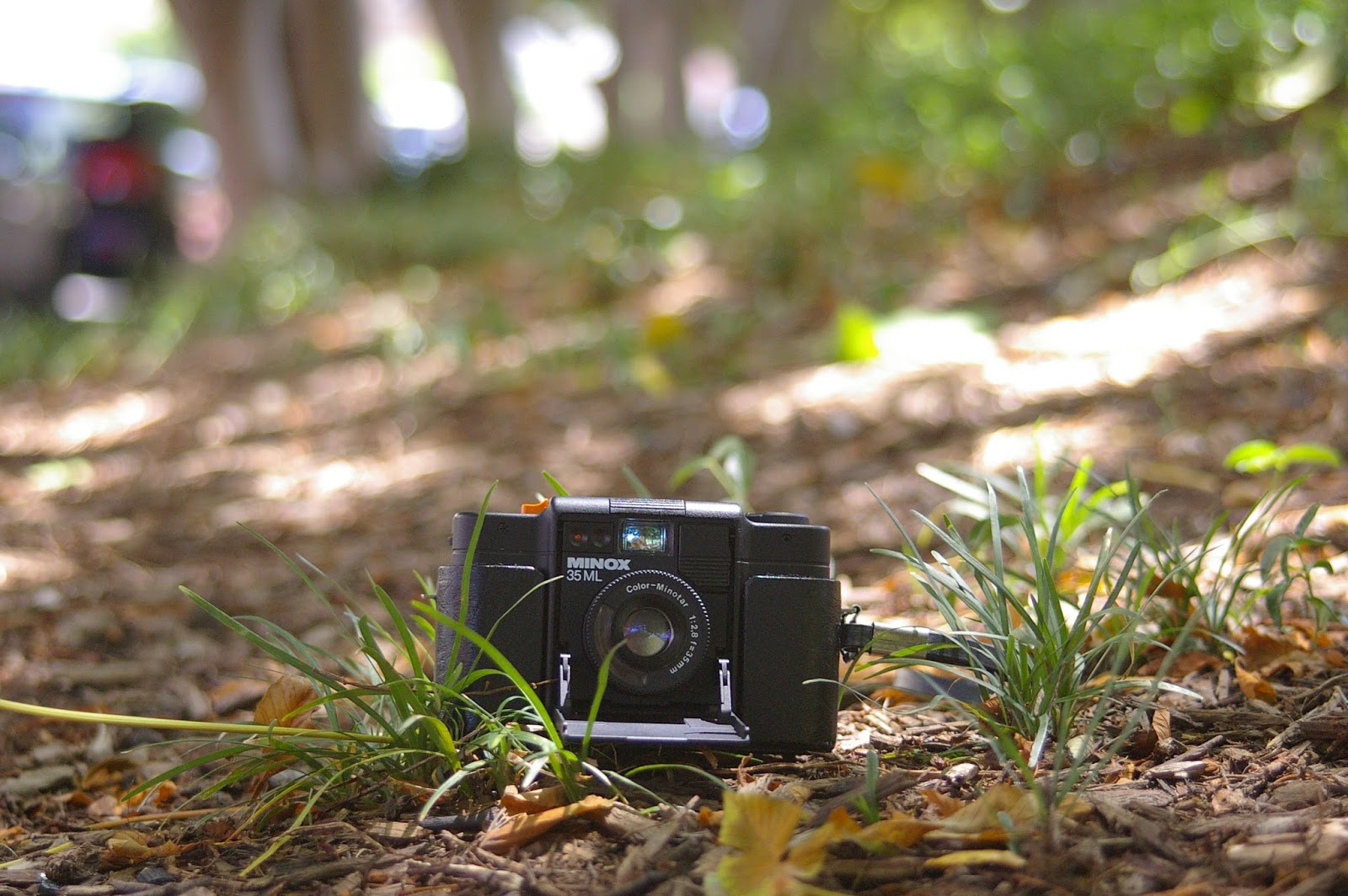
Agent Double-0-Thirty Five: The Minox 35ML

Just yesterday, I posted an article covering one camera that I'd hoped might be a 35mm version of my beloved Bantam, and here, a mere 24 hours later, I'm posting an article on another similar camera, at least when it comes to size, form factor, and country of origin.

Typically I deliberately try to keep my articles staggered.  An SLR camera review isn't followed with another SLR camera review, Rangefinders don't follow other rangefinders, and so forth.  However, in this case, two cameras of a different build type, but both offering some features to make them something of a 35mm Kodak Bantam, have managed to pace behind each other.  

In the case of this review, this similarity comes in the form of the Minox 35ML, a tiny and amazing piece of machinery in 35mm format that, for lack of a better descriptor, is best termed as a modern day compact folding camera. 

While not entirely spy-worthy, the Minox 35ML is an amazingly small device.

The Minox 35ML comes from a photographic icon famous in the photographic community for its smaller "Spy Cameras" utilizing tiny devices to record 8x11mm images on small size film.  The Minox name brings to mind the thrilling world of James Bond movies from the 1960's and 1970's, as a means to discretely take images of documents. These cameras still have a following to this day keeping the medium alive and well.

Less known however are Minox's 35mm offerings, which stay very true to the maker's tendency to create amazingly compact devices with a surprising amount of functionality.  I had never noted the presence of Minox in the sphere of 35mm film photography when I suddenly stumbled upon one for sale at a local Goodwill for a modest $25.  I picked it up and could immediately see what a unique gem of a camera this was.

6.08.2017

Overshadowed Overachiever: The Minolta Maxxum 5

A few months ago, I waxed poetic about an oft-overlooked Minolta camera model, remarking of its many charms, and insisting that it was a great sleeper find that was overlooked due to all of the attention of its slightly more capable siblings that hog the spotlight.

Well, prepare yourself for more of that.


Like a Hollywood reboot brought 30 years forward from its original setting, I'm once again here to espouse the virtues of an oft-overlooked Minolta camera model that I feel to be a phenomenal bargain in the marketplace today.  


To those of us either discovering or re-discovering film, the myriad of Minolta Maxxum models and their generational successions can be a daunting learning curve.  However, the one most novel standout from the procession of about 15 years of Minolta "Maxxum" film SLR models is the Minolta Maxxum (Dynax) 7, an amazing machine that uses an intuitive LCD display on the back to display settings.  It is a film camera that can easily be mistaken for a DSLR, and regularly fetches upwards of $100 on the used market.  It has, to this date, retained a certain degree of cult status that is only reinforced by the scarcity and price in the used market.


But for a mere fraction of the price of a Minolta Maxxum 7, a comprehensively featured alternative in this same line up can be readily found in working condition: a light weight camera excellently suited for advanced film photography on a budget. This my friends, is the Minolta Maxxum 5.


Unlike the dated look of many Maxxum line cameras of the 1980's and 1990's , the 2000 vintage Maxxum 5 presents a fairly contemporary look in comparison.

3.20.2017

Innocuous and Impressive: The Konica I

The hobby of film photography on classic cameras is a road often fraught with perils and temptations, particularly when it comes to resisting expensive items with prestigious name plates.  Fortunately, my budget and sensibilities are right about in line with each other to keep this in check for the most part, leaving me to stay with more affordable cameras and options, rather than to splurge on fancy models such as those that begin with "L" and end in "ica."

However, the form factor of an early Leica is certainly intriguing, and has often been mimicked by other makers, particular in the 1950's and 1960's.  I found a stellar buy back in the Summer of 2016, in which I found a camera with the Leica form factor and which also ended in "ica" but started with "K" rather than "L."  And with a $22 splurge, I elected to become the owner of a Konica I Rangefinder!

The classic rangefinder look is handily accomplished by the Konica I, seen here in its "collapsed" state.

While the 1948 vintage Konica I is hardly a candidate for a complete doppelganger for a Leica, it certainly bears a favorable resemblance to early model 35mm cameras of Ernst Leitz.  It has a collapsible lens that gives it a very compact form factor when folded up, and a nicely polished set of finishes that evoke a very stately look.  Pulling out the compact Konica I, extending the lens barrel, and then getting a photo feels very satisfying photographically.


3.14.2017

Solida Success! Sorta!

A few years ago, I had the odd (OK, well now typical for me) fortune of having a mercy camera pick-up that I shot with only half-hearted interest, only to have it pleasantly surprise me with its image results.  That camera was none other than the 6x6 folder known as the Franka Solida.  

Of course, as soon as I became more enamored of this camera and its Schneider Radionar lens, the shutter began to get particularly flaky.  It hit the point where I developed a love-hate relationship with the Solida, in which each roll would prove a major pain to shoot, but the good shots from the roll mostly made up for this headache of a camera.  

I kept my eyes open for another cheap Solida with the same specs, particularly the f/2.9 lens.  By the dawn of 2016, I had found one, and elected to more or less retire the cantankerous Solida to focus upon its sibling, whom I'd christened as my "Solida 2.0."  

One roll in this replacement camera and my thoughts began to change.  This Solida seemed to not only suffer from some lens fungus, but it didn't seem to render with any sort of pleasing tonality. Even worse was that the focusing distances didn't seem to match up to the rendering of the lens, indicating a need for a lens collimation. Finally, the film rollers tracked muck onto the film surface, resulting in gritty lines across some exposures.  

While some of its issues could be addressed, this Solida was not one that I was quite ready to putz with.  I briefly considered if I could transfer the lens from the original Solida to the "2.0" version, but the camera essentially sat next to the other one for the better part of a year.

And then a few months ago, I just happened to stumble upon this in a nearby antique store, priced at a very modest $25.  


12.06.2016

Univexed Again! The AF-5, a Jewel of a Camera!

It was a depression era story of the likes of David and Goliath in which a small upstart business with no previous experience in an industry emerges upon the scene to create a surprising splash, selling thousands upon thousands of units and puts forth impressive competition to the industry giant.

And nearly as soon as it ascended, one big logistical decision would lead to its rapid decline.

It is the story of Universal camera, documented in print as well as online.  Had its momentum not been upended by global conflict that cut off its supply line, it is anyone's guess as to how history would have played out for this once popular brand.

The "Univex" AF line was in many ways the bread and butter of the company, debuting in 1935 and bringing low acquisition cost and extreme portability to the masses.  Initially costing under a dollar, successive models that added improvements resulted in modest price increases over the following years, but these value priced cameras were merely a gateway to sell film and developing on Universal's "00" size film, the real cash cow of the operation.  Thousands of these cameras were made and sold, and within a few short years, Eastman Kodak had some serious competition to their value market from Universal folks, whose AF line had sold over a million cameras by the late 1930's.


Add in escalating conflict in Europe and this competition came to an abrupt halt.  Gevaert in Belgium, supplier of the film for the Univex lost their trade lines to the west as World War II began taking shape, resulting in a sharp dip in sales of both cameras and film.  By the time the connection was restored, the damage had been done and the "00" format faded away from view by the early 1950's.

As a result, perhaps more than any other single camera model aside from the 116 format Kodak Vest Pocket 1A, the Univex AF may hold the distinction as the most common camera model seen today for which film in its format can not be reasonably acquired.

Today, the five models of the AF line are coveted by many camera collectors who enjoy their art deco styling and miniature footprint.  But it seems that these sleek little cameras are too often relegated to being display items partially as a result of the film availability issue.  Go ahead and try to "Google" for images taken with a Univex AF camera model.  I have the feeling you'll come away empty-handed.  I know I had no luck at all.  There is no Flicker group for shooters of Univex AF cameras, and no Lomography feature page.


Big camera, small footprint in what the gilded box states as being a "jewel of a camera." Univex AF cameras were all simple and cost effective folding cameras that emphasized portability.  Folded down, a Univex AF model camera carries a very modest footprint, as can be seen when compared to other relational items in scale. 


7.28.2016

Square Shooter - Part II - Shooting 24mm shots on the Bantam RF

I have a tendency to like to interject idioms or expressions into my postings, and in this case, I feel the need to do a common intro theme to what is a natural pair of postings with the following theme: An Opportunity Lost is An Opportunity Gained.

Most hobby photographers (and many pros) are often well aware of the phenomenon known as GAS, or "Gear Acquisition Syndrome."  It's a tendency to want to constantly add to your inventory of photographic items, either with new cameras, new lenses, or even new accessories.  Even on a greatly reduced budget such as mine, there are cheap opportunities to add to one's collection.

When I first saw results on Lance Rothstein's "labeauratoire"site from the square format 35mm shooter known as the Minolta 24 Rapid, I had a lot of interest in picking one up when the opportunity might present itself.  However, due to some reluctance after a few too many bad rangefinder acquisitions, I dragged my feet when a cheap example popped up for sale, and someone else beat me to it.

Perusing the interwebs for other possibilities, I came across a striking suggestion to MAKE a square format camera from an 828 body.  As a huge fan of 828, the idea certainly struck a chord with me, and with some help from my buddy Mark at the Gas House, I managed to install a pair of varied mods to make this interesting idea a reality.  Each of these concepts has some uniqueness, and both have some advantages over the other. 

Have a look at this "creation" of a square shooter.


While it seems as though I've been shooting 828 cameras forever, the reality is that I've only been creating decent images from them for about 6 months.  Still, I've shot a decent amount in this 28x40mm format.  And while the film is no longer commercially produced, I'd yet to use the most common method to improvise 828 film, namely to tape 35mm film to an 828 backing, instead electing to mostly use cut down 120 stock, supplemented at times by expired "true" 828 stock.


4.15.2016

Bantam Bridgade: The Prince (Bantam RF) and the Pauper (Bantam f/8)

Every once in a while, good deeds are met with unexpected and unsolicited rewards.

I'd been collaborating with fellow collector/shooter/web documenter Mike Eckman to whom I'd sent some surplus and cut down 828 film, and who knew me as quite the 828 format enthusiast. I'd raved in great length about how much I had come to love my Bantam and similar Bantam Flash camera, mostly with the interest of encouraging him to make use of an 828 camera he had picked up a while back, and secondarily, encouraging him when he considered adding a very affordable addition to his 828 collection.

Still, imagine my surprise when he told me "Keep an eye out, as I have a package I'm mailing to you."  I didn't know what to expect, and thought maybe he'd stumbled upon a stock pile of 828 spools to enable more cut downs.  Well, indeed he had stumbled upon some spools that he was sending to me.  And to keep those spools safe, he enclosed them within A PAIR of Bantam cameras he had recently acquired, both for about a dollar.  He simply asked me to hang onto the spools in case he wanted more created 828 film sent to him, but that the cameras were mine.  And with that, I now had a Bantam Brigade at my disposal.