Showing posts with label Portfolio. Show all posts

7.04.2017

As American as the Fourth of July: The Kodak Instamatic 704 and 804

"You know, we once made stuff here."

It's a common refrain still prevalent among older Americans, and is something that can be particularly difficult for a larger percentage of our population to relate.  I tend to consider myself as one who can occasionally forget the significance that the U.S. once held in the manufacturing world as I type away today on my Chinese made computer, uploading some digital photos taken on a camera made in the Philippines, embellished with a Japanese made lens, and adding scans of film shots done on an Indonesian made scanner. 

Yes, the United States once had a robust manufacturing sector, which certainly extended to the world of photography, with names like Kodak, Argus, Detrola, Revere, Falcon, Ansco, Polaroid, Bolsey, Universal, and others all competing head to head in a crowded marketplace for the photographer's dollar.

So what was the most American camera model of all-time?  Some might say the ubiquitous Argus C3, a classic example of a well built camera that remained nearly unchanged for a production run spanning 3 decades.  Others could opine for any of the Polaroid Land Camera models as being stellar examples of American ingenuity.  Still others might pick a wild card like the Bolsey B2 as a classic example of an immigrant landing in this country and setting forth to accomplish his dreams in a new country.  And for the curious, there is certainly the story of the Univex cameras resulting from a pair of capitalists putting their minds and resources together in the midst of the Great Depression.

My answer for the most "American" camera of all time uses much more simplistic logic. There is no holiday more American than Independence Day, often simply known as the "Fourth of July."  So is there a camera out there that is as American as July 4th?!? I'm not sure there could exist a camera as American as Independence Day as this one...

All this camera needs is some deep blue leather on the front and some white stars and it would be the ultimate "American" camera.

The Kodak Instamatic 704, along with its upmarket sibling: the 804, represent some of the finest American camera craftsmanship out there.  These sturdy 126 format cameras, produced between 1965 and 1969 are a particularly endearing pair of photo taking partners with complementary red and blue emblems that truly portray a patriotic air to them.

5.09.2017

Fun with Film: Cross Processed Ektachrome Elite 100

What two things will make me cross process slide film?  Well...
  • Slide film that is expired and that I worry won't process accurately, and
  • A mixed set of C-41 compatible chemistry from which I've gotten my desired rolls of color negative film developed. 
In these instances, the cost of running a roll of slide film through and processing it in the existing chemistry is really only a matter of one's time, and doesn't involve a financial outlay, so it's like the frosting on the cake.  

I had a 10 year old roll of Ektachrome Elite 100 that I put through my Ricoh 520M and dunked in the Unicolor chemistry.  Though it took a bit of trial and error to scan the results to a nice result, I managed to get some very vivid end products from this experimentation, that you can view below:

The rendition from this shot is reasonably close to life, aside from some pastel hues in the cooler end of the spectrum.

12.02.2016

Film Fun Folio #28: Kodak Autographic 1A and Long Expired Kodak Verichrome

Periodically, I'll be posting scans of some complete rolls of film on here, showing both the good and the bad, and giving some basic information as well a little write up of the shoot as well as the reasons why I selected each camera and film.  Enjoy the trip! 

Feature #28:
Camera: ca. 1929 Kodak Autographic 1A with Kodak f/7.9 lens.
Film: 1954 vintage Kodak Verichrome (orthochromatic version)
Locale: Frederick and Sharpsburg, MD

I've sort of taken my "Autographic Experiments" with the Kodak 1A and upped the ante with this roll.  I realized that I greatly enjoyed shooting the 1A as the 116 format camera that it was designed to be, and wanted to try it again.  At the same time, I had been challenged to try again with true "old school" ortho film that is more in line with the type of film used in these cameras in their heyday.  Since I'd not too long before gotten into developing my own black and white negatives, and since I had a tank and reel that could accommodate 116 format, I elected to give it ta try.  Below are the results.  

I developed this long developed film in a "cold brew" of HC-110 at a rather high concentration of about 1 part direct developing solution with 9 parts water, refrigerated for about 45 minutes before developing, and developed for about 9 minutes of nearly constant agitation.  The results rather pleasantly surprised me, as some show effects that would be largely impossible to replicate from a digital starting point. 


I started this roll with a shot taken in early Spring of a stone bridge near Boonsboro, MD.  As this was the outermost exposure on the roll, it suffered from the highest degree of fogging over the 60 years it sat dormant, but there is certainly a discernible result that gives off a wildly vintage feel.

11.29.2016

Superb Reflex Twice: The Minolta SR-T 101 - A Gallery

I just expended time, effort, and brain cells (Ok, that last part may be debatable) to reason why an SR-T 200 is for all intents and purposes, just as usable as an SR-T 101, and then I seem to contradict myself with this posting showing images taken with that very camera.  Am I that much a hypocrite?

In actuality, I'm proving my own point.  The following images were shot with an SR-T 101, and upon reviewing them, I can readily attest that every one of them would have been just as easy to have captured on the SR-T 200.  And I can speak of this having shot both models of camera.

So how did I wind up with an SR-T 101 after making the case for the underdog camera that is the 200?  It's simple really.  The lens.  I spotted this camera for a bargain price with a Minolta Rokkor 28mm wide angle lens attached, so it seemed like a perfect pickup, and it was.  It's a great camera, but so is the model 200 in nearly every way.

Since both the 101 and 200 model will meter down as low as ASA 6, this seemed the perfect chance to shoot another roll of Mr. Brown LOW ISO film on a week in mid-November.  Yet again, this film is increasingly showing itself as a great medium that allows some great strengths: namely limited depth of field photos as well as daytime time exposures!  The following shots were taken with both the 45mm and 28mm lenses and made for a great time out shooting.  Enjoy! 

First shot taken with the both the SR-T 101 and with the 28mm lens in late afternoon light.  I'd forgotten how easy it is to accidentally "appear" in your pictures with wide angle lenses.  I guess this shot is sort of like that first "tester pancake."

7.29.2016

Film Fun Folio #27: Kodak Bantam Flash and Rollei Infrared 400

Periodically, I'll be posting scans of some complete rolls of film on here, showing both the good and the bad, and giving some basic information as well a little write up of the shoot as well as the reasons why I selected each camera and film.  Enjoy the trip! 

Feature #27:
Camera: ca. 1948 Kodak Bantam Flash with 48mm/f4.5 Anastar Lens.
Film: Rollei 400 Infrared
Locale: Frederick, MD.
First, let me be perfectly clear, Rollei does NOT make it's Infrared film in 828 format, but thanks to my methods, I quickly made a roll of 828 stock from a roll of 120 stock and dark loaded it into the Bantam Flash.  I took a first shot as Spring blossomed, and then the camera and film just sat, week after week, seeing no action whatsoever, until I just so happened to bring it along on a lovely day, and had about 20 spare minutes to shoot it in one shot as I strolled near Baker Park in Downtown Frederick.  Nearly all of the shots were tripod taken under an approximate EI of 12, which in this case meant a typical shutter speed of 1/50, and an aperture of f/8, (or 1/25 with an f/11 aperture) which as it turns out was usually decent enough to get a workable shot while holding the R72 over the lens.  


I hadn't quite worked out my filter holding method for this first shot. 

5.16.2016

Film Fun Folio #26: Franka Solida (2.0) and Rollei RPX 25

Periodically, I'll be posting scans of some complete rolls of film on here, showing both the good and the bad, and giving some basic information as well a little write up of the shoot as well as the reasons why I selected each camera and film.  Enjoy the trip! 

Feature #26:
Camera: ca. 1952 Franka Solida II with Schneider Radionar 75mm f/2.9 lens.
Film: Rollei RPX 25
Locale: Central Maryland and nearby.

Though the camera is called a Franka Solida II, I'm calling this camera a Franka Solida 2.0, as it is a replacement for my original unbadged Franka that I got in late 2014.  The original gave great results, but had a extremely fidgety shutter whose stickiness resulted in far too many lost shots.  I had a replacement on my radar for months, and finally found one with the same Schneider Radionar lens in January.  The shutter works great, though the lens shows some signs of internal fungus.  I elected to give it an initial try before seeking to remedy the issue on this camera (or trying to switch lenses) and here are the results. 


1 - Frederick, MD - f/2.9, 1/25 - Looking like some sort of photo taken on an Arctic expedition a century ago, I can't speak of what didn't quite go as expected with this image. 

4.22.2016

Film Fun Folio #25: Seagull 4A103 and Expired Agfa Ultra 50

Periodically, I'll be posting scans of some complete rolls of film on here, showing both the good and the bad, and giving some basic information as well a little write up of the shoot as well as the reasons why I selected each camera and film.  Enjoy the trip! 

Feature #25:
Camera: ca. 1992 Seagull 4A-103 TLR Camera.
Film: Agfa Ultra 50 (expired 2002)
Locale: Central Maryland and Washington DC.

Color negative films really are not my thing.  Compared to color transparencies, I find their rendition to generally be quite anemic, their white balance often looking a touch sickly, and their contrast level just unrealistic compared to the dynamic world at large.

Getting back into film, I had read people posting comments online referring to Kodak Ektar 100 as "the Fuji Velvia of Color Negative Films." Well, my friends, I have tried many rolls of Ektar and while it is certainly nicer than the Kodak Gold of olden days, it certainly seems a far cry from Velvia.  

But there WAS a print film worthy of that splashy moniker, and it was not made by Kodak, nor was it even made by Fuji.  This film was a product of none other than Agfa, named "Ultra 50" and it was an incredible product.  It, along with its less saturated sibling "Portrait 160," constituted the only color negative films that I ever loved.

Sadly, Ultra 50 is no longer made, but its dwindling expired stocks can still be acquired at a rather sizable premium.  I recently elected to snag a roll of 120 stock that had expired in 2002, and elected to see if it was still any good.  I loaded it into my long-owned Seagull (which almost certainly saw a roll or two of this film decades ago) and rated most of the shots at about ISO 25 to account for expected loss in sensitivity.  Still I worried about how the color in this vivid film might portray after all this time.


Well, let's just say the old film still has that special something.  See for yourself!

1 - Washington, DC - f/4 - 1/300 - I elected to do a little bit of deliberately shallow depth of field on some of the shots since I had a TLR to assist in focusing, and the results were generally pleasing.  What is really pleasing is the color rendition on the Ultra 50! 

4.08.2016

Film Fun Folio #24: Balda Lisette and Efke 50R

Periodically, I'll be posting scans of some complete rolls of film on here, showing both the good and the bad, and giving some basic information as well a little write up of the shoot as well as the reasons why I selected each camera and film.  Enjoy the trip! 

Feature #22:
Camera: ca. 1938 Balda Lisette 645 with Meyer Trioplan 75mm f/2.9 lens.
Film: Efke 50R (Recently Expired)
Locale: Central Maryland and Washington DC.

Winter doldrums are never fun, and for me, they have tended to send any camera I own into a state of hibernation.  This year, however, with a new setting around me, I vowed to keep the shutters clicking as the days grew shorter, the temps got colder, and the palette grew increasingly more bland. 

Fortunately, I'd seen a lot of good black and white work online that became an inspiration for me to try to get the most from a medium that I too often downplayed.  It had been a while since I'd played with the creamy tones of Efke's 50R film so I loaded a roll in my pretty reliable little Lisette and shot through it over a period of weeks.  A few frames into the roll, I decided that I would do something offbeat and try and shoot the entire remainder of the roll wide open at f/2.9, trying to take full advantage of the Trioplan's fast lens and interesting bokeh. Doing this on a "guess focus" camera was quite risky, but I hoped for the best as I made my way through the roll. 


In addition, I decided to "tone" the results in an online photo editor, since I felt the originals were just a bit too bland.  I tried not to overdo it, and I think in that regard I did well, though the results are likely to be subjective.  


Washington, DC - One of my favorite classic signs in the Nation's Capitol for photos only comes out so-so in this image that is contrasty and uninspiring.

3.25.2016

Film Fun Folio #23 - Balda HaPo 10 and (LONG!) Expired Verichrome Pan

Periodically, I'll be posting scans of some complete rolls of film on here, showing both the good and the bad, and giving some basic information as well a little write up of the shoot as well as the reasons why I selected each camera and film.  Enjoy the trip! 

Feature #23:
Camera: ca. 1938 Balda Hapo 10 with 105mm Steinheil Munchen f/3.8 lens.
Film: Kodak Verichrome Pan (Expired 1962)
Locale: Central Maryland and Washington DC.

It's always the ones you have the highest hopes for that let you down.  When I pulled the trigger on the Hapo 10, enamored with its looks, I hoped this would be a great addition to my 6x9 cameras.  I ultimately was underwhelmed after three rolls of film through this camera failed to really give much in the way of good results.

However, after experiments using old Verichrome Pan gave me surprisingly good, if somewhat vintage looking results, I thought it might be time to give the old Hapo one more try.  It's slow performing shutter seemed a good fit for a long expired film that needed over exposure.  I hoped I could get at least a suitable result or two from this old camera that had been sitting for nearly a year, or at least I could play on the seeming flaws of the Hapo and create a roll of very distressed shots done just for fun.  

The first two shots were immediately blown, to no fault of the Hapo.  When I loaded up the film, I should have done an initial re-taping of this 50 year old film to its backing paper in the dark prior to loading. Sure enough the tightly curled film separated from the backing and as a result, I lost the first exposures.  I could only hope the remaining six chances were enough to get something good from this pretty, but pretty disappointing camera.  Note: Keep in mind the "settings" here are what was on the camera, but this camera is known to have a slow shutter, so they are likely to be about half as fast as what is indicated for these images.  

A---------------------------------------B--------------------------------------------C---------------D
3 - Monrovia, MD - f/4.5, 1/100 -  Interestingly, what would pretty much turn out to be the most disappointing shot on the roll would also serve as the most informative,  I should have really backed further up to get this ramshackle old house along the road, for a better result, but looking at the image, something is apparent: the area between B and C above is fairly sharp, while the areas outside of this tend to be blurred.  I had never noticed this tendency before on previous rolls, and by sheer coincidence, the rest of the roll would tend to have its subjects in this area of the frame.  


3.11.2016

Film Fun Folio #22 - Zeiss Ikonta 521 and Cross Processed Agfa CR 200

Periodically, I'll be posting scans of some complete rolls of film on here, showing both the good and the bad, and giving some basic information as well a little write up of the shoot as well as the reasons why I selected each camera and film.  Enjoy the trip! 

Feature #22:
Camera: ca. 1946 Zeiss Ikonta 521 with Novar f/3.5 lens.
Film: Agfa CR 200 (Cross Processed in C41)
Locale: Central Maryland.

Amid a very busy shooting session in the Fall of 2015 in Frederick County, Maryland, I ran through my rolls a bit more rapidly than originally anticipated.  I'd brought along a few spare rolls as insurance, and I hastily elected to use this roll of CR200 to get a few more exposures.  In hindsight, I'd have more likely elected to use one of the many rolls of Velvia 100F I had on hand rather than my only roll of CR200, but this allowed a good chance to get another look at this unique film.  The frugal part of me would have felt better eeking out 12 or 16 exposures from this roll rather than the 8 possible using a 6x9 camera, but this allowed me a fun chance to see the capabilities of this film in a range of daylight situations.


When it came time to process the film, I elected to cross-process it, mainly because I had read good things about cross processing this film compared to more disparaging things about developing it in E-6.  I guess it was time for me to see what the fuss was about.  


1 - Braddock Heights, MD - f/11, 1/250 - The first shot is sharp enough, but man is it golden in hue.  I don't hate it, but it didn't quite have the fun vibe from the offset that my first cross processed roll had going for it.

2.26.2016

Film Fun Folio #21 - Agfa Billy Record and Rollei Retro 80S

Periodically, I'll be posting scans of some complete rolls of film on here, showing both the good and the bad, and giving some basic information as well a little write up of the shoot as well as the reasons why I selected each camera and film.  Enjoy the trip! 

Feature #21:
Camera: ca. 1951 Agfa Billy Record I with Agnar 75mm/f 6.3 lens.
Film: Agfa Rollei Retro 80S 
Locale: Frederick County, Maryland.

Since the day I first used it, the basic Agfa Billy has been all but asking to be taken seriously in spite of its very limited shutter speeds, and its slow and basic lens.  It's a well working and easy camera to use, but in retrospect, it has often been overlooked as a serious image maker for other cameras in my repertoire.  As a result, it has seen decent usage, but its most recent "assignments" have been more for novelty photography, such as with long expired film or as a test bed for cross processing of slide film.  

In these experiments, I had been pleasantly surprised by the quality of the images put forth by the less than revered Agnar lens.  Thus, I elected to approach this roll of my much liked Retro 80S film with a more serious tone.  All shots were exposed at an EI of about 50 and all are taken within an aperture stop of one stop from wide open.  And this marks one of the few times when I actually load one of these old cameras with film that has a common brand with it, as Rollei film carries the same Agfa diamonds as this camera.  

Though sent off with 7 rolls of color 120 slide film of colorful fall scenes for developing, I was extremely eager to see the results from this roll taken on black and white.  My findings are below.


1 - Catoctin Furnace, MD - f/8, 1/50 - I struggled for a good perspective from which to shoot this old iron furnace.  Foliage just didn't seem to fall in the most photogenic places.  The result above is OK, but doesn't quite hit the mark. 


2.19.2016

An Autographic Experiment - Part 3 - Using 116 Film in a 116 Camera

My love affair with my Autographic 1A had seemed to have plateaued.  Once envisioned as a cheap (only $7.19) camera that would enable me to shoot occasional "supersized" landscape photos on 120 film, my actual results, initially promising, were getting progressively worse, and after another set of washed out results in Film Fun Folio #19, I had begun to question whether I needed to simply relegate this elegant old camera to a shelf display.  Besides, if I wanted large transparencies, the smaller 1A paled in comparison to the 3A to provide such goodies. 

But being the master of last chances that I am, I gave the venerable old Autographic one last grace period to prove to me that it could find value as an active member of my collection. This was helped no doubt by a lucky lowball bid that landed me a roll of long expired Verichrome Pan film in the 1A's native 116 film format.  And with this, I figured, it was time to do one more "Autographic Experiment"

Though I had heard of good results from using long expired Verichrome Pan, the truth was that results could still be hit and miss, largely in relation to how well the film had been stored.  This roll expired in the mid-1970's: not a "Spring Chicken" but not as ancient as some rolls that people were shooting with success.  I loaded up the Autographic and began to flesh out ideas for shooting subjects.  I was not about to simply fire off these 8 shots on just anything.  Rather, I would try to bias my subjects to those of a historical nature, and potentially see if this old film would give me some successful tries of "Nostalgraphy."

I had been discovering the wealth of Civil War era history near where I live, so it seemed this camera and film would eventually get an assignment to capture some battlefield sites.  For now though, with a loaded camera and an itchy shutter finger, I set my sights on a lady.  I had a lunch date, and her name was "Aggie." 

The "Black Aggie" statue is the subject of a decades old legend involving a curse.  An unauthorized copy of a similar figure called "grief," this statue once adorned a cemetery plot in Druid Ridge Cemetery outside of my hometown of Baltimore, MD.  The origin of this supposed curse vary, and its effects include stories of women made infertile, a man losing his arm, and night time visitors reporting Aggie's deep set eyes glowing in the darkness.  The monument was removed from its site in 1967.

I had recently been reminded of this legend, and had just discovered that Aggie had been relocated to a courtyard just a 20 minute walk from my work.  So off I went to memorialize this legend on film, using a camera that wasn't much younger than the memorial itself. Unfortunately, the lighting in the courtyard on a lightly overcast day was pretty drab for the ISO 50 at which I was rating the film, so the nominal shutter speeds available of 1/25 and 1/50 were a stretch.  In addition, I'd neglected to bring a tripod this day, so I had to do some particular improvisation on the fly, letting my Olympus Pen digital double as a prop as I tried to frame Aggie in the dim "Brilliant Finder."  I fired off a pair of shots and expected to use the rest on some of the Civil War sites in Central Maryland in the coming weeks.


2.12.2016

Film Fun Folio #20 - Yashica 12 and Velvia 100F

Periodically, I'll be posting scans of some complete rolls of film on here, showing both the good and the bad, and giving some basic information as well a little write up of the shoot as well as the reasons why I selected each camera and film.  Enjoy the trip! 

Feature #20:
Camera: ca. 1967 Yashica 12 TLR
Film: Fuji Velvia 100F
Locale: Central Maryland.

When I picked it up late in the Summer of 2014, I saw it as my TLR of the future.  Only problem was that my interest in TLR cameras was soon overshadowed by the magnificent portability and varied formats of 120 folding cameras.  The 12 continued to see decent usage, particular when experimenting with new films when I wanted to be sure of proper focus on the final image, but it never really grew to be the tagalong camera I expected it to be when I first bought it.  Having shot a few rolls through my Seagull TLR recently, it seemed only natural that the 12 should see some use as well, and it did indeed on the advent of Fall in Central Maryland.  Though I had hoped to do more shallow depth of field shots with the camera given its ease of focus accuracy compared to most folding cameras, it really didn't get that chance on this roll, though it was nice to get 12 shots from a roll of film compared to the 8 on the larger format cameras.


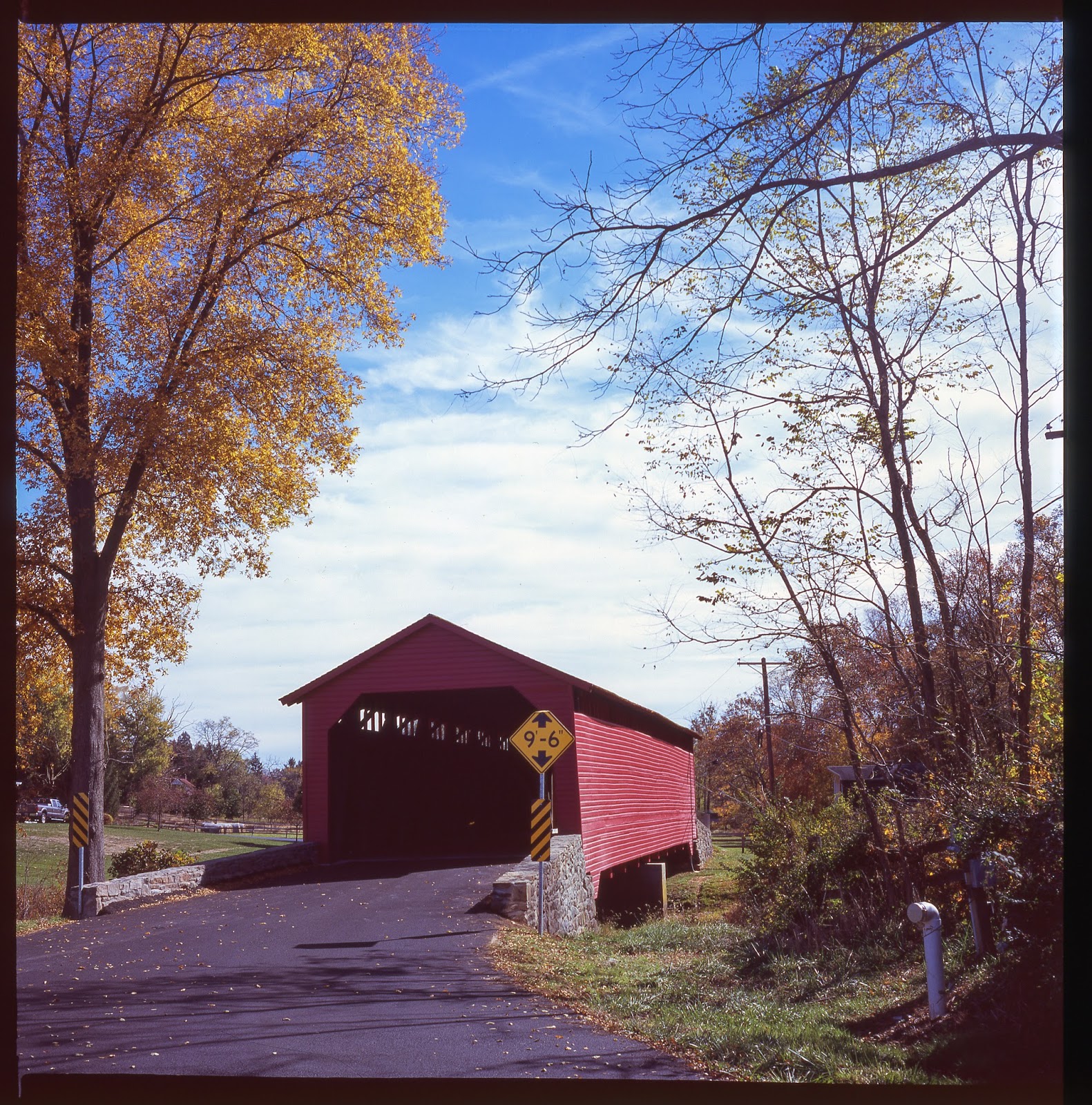
1 - Lewistown, MD - f/11, 1/125 - Continuing the covered bridge ramble in late October, I snapped this shot of the Utica Mills bridge from the opposite side as the other cameras.  The result is one that does brim with image sharpness.


1.15.2016

Film Fun Folio #18 - Balda Pontina and Provia 100F

Periodically, I'll be posting scans of some complete rolls of film on here, showing both the good and the bad, and giving some basic information as well a little write up of the shoot as well as the reasons why I selected each camera and film.  Enjoy the trip! 

Feature #18:
Camera: ca. 1951 Unbadged Franka Solida with Schneider 75mm f/2.9 lens.
Film: Fuji Velvia 100F
Locale: Central Maryland.

There have been times when I thought that this camera and my Zeiss Ikonta 521 were the only 6x9 folders that I would ever need, but some light leaks in recent rolls cast some concerns about my beloved Balda Pontina's ability to be completely trusted to deliver a competent image free of defects.  The summer was spent with the Balda sitting with a roll of Provia loaded, but unused.  Finally, with Fall upon me, and some time to explore, the loaded Balda got the call for 8 more images to see what I could muster from it.  I did a nice range of images, including some landscapes in bright light and some time exposures taken in the wee hours of the morning.  


1 - Thurmont, MD - f/5.6, 1/50 - Nice pictoral representation of colors, but a light leak is again evident in this shot.


1.01.2016

Film Fun Folio #17 - Zeiss Ikonta 521 and Provia 100F

Periodically, I'll be posting scans of some complete rolls of film on here, showing both the good and the bad, and giving some basic information as well a little write up of the shoot as well as the reasons why I selected each camera and film.  Enjoy the trip! 

Feature #17:
Camera: ca. 1946 Unbadged Franka Solida with Schneider 75mm f/2.9 lens.
Film: Fuji Provia 100F
Locale: Frederick County, Maryland.

Very few of my 6x9 folders lack some sort of issue.  Some are just less than stellar performers, while others have an issue or two that make completely care free operation an impossibility.  The Zeiss 521 along with the Agfa Billy Record are in fact the only two 6x9s that I have which function just as they should, and of these, the Zeiss is the far more capable of the two.  Given this, you would think that the 521 would constantly have an active roll of film going through it, but in fact, it had been sitting idle and empty since March for little good reason.  


Finally, with Fall in bloom, I rekindled my affection for this reliable and venerable folder by feeding it a roll of Provia, to see what would result in my rambles through Frederick County, Maryland.  Enjoy!                                                       


1 - Lewistown, MD - f/11, 1/100 - I made the error of not really checking out the shutter a few times before loading film into the Ikonta, and when I shot this image, I heard a bit of drag.  I thought I had overexposed it, but it wasn't so bad.  Since I shot the image again, I didn't bother cleaning up the dust after the scan.


12.18.2015

Film Fun Folio #16 - Super Ikonta 531 and Rollei Retro 80S

Periodically, I'll be posting scans of some complete rolls of film on here, showing both the good and the bad, and giving some basic information as well a little write up of the shoot as well as the reasons why I selected each camera and film.  Enjoy the trip! 

Feature #16:
Camera: ca. 1946 Zeiss Super Ikonta 531 with 105mm/f3.5 Tessar Lens.
Film: Rollei Retro 80S
Locale: Central Maryland.

It's a camera that took a little while to impress me, before finally showing its capabilities when I took it as a late addition to a March trip to Portland.  Despite this, the Super Ikonta had been sitting idly for months, as I lacked the time to shoot film in a way that rotated through my collection.  Finally, after being smitten by Rollei Retro 80S, I deemed that I'd run my next roll of this film through the 531 and hope I could manage to adhere to it's particularities in carefully cocking the shutter so as to avoid accidentally exposing the frame prior to releasing the shutter.   


1 - Baltimore, MD - f/11, 1/100 - A shot taken on a mild September day shows great sharpness, and some very pleasing tones.  The Super Ikonta is gradually looking a bit more super as I feed more rolls through it. 


12.11.2015

Film Fun Folio #15 - Franka Solida and Astia 100F

Periodically, I'll be posting scans of some complete rolls of film on here, showing both the good and the bad, and giving some basic information as well a little write up of the shoot as well as the reasons why I selected each camera and film.  Enjoy the trip! 

Feature #15:
Camera: ca. 1951 Unbadged Franka Solida with Schneider 75mm f/2.9 lens.
Film: Fuji Astia 100F (Expired 2013)
Locale: Central Maryland.

It's the camera that, when I'm shooting it, I can't wait to get the roll over with, and when that is done, I can't wait to see the results.  Just after getting back the results from the last roll of Velvia 100F shot on this camera, I elected to give it another go, this time with one of only two rolls of Astia that I had been holding on to, and had no idea what to do with.  I decided to keep it simple in some respects, and keep the stubborn shutter on 1/200 and to adjust the aperture as needed.  Below are the results from this experiment.


1 Lower Marlboro, MD - f/11, 1/200 - My first shot results in a somewhat washed out exposure that I had to contain in post processing by stopping down the exposure a bit.  Overall, not bad, and certainly sharp at this aperture.


12.04.2015

The Varied Commute

A few months ago, I made a pretty significant change in my life, moving from my environs in Columbia MD out to Frederick, further to the west.  There are any number of reasons for this, but in doing so, I certainly weighed out the pros and cons.  One of the biggest cons was an increase in my commuting time to work in Washington DC.  However, I fancy myself one who likes exploring, and have always tried to "make lemonade from lemons."  In the process of settling in, I would try a number of different commuting options that involved various combinations of driving, bus riding, commuter trains and the DC Metro.  And each of these new views also brought with it a chance for some new photographic fun that I did not have on my previous commute.  Have a look at some shots taken on the Exakta, of my new and often varied commute.


Believe it or not, this image on Fomapan 200 was actually taken from the MTA commuter bus #515, and depicts a retention pond in the middle of the exit from Interstate 270 to Urbana.  


11.27.2015

Film Fun Folio #14 - Autographic 3A and Velvia 100F Double Feature

Periodically, I'll be posting scans of some complete rolls of film on here, showing both the good and the bad, and giving some basic information as well a little write up of the shoot as well as the reasons why I selected each camera and film.  Enjoy the trip! 

Feature #14:
Camera: ca. 1928 Kodak Autographic 3A Camera with f/7.7 Bausch & Lomb Rapid Rectillinear Lens.
Film: Fuji Velvia 100F
Locale: Frederick County, MD.

The thought of what could be done with huge 120 exposures as panoramic scenes taken in a 122 camera was sooo appealing, and I'd gotten a few promising results from some of my first rolls in the Autographic 3A, only to be disappointed in a follow up roll.  I tried to take a few lessons learned from these experiments and feed the massive camera two more rolls of film to see if I could find something encouraging and useful among the exposures.


All photos were taken at 1/100, with real apertures set between f/22 and f/32.  These "settings" however are not accurate for the light levels in the scenes, but are an adjustment due to the tendency of previous attempts to shoot at normal settings on this camera that came out looking overexposed.  I tend to suspect a slow shutter or an odd aperture iris that causes these overexposures, so I tried to properly compensate.  


1 - Feagaville, MD - Off the bat, the exposure compensation has worked wonders for the exposure.  The result is one with vibrant colors and very natural looking contrast and toning.  The only problem is that the scene, focused at infinity, fails to really render fully focused.  Not sure if this is an issue with the film plane or the focus of the camera. 


11.13.2015

Film Fun Folio #13: Franka Solida and Fuji Velvia 100F

Periodically, I'll be posting scans of some complete rolls of film on here, showing both the good and the bad, and giving some basic information as well a little write up of the shoot as well as the reasons why I selected each camera and film.  Enjoy the trip! 

Feature #13:
Camera: ca. 1951 Unbadged Franka Solida with Schneider 75mm f/2.9 lens.
Film: Fuji Velvia 100F
Locale: Central Maryland.

Working with this camera is like being in a bad relationship that you keep going back to.  It's arduous, grating, and often results in disaster, but you work within the perilous confines of its many laborious rules, it can deliver some great results.  I'd almost given up on this camera, as its shutter sticks like crazy, and seemed to be out completely, when after some tinkering, it began to work once again.  Thing is, once you get out there and try to shoot it, it is back to its old tricks.  I finally worked around this by bringing a spare lens cap to cover the lens and coercing the shutter to fire a few times before uncovering it for the actual photo. This usually worked, and the results are below. 


1 - Columbia, MD - f/2.9, 1/200 - At the same time I was undergoing my trials with the troublesome Praktica FX3, I took this shot on the Franka.  The sad thing is that it looks little different from the washed out shots on the 35mm camera.  Now I know I took a hasty exposure reading given this result.