Showing posts with label Ilford FP4. Show all posts

12.20.2017

Dutch Date - Part 5: Ricoh Singlex TLS and Ricoh 35 Flex

Every so often, I'll get really frugal and ask a couple of cameras to share a roll of film.  Though there are problems here and there, they'll usually agree.  I call these "Dutch Dates" and usually try to pair cameras with something more than simply the film format in common.  Below is a look at just one such pairing...


As they settled in to enjoy an English delicacy, the 35 Flex asked the Singlex if the battle wounds were real or self-inflicted. 

Camera Models: Ricoh Singlex TLS (1967) and Ricoh 35 Flex (1963)

Similarities: Both are 1960's Ricoh SLR cameras under their own brand name.

Differences: The Singlex is a conventional focal plane shutter SLR with interchangeable lenses, while the 35 Flex is a leaf shutter SLR with a fixed lens. 

Film Shared: Ilford FP4+, Fresh Dated 

The 1960's might be considered to be the prime period for Ricoh's camera models.  Though the Japanese camera maker certainly had a pretty lengthy run of producing some very capable, and often quite unique film cameras, the Sixties seem to be when Ricoh made a name for itself in a pretty crowded industry.  Though the maker continued creating some excellent cameras in the decades to follow, it seemed to be increasingly marginalized, at least in the US, as Canon, Nikon, Pentax, Minolta, and Olympus took the top spots in the remaining field.


6.22.2017

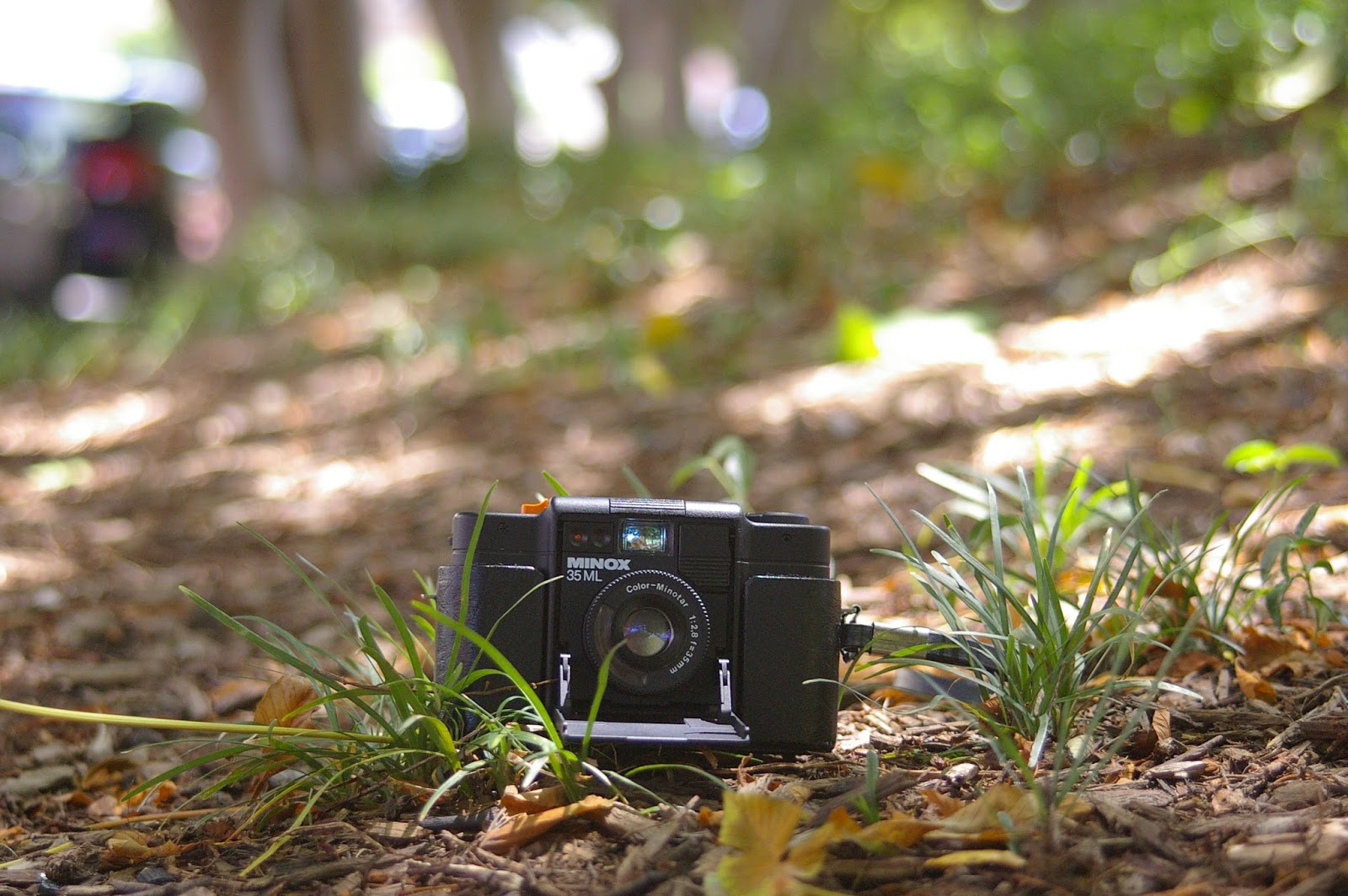
Agent Double-0-Thirty Five: The Minox 35ML

Just yesterday, I posted an article covering one camera that I'd hoped might be a 35mm version of my beloved Bantam, and here, a mere 24 hours later, I'm posting an article on another similar camera, at least when it comes to size, form factor, and country of origin.

Typically I deliberately try to keep my articles staggered.  An SLR camera review isn't followed with another SLR camera review, Rangefinders don't follow other rangefinders, and so forth.  However, in this case, two cameras of a different build type, but both offering some features to make them something of a 35mm Kodak Bantam, have managed to pace behind each other.  

In the case of this review, this similarity comes in the form of the Minox 35ML, a tiny and amazing piece of machinery in 35mm format that, for lack of a better descriptor, is best termed as a modern day compact folding camera. 

While not entirely spy-worthy, the Minox 35ML is an amazingly small device.

The Minox 35ML comes from a photographic icon famous in the photographic community for its smaller "Spy Cameras" utilizing tiny devices to record 8x11mm images on small size film.  The Minox name brings to mind the thrilling world of James Bond movies from the 1960's and 1970's, as a means to discretely take images of documents. These cameras still have a following to this day keeping the medium alive and well.

Less known however are Minox's 35mm offerings, which stay very true to the maker's tendency to create amazingly compact devices with a surprising amount of functionality.  I had never noted the presence of Minox in the sphere of 35mm film photography when I suddenly stumbled upon one for sale at a local Goodwill for a modest $25.  I picked it up and could immediately see what a unique gem of a camera this was.

5.29.2017

Minolta's Metropolitan: The A5 Rangefinder

"Wow, but you're handsome."  That was my very first thought. 

As someone who owns rangefinder cameras made from the 1940's through the 1970's, I tend to be a bit dismayed to see how the outward appearance of this genre of cameras gradually grew to be a bit less attractive as the years went onward. The svelte design of a flagship camera like the 1948 Konica I had become less endearing by the time the Auto S2 was released less than two decades later. Both are excellent cameras in their own way, but the earlier camera possesses a sleek design that had been jettisoned as the camera took on a faster lens and improved functionality in the form of exposure metering. 

Looking at some of my other rangefinders of the 1960's, I'm not particularly smitten by the overall look of the Ricoh 520M CDS, Taron Marquis, or Yashica M-II.  But then I happen to acquire a little gem of a camera from the 1960's that really impresses me with its outward appearance...

Simple and elegant, the Minolta A5 puts forth an attractive and clean look. 

I call it my "Metropolitan" as the gorgeously raised "M" logo, looking more like an upside down "W," strongly reminds me of the solitary "M" logo associated with New York's Transit system during the later part of the same decade.  It's clean, simple, and even a bit elegant. It seems right at home in the decade in which it originated.  It's specifications are more or less identical to most decent Japanese rangefinders of the era, sporting an f/2.8 lens and a capable shutter that shot as fast as 1/500 of a second.  Another spare item generously granted to me for trial by Mike Eckman, the A5 impresses me with its clean look.  

5.23.2017

Franka's Tower of Portable Power: The Tower 60

It was a purchase decision that took the better part of 2 minutes.  Spotted in a nearby antique mall was what seemed to be THE perfect camera to add to my collection.  A medium format folder with a fast and rather reputable f/2.9 lens AND a rangefinder.  Priced at $40 with a 20% discount, I gleefully raced up to the front desk to ask to see this camera to check its operability.

Shutter: check.  Rangefinder: check.  Folding and unfolding: check.  There was nothing whatsoever that I could detect as being of serious issue with this camera.  It was oddly parallel to several others in my collection, but having the working rangefinder was the perfect incentive to add the Tower 60 to my camera collection.

Franka made models seem to come past me with surprising regularity.  This one was was a very pleasant surprise. 

Though sold by Sears Roebuck, the Tower 60 was a product of Franka, the very same maker who made the Solida camera that is a beloved favorite of mine.  In fact, the Tower 60 is more or less a Solida Variant with different markings.  It is for all intents and purposes identical to the Franka Solida IIIE.  Equipped with the same Schnieder Radionar 80mm f/2.9 lens as my previous Solida cameras that I loved using wide open wherever possible, I wholeheartedly welcomed the ability to add a version with a rangefinder to ensure accurate distance measurement.  I was $32 poorer, but vastly enriched culturally.  

5.19.2017

From Russia with Lovely Bokeh: The Zorki 4

The camera sat on my shelf looking sort of lost among a handful of Japanese, American, and German counterparts, bedecked with its incongruous Cyrillic lettering on its face plate, and looking every bit the fish out of water.  It certainly didn't beckon to me, resulting in a feeling that was anything but love at first sight. 

I picked it up and briefly peered through the combination viewfinder and rangefinder, and my eyes literally began to hurt to try to focus on a nearby object, as the entire field of view looked both bright and fuzzy to me.  I placed it back on the shelf, a tad overwhelmed by the operational nuances of this interesting but somewhat puzzling machine, but also confused as to why its benefactor thought I would appreciate it.

So, fellas?  Heard any good state secrets lately?

The camera in question was the Russian made Zorki 4, a generous loaner from Mike Eckman, who also runs a great site featuring vintage cameras.  Though I certainly appreciated the kindness of the gesture, I had yet to grasp just what was so enthralling about this Cold War relic that emerged in 1957 from behind the Iron Curtain.

1.06.2017

One Goodwin Turn Deserves Another - The Ansco No. 2A Goodwin

Certain groundbreaking names are often etched in the memory of the photographic community.  Even those who have never shot film have typically heard of George Eastman and Auguste Lumiere.  It is tough not to think of Ansel Adams or Henri Cartier Bresson when thinking of early photographers. As well, hobby collectors of film cameras are often well aware of the legacies created by Ernst Leitz and Carl Zeiss.

But what about the Reverend Hannibal Goodwin?  In a way, most of the people mentioned already owe a bit to the Reverend Goodwin for his contribution to photography.

Goodwin filed the first patents to produce film in a flexible roll form.  In this way, he could be considered the "Grandfather" of motion pictures, and of the 35mm film format, though he never lived to see his innovation reach its widespread potential.

Prior to the recently retired Reverend's patent filing in 1887, most photography was done on rigid materials such as glass plates.  Goodwin's intent was to create a sturdy film material from a nitrocellulose film base for the purpose of biblical teachings.  His patent was not granted until over 11 years later, by which point George Eastman was already producing roll film using a process of his own.  Goodwin would begin setting up an operation in 1898, only to die in an accident at the end of 1900. 

Later, this patent would be sold, along with the Goodwin's film production business to Scovill & Anthony (later shortened to "Ansco") who used their leverage as patent holders to sue Eastman for patent infringement, resulting in an award of $5 million dollars to Ansco in 1914, and saving it from bankruptcy.

The Ansco film and camera production business would continue to exist in various forms over the next several decades, merging first with Agfa in 1928, and eventually simply was folded into parent company GAF in the late 1960's.  In its earlier years, the company did pay a modest tribute to Reverend Goodwin by naming some models in its box camera lineup with his name, such as the Ansco No. 2A Goodwin.

The austere and basic Ansco No. 2A Goodwin

12.15.2016

Sheep in Wolf's Clothing: The Nikon N5005

Looks can be deceiving.

This has proven itself to me on several occasions in film photography.  Some of the most basic cameras have delivered me some of my favorite images.  Kodak Retinette cameras have yielded some great photos for me, while I have a full size poster of a photo that I took using the basic Agfa Billy Record.  

This phenomenon works in reverse as well.  While browsing some bulk camera lot listings on our favorite online auction site, I happened upon a listing that contained photos of a camera that gave me the initial impression that it was built to be a professional workhorse, helped no doubt by the presence of bulbous analogue dials atop it indicative of a machine of professional standards...


Of course it didn't hurt that this camera carried a name broadly displayed vertically upon its grip that is considered to be the premier 35mm SLR brand for professional users...


My initial thought on this quick first impression that this was certainly a camera that would fetch a hefty price tag.  I dug in and looked a bit deeper at the model of interest to discover, much to my surprise, that it was readily available for under $20.  I did a modest bit of research and rather quickly discovered why this camera was so readily attainable, but yet, I was still intrigued enough to add this rather offbeat addition to my collection.  And with this, I became the owner of a circa 1991 Nikon N5005.


4.15.2016

Bantam Bridgade: The Prince (Bantam RF) and the Pauper (Bantam f/8)

Every once in a while, good deeds are met with unexpected and unsolicited rewards.

I'd been collaborating with fellow collector/shooter/web documenter Mike Eckman to whom I'd sent some surplus and cut down 828 film, and who knew me as quite the 828 format enthusiast. I'd raved in great length about how much I had come to love my Bantam and similar Bantam Flash camera, mostly with the interest of encouraging him to make use of an 828 camera he had picked up a while back, and secondarily, encouraging him when he considered adding a very affordable addition to his 828 collection.

Still, imagine my surprise when he told me "Keep an eye out, as I have a package I'm mailing to you."  I didn't know what to expect, and thought maybe he'd stumbled upon a stock pile of 828 spools to enable more cut downs.  Well, indeed he had stumbled upon some spools that he was sending to me.  And to keep those spools safe, he enclosed them within A PAIR of Bantam cameras he had recently acquired, both for about a dollar.  He simply asked me to hang onto the spools in case he wanted more created 828 film sent to him, but that the cameras were mine.  And with that, I now had a Bantam Brigade at my disposal.